Sprinkler Irrigation Challenges in Spinach Cultivation: Specialized and Practical Solutions
Become an expert in drip irrigation
Cumin (or Shaveed) is a highly demanded product in export and domestic markets that is very sensitive to root stresses. In recent years, to reduce labor costs and increase the speed of operations, many crops have switched to drip irrigation instead of flood or sprinkler irrigation. However, drip irrigation for cumin is not a simple process but a set of complex variables including water depth penetration, light distribution, soil resistance, and environmental temperature. This article will thoroughly examine the technical challenges of this method and provide corrective solutions so that farmers can benefit from its advantages without experiencing quality reduction or crop shortage. Correct management of this process requires attention to minute details, as the slightest deviation in water pressure or flow can have chain effects on plant health.
Why is cumin sensitive to irrigation challenges?
The roots of cumin are often shallow and very sensitive to sudden changes in moisture. In drip irrigation, if not properly planned, it can lead to ‘water estimation’ at the surface and drying at depth, which is deadly for this crop. Therefore, a deep understanding of the physical behavior of soil and its relationship with the delicate plant roots is a prerequisite for success with this method.
Main challenges of drip irrigation in cumin cultivation
When implementing a drip system, there are three major challenges that must be managed. If these challenges are ignored, they will directly affect the final performance and grain quality.
- Wetting Fringe Control: In tightly coiled soil, water may move in streaks, leaving a significant portion of the roots dry.
- Uniformity of soil coverage: Variation in vertical water movement across different partnership sectors, which depends on drainage and terrain slope.
- Physiological stress: Rapid moisture changes can cause thin roots to rupture, resulting in reduced nutrient uptake.
Effect of pipe material on water quality
Using polyethylene pipes with inadequate thickness or short service life can generate fine particles that clog impact nozzles. Additionally, leaks from joints can cause localized humidity and decay. To ensure system health, familiarity with types of drip tape and impact nozzles is essential. By studying drip tape types, you can select the best option for your climatic conditions and ensure long-term system durability.
Technical analysis of execution challenges
To overcome the challenges mentioned, a proper understanding of water dynamics in furrows is essential. In furrows with slopes, runoff water tends to move toward the lower end of the crop row. If the flow rate of the emitters is not regulated, the drip line in the lower part of the furrow will dry out. This situation requires precise adjustment of the system pressure. Additionally, the presence of dissolved nutrients in the water must be considered; since sedimentation resulting from water hardness can lead to emitter clogging. An effective solution is the use of appropriate filtration and proper pumping, which is detailed in the article Modern Irrigation Methods for Agricultural Land in detail. Although these technical aspects may appear complex, they are entirely manageable if basic principles are observed.
Table comparing challenges and solutions
Practical tips for optimizing surge irrigation
Correct system implementation improves water-use efficiency. To achieve this, the following items are mandatory and can make a significant difference in crop performance:
- Leveling the field: Even small ridges in the surge furrow path can disrupt water flow. Before installation, the furrow surface must be level.
- Selecting the appropriate nozzle diameter: For narrower furrows (for example, 40 centimeters), nozzles with closer spacing and smaller diameters are more suitable. Using low-pressure micro-spray nozzles can help prevent soil erosion.
- Irrigation scheduling: Irrigating during the hottest hours of the day leads to rapid evaporation. The best time is midnight or early morning, to allow the water time to infiltrate.
- Line end-of-season review: Flush the lines at low pressure to remove internal deposits. This extends the service life of the drip tape.
One key point is selecting the type of drip tape. Textured lines are more resistant to farm pests such as mice but are more expensive. To ensure system durability, you can review The importance of site inspection for polyethylene pipes and drip tape Selection criteria. These inspections help minimize the risk of breakage and leakage.
Managing planting density and line spacing
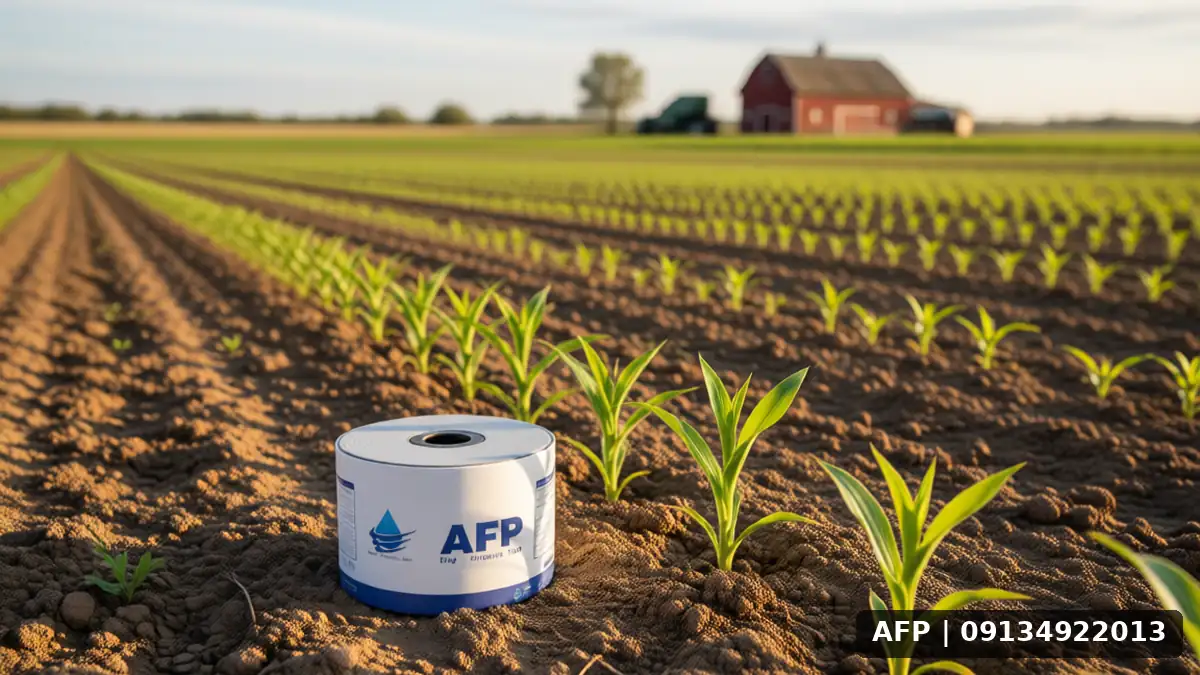
Letuce is usually planted at intervals of 20 to 30 centimeters. High planting density increases competition for water and nutrients. In this case, it is better to place the center pivot system bidirectionally between two rows of lettuce to ensure more uniform moisture coverage. In lower-density crops, one drip line per block is sufficient. Selecting appropriate density directly affects seed usage. To better understand these calculations, you can reference the modeling approach in the article Seeding rate per hectare Harvest it and adapt it to specific conditions. This systematic approach ensures optimal resource utilization.
Frequently Asked Questions (FAQ)
Is surge irrigation suitable for sloping furrows?
Yes, but it requires precise pressure adjustment. On steep slopes, there is a risk of the downstream furrow drying out. Using thicker pipes and dividing the sets into shorter sections can resolve the issue.
What is the standard spacing for surge nozzles?
Typically between 10 to 15 cm, depending on soil type. For sandy furrows, a shorter spacing (10 cm) is recommended, while for clay furrows, a wider spacing (15 cm) is advised.
What are the signs of root water deficiency?
Wilted upper leaves, yellowing leaf veins, and curled leaf tips are early signs of root stress in chives. In this case, you must increase the water volume and prevent changing nozzles to lower-pressure types.
Summary and final recommendations
Moving irrigation in chive cultivation, if implemented considering technical challenges such as uniform wetting coverage, ground slope, and pipe material, can significantly increase crop yield. The key to success lies in adjusting pressure, selecting the appropriate drip line type, and closely monitoring roots throughout growth. Combining this technical knowledge with regular system inspection is a long-term investment for increasing the quality and flavor of chives. We recommend performing a leak test on a sample of the system before the season begins to ensure the integrity of the connections. Also, to familiarize yourself with the general principles of moving irrigation system design, study Production of phototip in knotted cone with polycap can provide you with a perspective beyond a specific product.