Rainfed Irrigation via Runoff in Onion Cultivation: Applications and Practical Guidelines
Introduction to sprinkler irrigation for onion cultivation
Onion is one of the most important cool-season vegetables and early crops in Iran, requiring adequate, uniform, and timely water for optimal growth. Until a few decades ago, surface and flood irrigation methods were the most common options for farms; however, with water resource constraints and the growth of modern irrigation infrastructure, adopting low-consumption and more precise methods has become essential. In this context, sprinkler irrigation also known as traveling sprinkler irrigation, has gained attention as a simple, economical, and reliable method for a significant portion of farms. This method delivers water as fine droplets over the soil surface where onions are planted, thereby creating more uniform water overlap in the root zone.
While drip and tape-line irrigation still offer higher precision, sprinkler irrigation is considered a suitable option in situations where drip irrigation infrastructure for onions has not yet become fully widespread. This article examines the applications, operating principles, advantages and limitations, as well as practical tips for optimal use of irrigation systems in onion cultivation.
Principles of sprinkler irrigation for onions
In sprinkler irrigation, water is delivered through small pipelines to sprinklers, which distribute it over the field as artificial rain. The sprinkling process ensures that water exits the sprinklers with controlled pressure and velocity, applying it to the soil surface where onions are grown. This allows the water to infiltrate gradually and adequately moisten the onion root zone.
Main components of an onion sprinkler irrigation system
- Sprinklers: These are typically manufactured as rotating or fixed models and can adjust the water application radius at various speeds.
- Water transmission lines: Pipes that convey water from the pumping station to the headworks; selecting an appropriate diameter is critical to minimize pressure loss.
- Pumping station: Maintains stable pressure and flow rate to ensure uniform water delivery.
- Regulators and control valves: For pressure and flow regulation at different points in the field.
Onions have shallow root systems and require uniform soil moistening, especially during early growth stages. Therefore, even water distribution from sprinklers plays a critical role in yield stability.
Applications and benefits of sprinkler irrigation for onions
Practical applications
- Transition from flood to sprinkler irrigation: In water-scarce areas, large onion farms can reduce water consumption by 30 to 40 percent by switching to sprinkler irrigation.
- Application in Plain and Mountain Fields: For onion cultivation in high altitudes or sloped areas, furrow irrigation is considered a better option than flood irrigation due to reduced soil movement and surface erosion.
- Water Stress Management: By dividing irrigation into shorter intervals, water stress can be prevented in the first half of the growing season.
Advantages
- Reduced Water Consumption: Due to decreased evaporation and controlled infiltration, the water required is less than in flood irrigation.
- Uniform Moistening: Uniform water distribution from sprinklers helps reduce patches of moisture and dryness across the field.
- Ease of implementation: Compared to drip irrigation, the sprinkler system has a lower cost and faster installation.
- Reduced soil salinity: In areas sensitive to salinity, sprinkler irrigation can help leach salts to deeper layers, keeping the field surface clean.
Alongside these advantages, using sprinkler systems in rotation with other irrigation methods can be beneficial. For more details on selecting the appropriate method, you can look at fava bean yield per hectare, which is an example of using precision irrigation methods for crops with shallow root systems.
Comparison with drip and subsurface drip irrigation
Drip and subsurface drip irrigation methods rank higher in terms of precision, moisture control, and reduction of fungal diseases. Subsurface drip delivers water directly to the roots through narrow trenches. Although the initial cost is higher, it offers better long-term returns. To examine the details of subsurface drip and its selection for crops like cantaloupe, we recommend reading ‘Subsurface Drip for Cantaloupe: A Comprehensive Guide to Irrigation, Selection, and Purchase’.
Key Considerations for Method Selection
- For large, flat onion fields, furrow irrigation may be suitable.
- If electricity and high-capacity pumps are available, drip irrigation offers superior precision control.
- Drip systems have higher initial costs; however, furrow irrigation is more practical for complex cropping systems.
Practical Tips for Optimizing Furrow Irrigation for Onions
- Assessing Field Slope: Slopes exceeding 2% reduce the uniformity of water distribution from sprinklers; in such conditions, reduce the spacing between sprinklers.
- Adjusting Pump Pressure: Pressure above 1.5 bar can cause uneven distribution and even soil erosion. The use of a pressure regulator is recommended.
- Irrigation scheduling: The best time for irrigation of onion with a lateral system is before peak consumption (mid-growth season) and during cooler night hours to reduce evaporation.
- Soil salinity monitoring: Irrigation with a lateral system in saline areas can help reduce surface salinity but requires flushing water. In this regard, attention to the yield of broccoli per hectare, as a related crop, would be useful.
- Balance with tape drip line: Combined use of lateral and tape drip lines to strengthen sensitive parts of the onion can increase efficiency; more details can be found in corn strip tape spacing forage corn you can view.
Frequently Asked Questions (FAQ)
Is sprinkler irrigation used in arid regions?
Yes, but it requires shorter lateral spacing and controlled flow rates. In very arid regions, combining sprinkler irrigation with drip irrigation is recommended.
Are sprinkler repair costs low?
Compared to drip irrigation, repair costs are lower, but regular cleaning of laterals is required to prevent clogging and sediment buildup.
Does sprinkler irrigation damage onion roots?
No, provided pressure and velocity are set correctly; however, pressure exceeding the safe limit can damage fine onion roots.
Is it possible to automate lateral irrigation?
Yes, the use of electric valves and smart controllers can make irrigation scheduling more precise.
Is a combination of lateral and drip irrigation efficient for onions?
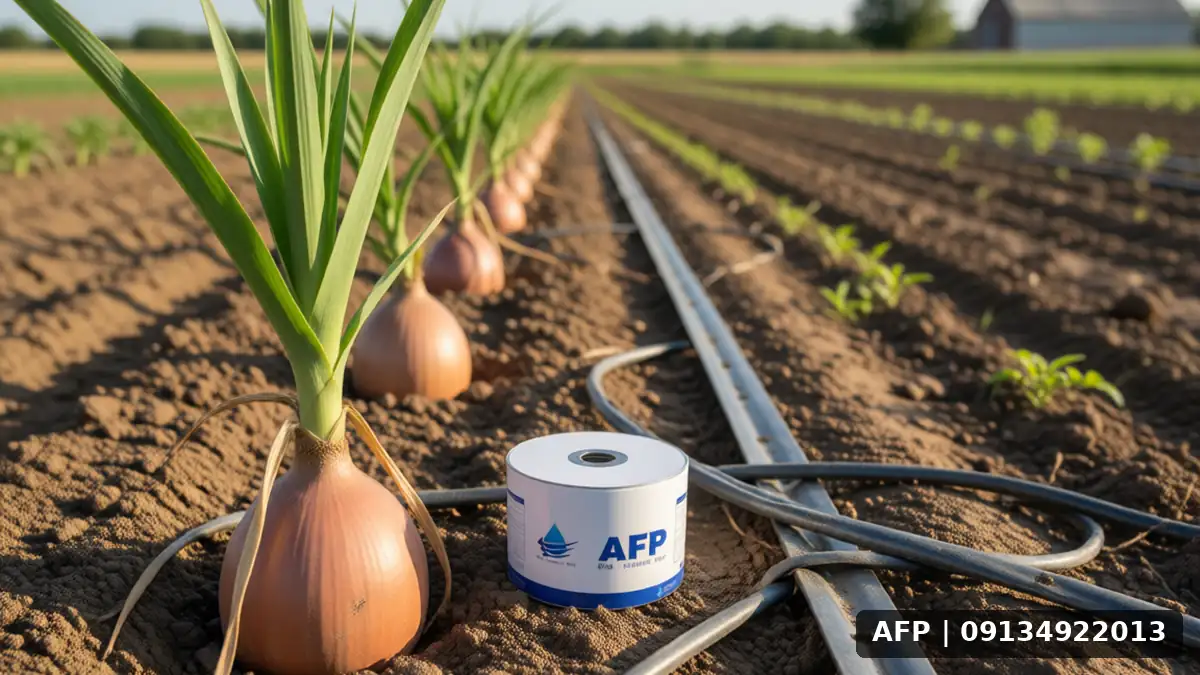
Yes, in large farms, a combined approach is optimized; lateral irrigation is sufficient from germination to early season, while drip irrigation provides greater precision during peak demand.
Summary
Lateral irrigation for onions is a practical and economic solution that can play a significant role in water management and yield improvement alongside modern methods such as drip and tape. Choosing the appropriate method depends on factors like field slope, initial budget, and equipment availability. By following practical guidelines and properly utilizing irrigation systems, water consumption can be reduced and onion quality improved. A better understanding of the various applications of lateral irrigation for onions is an important step towards sustainable water resource management in fall cropping.
Related articles: Lentil D8AFD8B1 yield per hectare, water lentil yield per hectare guide