Rainfall Irrigation with Runoff in Garlic Cropping: Advantages
Introduction: The Necessity of Smart Water Management in Garlic Cultivation
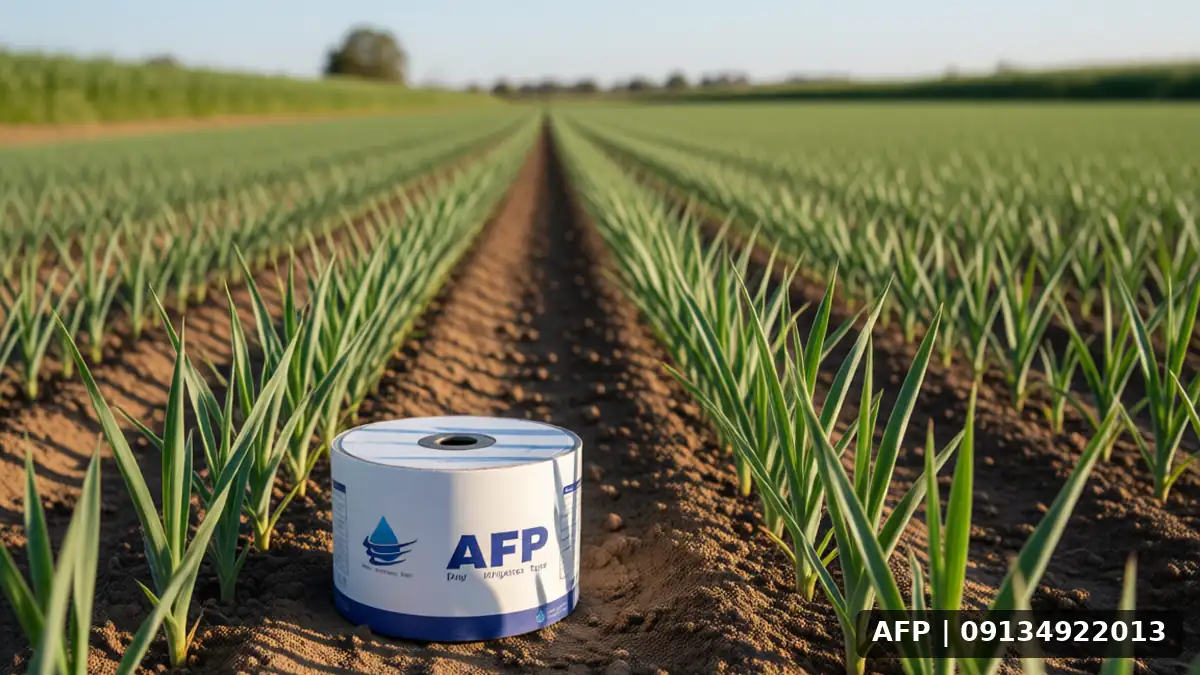
Garlic cultivation is one of the most sensitive crops in the field of water resource management due to its specialized requirements for soil conditions and adequate moisture. In semi-arid regions with specific climatic conditions, conventional irrigation methods may lead to water waste, soil salinization, and a reduction in the quality of produce such as garlic. In this context, sprinkler irrigation with momentum as a combined and dynamic method, has attracted the attention of many farmers and irrigation engineers. This method, which involves the spraying of water droplets at a controlled speed and direction, can have positive effects on soil structure and garlic root development. In this article, relying on the principles of drip irrigation and tip-line irrigation, the benefits and implementation points of this method are examined.
Understanding the Mechanism of Momentum in Water Spraying
Momentum here refers to spraying water as artificial rain using a Fumix (spray nozzle), which creates surface moisture and gently penetrates into the middle soil layers, thereby preventing rapid surface drying. For a better understanding of the place of this method in modern irrigation systems, you can study the article Sprinkler Irrigation of Garlic and Its Effects. This study shows that the correct adjustment of pressure and droplet diameter is the key to success in maintaining the moisture balance of garlic soil.
Specific Benefits of Sprinkler Irrigation with Momentum in Garlic Cultivation
The use of sprinkler irrigation with momentum in garlic farms is not merely a water delivery method but a management strategy for improving the root ecosystem. The following section discusses the most important benefits of this method:
- Maintaining uniform moisture at depthUnlike simple rain sprinkler irrigation, which can cause nutrient leaching, controlled advection ensures uniform water infiltration into the garlic root zone (the dominant root depth of garlic is approximately 30 to 50 cm). This is highly effective in reducing water stress during the mid-season growth period.
- Reducing relative surface salinityBy adjusting the spray angle and pressure, salt accumulation at the soil surface can be prevented. Garlic is sensitive to soil salinity, and strip line or drip irrigation often requires the discharge of excess water for leaching; however, low-volume and frequent advection reduces the need for heavy leaching.
- Improving soil aerationGentle water movement through soil layers, instead of flooding, creates micro-pores and improves aeration in the garlic root zone. This advantage is particularly useful in heavy or silty soils that often become compacted after pure drip irrigation.
Relation to strip line irrigation principles
Strip line irrigation is generally considered an ideal method due to the reduced water-soil contact surface. However, when cooling is needed during the peak growth of garlic, or in fields with a gentle slope, combining strip line irrigation with the advection process of surface fragments can yield better results. To better understand the seed rates and planting density, which affect the required water volume, refer to the guide Volume of garlic seed per hectare under manual planting. Proper management of seed density in conjunction with the volume of advective water prevents seeds from being washed away or seedlings from being suffocated in the surface layer.
Practical and technical implementation guidelines
Implementing rainsprinkler irrigation in garlic cultivation requires precision in equipment selection and technical settings. These points help you leverage the benefits of this method while minimizing potential risks:
- Selecting appropriate droplet size: Droplet size must be appropriate to prevent soil splash and sedimentation. In fine-textured garlic soils, finer droplets and lower pressure are recommended. Using sprinklers equipped with adjustable nozzles facilitates this control.
- Irrigation duration and frequency: Unlike flooding, rainsprinkling should be conducted in short, repeated intervals. Monitoring soil moisture at 20 and 40 cm depths using electric moisture sensors is essential to prevent deep drying.
- Consider prevailing wind direction: Drift refers to the movement of water in a specific direction. If local winds are strong, adjust the drift direction to be opposite the wind to prevent reduction in droplet impact intensity and moisture transfer from the target area. Also, attention to the thickness and quality of infrastructure systems such as transfer lines is important. To understand the standards, study Ideal Teflon Irrigation Tape Wall Thickness, as these principles overlap with spray feeder lines in terms of pressure.
Integrated Management with Other Methods
Often, farmers use combined systems. In this mode, main crop sections are managed with drip or tape irrigation, while misters are used during specific times (such as peak heat or when cooling is required). To choose the optimal spacing of components, the article Spacing of Tape Irrigation for Wheat and New Irrigation Principles can serve as a model for calculating spacing in similar crops. Although garlic is a different product from wheat, the logic for calculating density and water usage per square meter applies to both.
Frequently Asked Questions (FAQ)
In this section, we answer common questions from farmers about sprinkler irrigation with drift for garlic cultivation:
Is sprinkler irrigation with drift suitable for all regions of Iran?
No, this method is most suitable for regions with medium to high temperatures and low winds. In areas with very strong winds, controlled water drift is difficult, and drip irrigation covered with netting or simple netting (such as 3-inch cotton hose) is a better option.
Does this method harm garlic regarding fungal diseases?
Garlic is susceptible to fungal diseases caused by high leaf humidity, such as powdery mildew and leaf scorch. Therefore, drift should be used only in the early morning hours so that the leaves dry before the sun reaches its peak heat. This is important to ensure that relative humidity at the plant surface drops below 80%.
What is the main difference between this method and simple sprinkler irrigation?
Simple sprinkler irrigation is usually performed with hoses or hand-made sprayers that lack uniformity. Drift, using a spray system, is a mechanized and measurable process that precisely controls the water dose and is reproducible.
Summary and Final Recommendations
Spray irrigation with runoff in garlic cultivation is a dynamic tool for innovative farmers that combines the benefits of drip and furrow irrigation with better management of relative humidity. The key to success with this method is precise adjustment of pressure, spray angle, and timing to prevent damage to garlic roots and leaves while maintaining soil moisture at an appropriate depth.
To expand your knowledge in crop yield optimization for crops requiring precise water delivery, studying the guide Onion Growth with Drip Irrigation may be beneficial, as garlic and onion share similar physiological and root development patterns. Finally, it is recommended to test the runoff method on a small section of the farm before widespread implementation to assess garlic’s response to local climate and soil conditions.
Related Articles: masofai lundayi tibi gandum va usulhoi navii obyori, mikdori tukhmi zira siyoh dar gektar dasturi kisht, Onion Planting Method Drip D8A7DB8C, Rye Yield per Hectare: Influencing Factors and Strategies for Improvement