Comprehensive Guide to Measuring and Installing 110 mm Threaded Pipes for Drip and Tape Irrigation Systems
Introduction: The Importance of Precision in Calculating 110 mm Main Pipes
In modern irrigation systems, selecting drip emitters and tapes is only half the equation; the other half is the engineering of the main distribution network. Polyethylene pipes with a 110 mm diameter form the backbone of many medium-to-large-scale farms that require high flow rates of approximately 20 to 40 liters per second. Using this pipe size without precise hydraulic calculations can lead to uneven pressure drop, flow stagnation at the end of the line, or even pipe rupture due to excess pressure.
The aim of this article is to present a practical and engineering approach to sizing 110 mm threaded pipes so that farmers can ensure the efficiency of their systems and reduce energy and maintenance costs. In this article, we start with general network configuration principles and proceed to simplified formulas for calculating the required length and quantity.
Basic Principles in Selecting and Calculating Polyethylene (PE) Pipes for Irrigation
Threaded pipes offer faster connection speeds compared to coupling-based pipes and are highly suitable for main lines. However, the main challenge with 110 mm pipes is managing local pressure loss. Each pipe segment is typically 10 or 20 meters long. When these segments are connected across the farm, the friction between the water and the pipe walls causes a pressure drop.
The Impact of Inlet Pressure on Permissible Pipe Length
Before measuring the required length, you must know the output pressure from the pump or the main network circuit. If the input pressure to the system is 4 bar, you have more allowance to run the pipe to distant points of the farm. However, if the pressure is 2.5 bar, you must be much more conservative in your calculations. A thumb rule for a 110 mm pipe with a flow rate of 30 liters per second is that the pressure drop per 100 meters of pipe is approximately 0.5 to 0.8 bar. Therefore, if you have an initial pressure of 3 bar, the maximum pipe length without needing a booster pump can be around 300 to 400 meters.
Step-by-step method for calculating length and number of pipes
To determine exactly how much pipe you need, follow these steps:
- Routing identification: On the farm map, mark the route for the main line. Usually, the main pipe is laid parallel to the drip lines. Consider the length of the longest line as L_max.
- Determining total flow rate: Calculate the total flow rate of all drippers or tape lines supplied by a single main pipe. If you are using tape lines with a 50 cm spacing and a flow rate of 1.2 liters per hour, and the line length is 100 meters, the total flow rate for each line is 120 liters per hour or 0.033 liters per second. If you have 100 lines, the total flow rate is 3.3 liters per second, which is very low for a 110 mm pipe. Generally, a 110 mm pipe is used when the total flow rate is above 15-20 liters per second. In this assumption, we consider a flow rate of 25 liters per second.
- Calculating the number of pipe segments: If your pipeline length is 500 meters and pipes are sold in 20-meter packages, you need 25 pipe segments. However, always add 10% for waste and breakage. This means purchasing 27 segments.
The role of fittings and couplings in pressure loss
Many farmers believe that only pipe length matters. This is a major mistake. Each threaded fitting that is tightened increases flow resistance. In a 110 mm pipe, for a 500-meter length, you have approximately 25 to 50 couplings. Each coupling is equivalent to 5 to 10 meters of same-diameter pipe in terms of pressure loss. Therefore, your hydraulic equivalent length is 25% to 50% higher than the actual physical length. In final calculations, always include this factor to ensure that pressure at the end of the farm line does not drop below the allowable limit for drip emitters (usually 0.85 of inlet pressure).
Application of 110 millimeter pipe in drip and tape systems
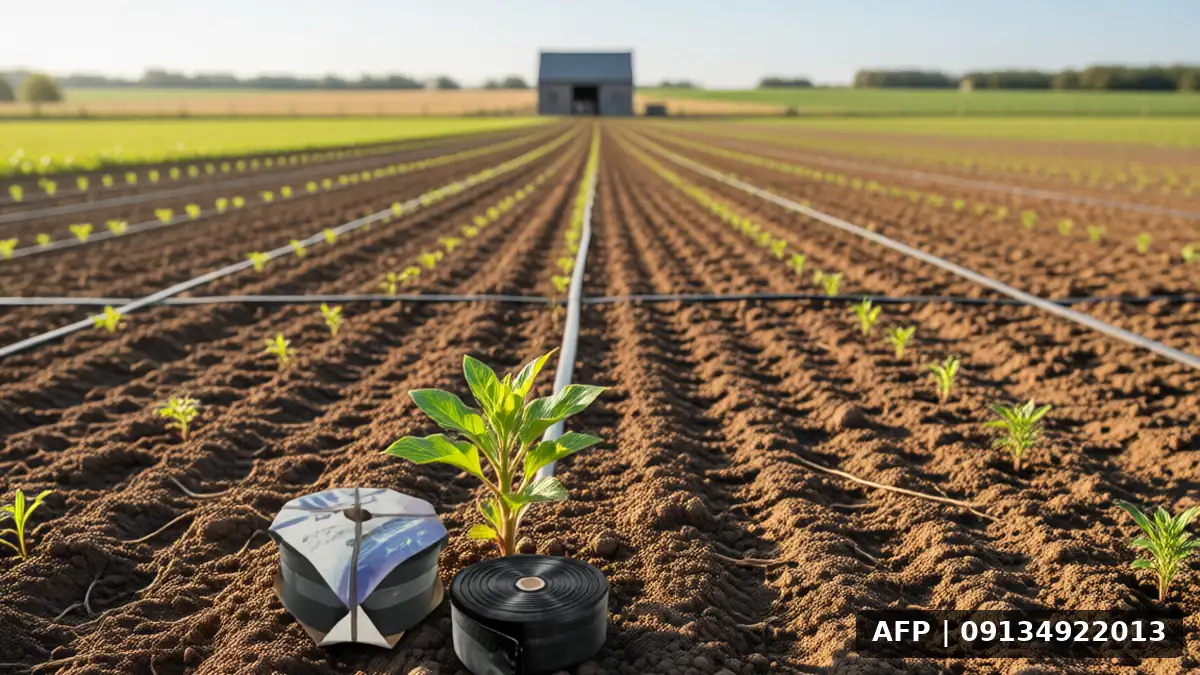
Tape systems generally generate higher flow rates compared to point drip emitters. If you use tape systems for cereal or vegetable crops with a 50-centimeter planting row spacing, the total system flow increases. In this scenario, the 110 millimeter pipe acts as the main artery supplying water.
One key advantage of using threaded pipes in this size is the ability to quickly reopen lines in case of damage. Unlike welded pipes that require a fusion machine, threaded pipes can be replaced with a simple wrench. This feature is beneficial for almond orchards where pipes may be displaced from their path due to machinery operation.
Cost optimization based on crops
Pipe size selection must be aligned with crop value. For low-yield, high-variability crops, using 90 or 110 pipes with lower precision may be acceptable. However, for crops such as vegetables that have high sensitivity to uniform water distribution, precision in calculating 110 pipes is critical. If you are looking to increase cropping efficiency, study Disadvantages and advantages of drip irrigation can provide a better understanding of water flow dynamics in these systems. Additionally, for grain crops, familiarity with pumpkin seed yield per hectare will help you accurately estimate the required water volume and, consequently, the inlet flow rate of the main pipe.
Practical installation and maintenance tips for 110 millimeter pipes
- For installing couplings: Ensure that the grip and washer are in place and the coupling is fully tightened. A loose coupling can cause a loss of system pressure, resulting in distant emitters delivering less water.
- Maintain a gentle slope: Avoid steep slopes in lateral lines. Excessive slope can cause air pockets that impede flow. A gentle slope of 1 to 3 percent is recommended.
- UV Protection: PE 110 pipes are typically black and UV-resistant, but prolonged exposure of pipes directly on sharp stones and in direct sunlight reduces their useful life. Do not use the pipe as a frame for planting plastics.
If you grow specific crops in your farms, such as leafy vegetables, precision in water distribution is of utmost importance. Familiarity with a comprehensive zucchini planting guide can highlight that the roots of these plants are deep and require water to penetrate the soil over time, which depends directly on a constant pressure in the 110 main pipe.
Frequently Asked Questions (FAQ) About Measuring 110 Threaded Pipes
Can 110 pipes be used for sub-lines?
Generally, no. A 110mm pipe has a large internal volume. For lateral lines with lower flow rates, this causes localized pressure drops and low water velocities, leading to issues such as sedimentation. This size is recommended strictly for the Main Line.
What is the difference between a threaded 110 pipe and a coupler 110 pipe?
Threaded pipes have internal threads (Thread), and connection fittings are secured by tightening screws. The installation speed is very high. Coupler pipes require a groove and a specific coupler. Threaded pipes are better for large farm projects requiring rapid installation.
How can I tell if the pressure at the end of my line is low?
Add a simple pressure gauge (Manometer) to the end of the 110 pipe line. If the pressure drop is more than 15 to 20 percent of the input pressure, you either have a higher flow rate, the pipes need to be larger (160), or a stronger pump is required.
To better understand how irrigation precision affects the crop, study Seed potato quantity per hectare planting instruction This indicates that even minor variations in moisture distribution can affect the number of stems and ultimately the yield.
Conclusion: Precision in calculation ensures water economy.
Using 110 mm threaded pipes is a smart investment in farm irrigation infrastructure, provided that the dimensions are correctly calculated. Remember that every meter of pipe, every coupling, and every slope affects the final pressure at the dripper. By applying the points mentioned in this article and referring to crop data, you can prevent resource waste and optimize farm efficiency. It is recommended that a brief calculation be performed by an irrigation engineer or online tools be used to estimate pressure drop before purchase. Precision irrigation is the art of balancing pressure and flow.
Related articles: Seed rate of Sahi per hectare: influencing factors and optimization methods