90mm NPT Pipe Technical Specifications: Comprehensive Selection and Installation Guide for Drip Irrigation
Introduction to 90mm Threaded Pipes and Their Role in Modern Agriculture
In an era of water resource variability and the need for increased agricultural productivity, pressurized irrigation systems, particularly drip irrigation and strip irrigation have become key indicators of sustainable development. In these systems, the correct selection of transmission and distribution piping plays a decisive role in maintaining pressure, reducing water waste, and extending equipment lifespan. Polyethylene (PE) pipes are the preferred choice for engineers and farmers due to their unique properties, such as high flexibility, chemical corrosion resistance, light weight, and ease of installation. Among the wide range of sizes available in the market, 90mm threaded pipes hold a unique position due to their optimal balance between flow capacity and pressure loss. This size is typically used as a main line or primary distribution line in small to medium-sized farms, as well as a branch line in larger farms. The following section details the technical specifications, standards, and key operational considerations for optimizing the use of this product.
Detailed analysis of technical specifications and manufacturing standards
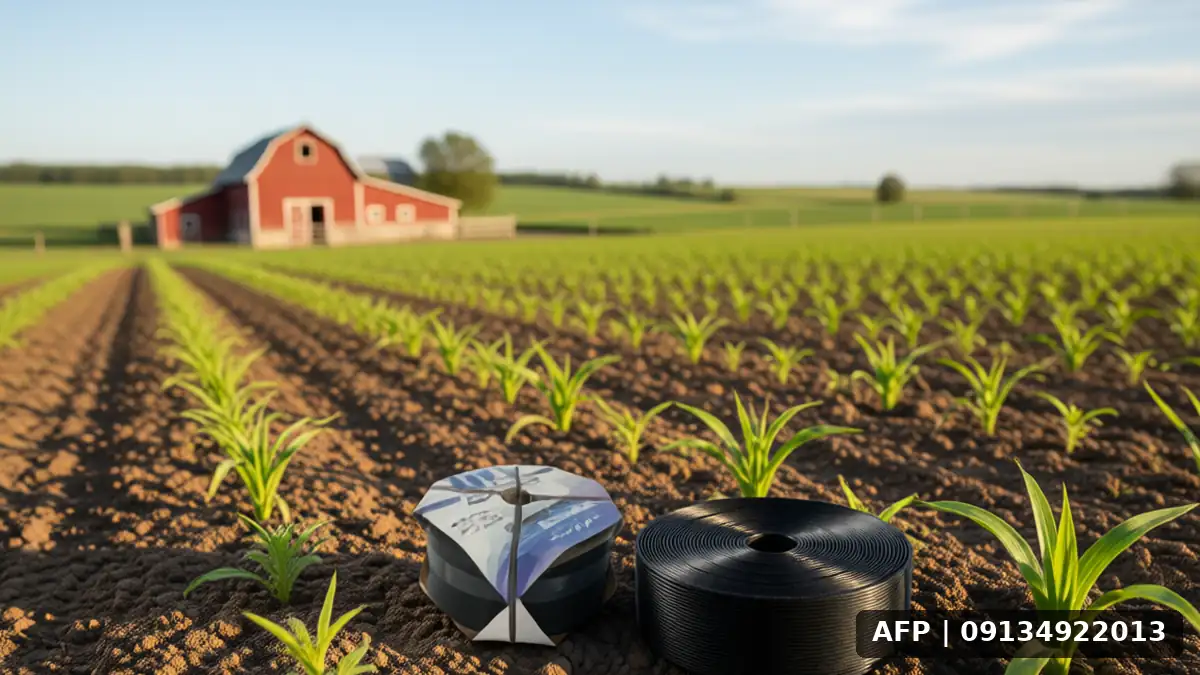
The field performance of the pipe depends directly on its manufacturing technical parameters. 90mm pipes are primarily produced from polyethylene PE80 or PE100 grades, each having different applications. The most important technical indicator to consider when purchasing is the ratio of wall thickness to inner diameter (SDR) . The most common pressure classes for this size are SDR17.6 and SDR11. The SDR17.6 class has a thinner wall thickness and is suitable for systems with lower operating pressures and lower flows. In contrast, SDR11 pipes have a significantly greater wall thickness, allowing them to withstand higher pressures; they are considered a safer and better option for main lines with high incoming flows. These pipes are supplied in standard lengths of 100 meters and usually feature a blue or black strip, indicating potable water or agricultural use. The linear weight (weight per meter) of PE100 pipe with SDR11 is approximately 6.5 kg; this data is critical for transportation calculations, determining support points, and estimating execution costs. Including this information on the pipe roll labels confirms the product’s authenticity and compliance with standards.
Strategic application in drip and strip irrigation systems
In the hydraulic design of irrigation networks, 90mm pipes are often selected as the main line, responsible for transferring water from the main valve or tank to distribution lines. Drip irrigation systems They are inherently sensitive to pressure stability. Any pressure fluctuation or undesirable pressure drop can result in uneven irrigation and reduced dripper performance. Since the internal frictional resistance of the pipe rises in a curved shape as flow rate increases, calculations indicate that a 90 mm size works optimally for flows of approximately 10 to 15 liters per minute (depending on line length). In tape-type drip systems, which are common in row cropping, the flexibility of PE pipes allows the line path to be easily redirected through mechanical (coupling) connections to cover complex field corners. These mechanical connections, which require no special tools, provide the flexibility for seasonal relocation (in case of changing planting locations). A very important safety point is the compatibility of PE material with weak acids such as citric acid, which is used for flushing lines and preventing scale deposition and nozzle clogging; metal pipes are prone to corrosion in such conditions, but polyethylene is completely resistant.
Practical guide for installation, connections, and maintenance principles
Even with the best equipment, incorrect execution leads to suboptimal network efficiency. For correct and long-term operation of the irrigation network, it is essential to adhere to the following principles when installing and maintaining the 90 mm pipe:
- Correct mechanical installation: Threaded couplings must be fully inserted into the pipe without resistance. The coupling guide arrow must be perfectly aligned with the arrow on the pipe to ensure proper O-ring sealing. Misalignment causes coolant leakage at the connection point.
- Managing thermal effects and freezing: PE pipes retain their tensile strength at temperatures below 0 degrees Celsius, but become brittle in extremely cold weather. In cold regions, it is recommended to bury the pipes or pump water at a higher temperature. Additionally, prolonged direct sunlight exposure without shading should be avoided, as UV radiation causes the degradation of polymer molecules.
- Pressure and Sediment Blowout: Before starting each irrigation season, accumulated pressure and sediment inside the pipes must be purged using a specialized cap. This prevents sudden pipe bursts and the early-season reduction in dripper performance.
- Precise Pressure Loss Calculation: In initial calculations, pressure loss in main lines must be minimized to ensure that pressure at drippers located at the end of the line does not exceed the allowable limit (typically 20% of the dripper’s allowable pressure loss). Using precise hydraulic tables for PE pipes facilitates this process.
Frequently Asked Questions about 90 mm Pipes
Is a 90 mm pipe suitable for all farms?
No, pipe size selection depends on multiple factors, including farm area, ground slope, the type of application device, and pump input flow rate. For large farms with high flow rates, 110 mm or 125 mm sizes may be safer to prevent excessive pressure loss and reduced flow velocity. Consulting with an irrigation engineer for precise flow and pressure calculations is strongly recommended.
What is the main difference between SDR11 and SDR17.6 pipes?
The main difference lies in wall thickness and, consequently, pressure rating capacity. SDR11 pipe is thicker and better suited for main lines with higher pressure and flow rates. SDR17.6 pipe is thinner and more cost-effective, making it suitable for low-pressure lateral branches. Selecting the wrong pressure class can lead to pipe cracking or crushing under high pressure.
Can second-hand pipes be used?
The use of second-hand or deteriorated pipes is strongly discouraged. These pipes are structurally weak, their connections are compromised, and they significantly increase the risk of leaks and sudden ruptures. To protect long-term investment and avoid reconstruction costs, always use new pipes certified by National or European standards (EN-ISO).
Conclusion and final recommendations for smart selection
Related Articles: Dry Wheat Seed Rate per Hectare: A Comprehensive Crop Guide | Parsley Seed Rate per Hectare: A Comprehensive Planting and Maintenance Guide | Eggplant Seed Rate per Hectare + Planting and Irrigation Tips