Tipe Strip Spacing in Sorghum Cultivation: Recommended Standards
Effective management of water resources in sorghum farms, particularly in semi-arid regions, requires meticulous attention to agronomic details. Among the factors influencing drip irrigation success, determining the appropriate drip line spacing in sorghum cropping is one of the most critical considerations a farmer must address before planting. Selecting this spacing not only affects water consumption but directly impacts root growth, soil moisture coverage, and ultimately the final crop yield.
Introduction to the Importance of Drip Line Layout in Sorghum
Sorghum, as a water-sensitive crop that also tolerates mild drought stress, experiences severe yield declines under improper irrigation conditions. Drip lines are considered the optimal option for this crop due to their precise control over water quantity and application timing. However, if the drip line spacing in sorghum cultivation is not correctly adjusted, a phenomenon known as ‘mid-row dryness’ occurs, where the area between two drip lines suffers from root stress due to insufficient water access. This issue leads to reduced dry matter uptake and limited bush expansion. Therefore, understanding the mechanism of water infiltration from drip line emitters and the formation of the moisture cone is the key to selecting the appropriate standard.
Factors Influencing Row Spacing Selection
When determining row spacing, one cannot consider only the plant type; rather, multiple factors affect moisture uniformity in the soil profile. The most important of these factors include soil texture, drip line flow rate, planting depth, and irrigation system type. For broader insights on general line layout principles across various farms, you can review our comprehensive guide on Potatoes: Comprehensive Drip Irrigation Guide, as the basic principles of water infiltration from drip lines are similar for many crops.
- Soil Type: In clayey soils, vertical infiltration is lower, and furrow spacing should be reduced.
- Sandy Soils: Due to high permeability, they require specific standard spacing to prevent water loss.
- Seepage Rate: Tapes with high seepage rates have a shorter wetting radius.
Furrow Spacing Standards for Sorghum Drip Tapes
Based on research data and field experiences in sunflower and seed-furrow sowing, drip tape spacing for sorghum cultivation typically falls within a specific range. A general rule exists where the distance between main furrows and lateral furrows is adjusted based on the horizontal water infiltration radius.
Numerical Recommendations Based on Climatic Conditions
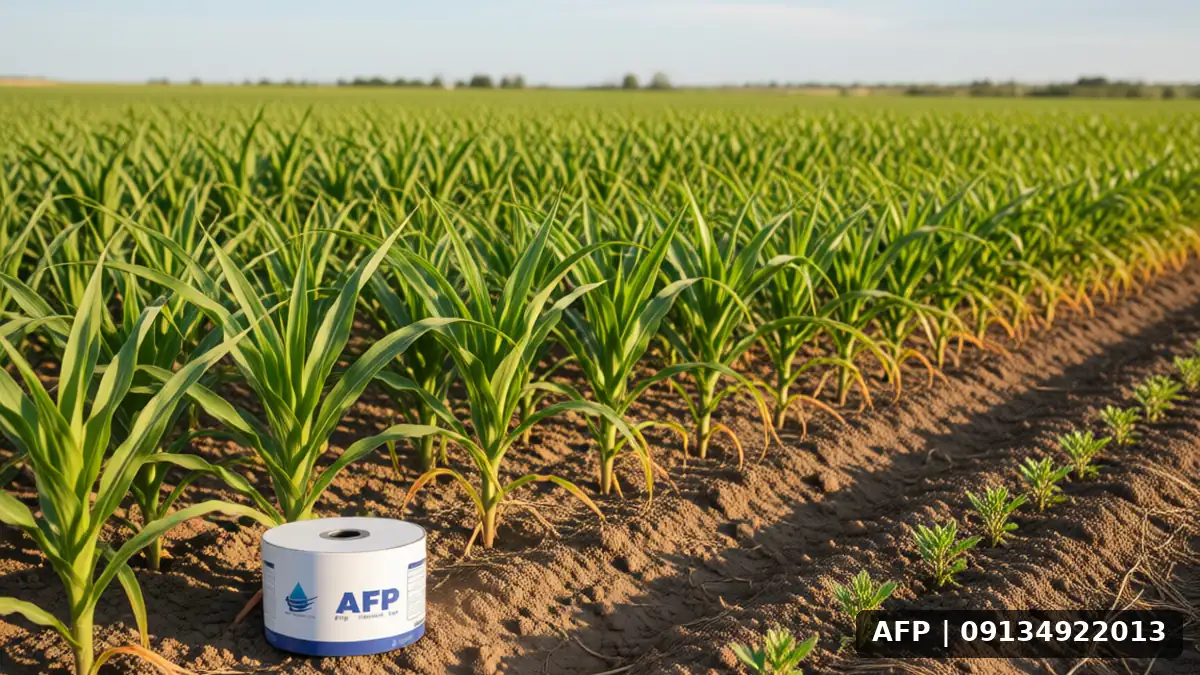
In seed-furrow and grove sowing conditions, main lines are typically spaced 1 to 1.2 meters apart. In this system, drip tape is laid at the bottom of the grooves or adjacent to the roots such that the horizontal distance between adjacent furrows ensures their moisture cones fully overlap, but not so much that they cause waterlogging in the areas. [[ [IMAGE_1] ]]
Referring to these tables, especially when using underground-rooted plants to compare layout arrangements, can be useful. For further familiarity with similar challenges in furrow spacing layout, read the article on Drip Tape spacing in sugar beet cultivation and its standard principles.
Technical Analysis of Furrow Layout (Row Layout)
In drip tape irrigation, the term Row Layout refers to the method of laying the tape in relation to the plant rows. In sorghum, because it is a grassy plant with a high-volume root system, the tape layout should be placed near the main root zone (Root Zone). There are two main methods: in-groove layout (In-groove) and lateral layout (Sub-surface).
Subsurface and Surface Layout
Subterranean installation with tape buried at a depth of 15 to 20 cm prevents direct evaporation and retains moisture at deeper levels. In this setup, the drip tape spacing for sorghum cultivation can be slightly wider than in surface installations since surface losses are eliminated. However, the increased system operating pressure and the need for more powerful pumps must be considered. To better understand the long-term challenges of tape erosion and degradation, it is recommended to review guidelines on extending drip tape service life, as the correct material selection directly impacts system durability.
- Soil water cycle depth check: The rooting depth of sorghum in suitable soils is up to 2 m.
- Determine wetting radius: Using the Gannier test, calculate the radius within which residual moisture is maintained.
- Determine spacing: The spacing between furrows should equal twice the horizontal wetting radius (under ideal conditions).
Practical tips for farmers
Implementing drip tape spacing theory in field sorghum cultivation requires strict adherence to execution guidelines. Many instances of reduced performance are caused by incorrect furrow spacing.
Pre-planting: System design
Never copy generic standards without conducting a soil test. If you are in a region with uniform soils, you can apply average standard values. If there are variations in the soil profile, spacing must be adjusted accordingly. Additionally, drip tape spacing must align with the seed row spacing. If the seeder has a 1-meter spacing, the drip tape must be placed exactly on the row line or 15 cm from it.
To learn about planting layout optimization methods tied to irrigation furrow spacing, you can review the guide on planting and harvesting water chestnuts per hectare and yield increase methods. Although the crop is different, the logic of linear row layout is shared.
Optimization with smart systems
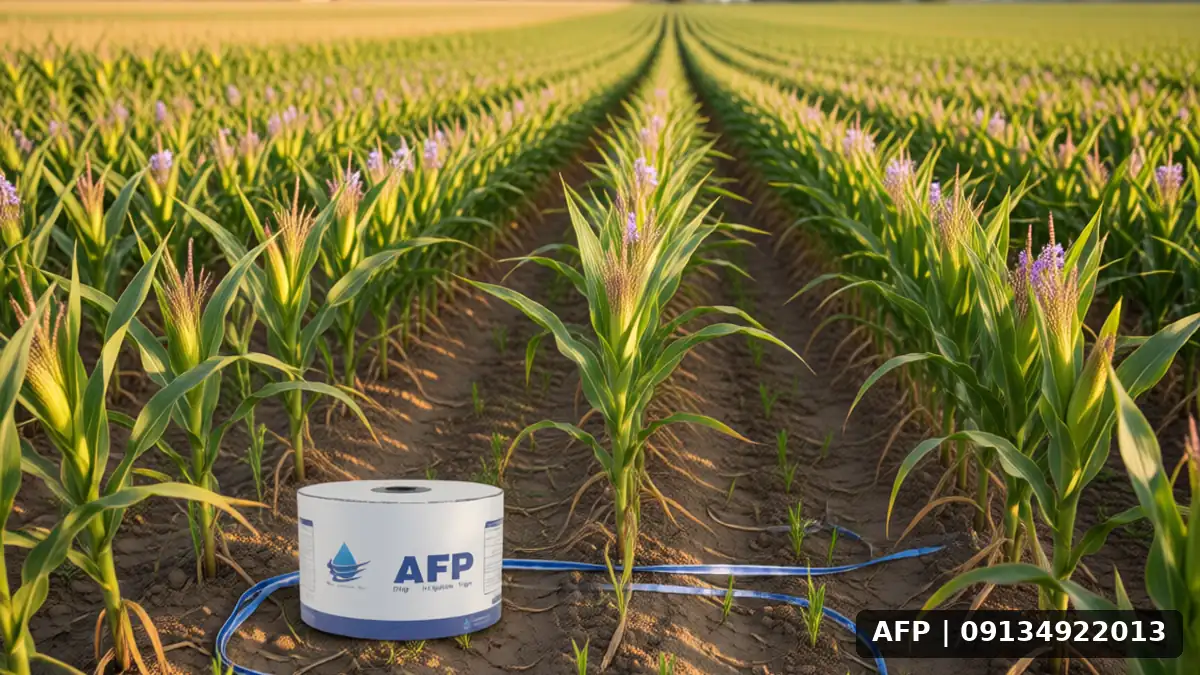
Today, using soil tensiometers to monitor drip tape spacing in sorghum cultivation is highly beneficial for farmers in terms of precision. If moisture in the midpoint between two tapes drops below 40% of field capacity, it means the tape spacing is too wide or the number of tapes is too low. In this case, you should increase the irrigation schedule to prevent the middle furrow from drying out. [[ [IMAGE_2] ]]
Drip tape protection
Drip tapes are vulnerable to sun, wear, and insect attacks. In sorghum cultivation, which is usually done during the hot seasons of the year, UV rays are the main cause of polymer tape degradation. Subsurface placement or covering with mulch are two main solutions to this problem. Finally, to manage secondary costs and maintenance, studying drip tape maintenance and costs can help with your financial planning.
Frequently Asked Questions (FAQ)
1. Is the drip tape spacing in sorghum cultivation fixed?
No. The furrow spacing depends on soil type, drip tape seepage rate, and planting method. There is no universal standard for all farms, although a range of 1 to 1.2 meters is common for most conditions.
2. What is a common mistake in determining drip tape spacing?
The main mistake is relying solely on general recommendations for sandy soils and ignoring the low permeability of clay soils. In clay soils, if the furrow spacing is too wide, the center of the furrow will remain dry.
3. How can I ensure the accuracy of the drip tape layout?
By taking a soil sample at a 30 cm depth at the midpoint between two drip tapes 4 hours after irrigation, you should observe significant moisture. If the surface is dry, your tapes are spaced too far apart or the seepage rate is low.
To better understand the key variables affecting annual performance, studying factors that increase saffron yield per hectare can provide a broader perspective, as resource management for high-value economic crops is a primary priority.
Summary
Correctly determining the lateral spacing in sorghum drip irrigation is a vital step toward sustainable and optimized farming. This parameter should be treated as a variable that changes based on local conditions. By considering soil type, selecting an appropriate leakage rate, and properly arranging furrows, you can reduce water consumption while ensuring higher yields. Combining knowledge of drip irrigation principles with equipment maintenance guarantees farm profitability. [[ [IMAGE_3] ]]
Finally, it is reminded that precision agriculture requires a combination of theoretical knowledge and practical trials. If you are seeking more cost-effective solutions to increase efficiency, the ‘Per-Hectare Product Guide’ for farmers can serve as a useful supplement to your economic decision-making.
Related articles: safflower yield hectare factors increase, Ginger yield per hectare + methods to increase performance, Related article Related article Related article D8AFD8B1 Related article, pakhtahosil yeki gektar rahnama kishovarzon