Tipe Drip Tape Spacing for Cucumber Cropping: Recommended Standards for Irrigation Efficiency

Why is drip tape spacing important in cucumber cultivation?
Cucumber is one of the plants sensitive to soil moisture management. In drip and drip tape irrigation systems, the layout and spacing between lines directly affect water and nutrient distribution in the root zone. If the drip tape spacing is inappropriate, some roots may remain dry, or excessive saturation may lead to root fungal diseases. Therefore, answering the question ‘What should the drip tape spacing be for cucumber cultivation?’ requires considering the seed type (seed or seedling), climatic conditions, planting depth, and soil properties.
In most greenhouse and open-field farms in Iran, row layout is defined as parallel lines with specific spacing. Drip tape is typically placed directly at the base of the planting row, in contact with the soil surface or slightly buried. The main question is whether there is a separate line for each row between two cucumber rows, or whether a shared line is used for two rows. The answer to this question determines the effective drip tape spacing.
The concept of effective drip tape spacing
Drip tape spacing refers to the width of the soil strip wetted by one line. In cucumber, roots primarily function at depths of 15 to 60 cm. Therefore, the distance between two lines should not exceed 80 to 100 cm, unless the system has a pressure compensator and very high flow rate. If the row spacing for cucumber is 120 cm, using one line per row (effective spacing of 60 cm from the root center) is recommended to reduce water stress.
Common standards for drip tape spacing based on cultivation method
For a better understanding, we categorize the standards based on the two main cucumber cultivation methods: direct seeding and transplanting. In both scenarios, the material type of the drip tape (PVC or LDPE) and the flow rate significantly impact decisions regarding tape installation density. If you plan to use low-flow-rate tapes, you can refer to the article Lenticular Spacing for Drip Irrigation to select the appropriate model.
1. Cucumber Transplanting in Modern Greenhouses
In roofed greenhouses, row spacing is typically set between 100 and 150 cm. In these conditions, the standard recommendation is to use one drip tape per row. For example, if the row spacing is 120 cm, the tapes are installed 120 cm apart. The reason for this is to ensure uniform moisture distribution in the root zone and better access for personnel to the floor. Using shared tapes in roofed greenhouses increases the risk of root stress in the zones between rows.
2. Direct Seeding of Cucumber in Open Fields
In open-field farming, the cost of constructing furrows for tape installation is higher. Therefore, two-row layouts with a central tape are sometimes used. In this configuration, the distance from the drip tape to the root of each row must not exceed 40 to 50 cm. For instance, if the row spacing is 140 cm, the distance to the central tape is 70 cm, which is excessive for cucumbers and requires either increasing the flow rate or installing a side tape. Consequently, in open fields, the golden standard is that each cucumber row should have at least one dedicated tape, unless there is a severe shortage of tapes.
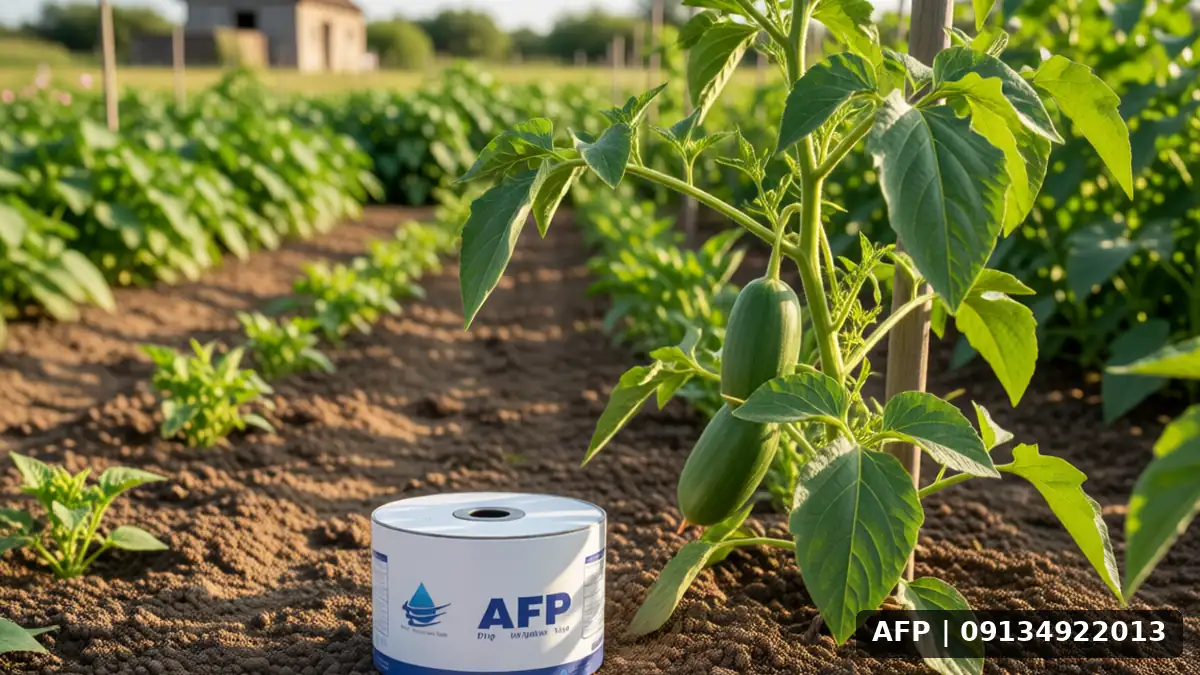
Effect of pipe material and weather conditions on installation spacing
The material of the drip line determines its resistance to degradation and pressure. Polyethylene (LDPE) lines are more flexible and suitable for curved piping, while PVC lines maintain their circular shape. For cucumbers, which grow vertically, resistance to roots and insects is important. Additionally, temperature during the warm season affects the evaporation rate from the soil surface under the line. In hot regions, the drip line spacing for cucumber crops can be set slightly shorter (i.e., denser lines) to compensate for faster evaporation. For technical specifications of the lines, refer to Key points before purchasing irrigation drip lines is recommended.
Table summarizing recommended drip line spacing for cucumbers
Practical tips for installing and maintaining cucumber drip lines
After determining the spacing, the physical installation method of the drip line in cucumber cropping is critical. Cucumbers are plants with strong surface roots, and roots can move toward the line. Therefore, the use of drip lines with anti-root mesh is recommended in fields with high root pressure. Additionally, soil slope must be considered; if the land is sloped, adjust the line spacing according to the slope direction to maintain pressure balance.
- Attention to soil depth: In light (sandy) soils, use a narrower drip tape spacing for cucumber planting because vertical water infiltration is faster, increasing the risk of deep soil drying below the root zone.
- Emitter Uniformity: Drip tapes come with emitters spaced 30 or 40 centimeters apart. Lay the tape so that emitters are positioned directly under the cucumber plants, not in the space between plants.
- Drainage Management: In cold regions, drip tape spacing for cucumber must not hinder the drainage of excess water. A drainage pipe must be installed at the end of the tape.
A common issue in cucumber cultivation is nutrient leaching (Fertigation). The density of the tapes affects the uptake of acid and the leaching of urea and nitrogen. Wider spacing between tapes increases the risk of salinity accumulation at the tail of the wetting strip. For general principles on calculating flow rate and water volume, refer to the guide for Required water quantity for drip tape .
Frequently Asked Questions (FAQ)
Can two-sided tape be used for cucumbers?
Two-sided tapes (Twin-line) can create wider wet bands but do not change the drip tape spacing in cucumber cultivation; they increase the coverage width. This model is more suitable for cucumbers with extensive branching.
What is the difference in drip tape spacing between cucumber and pickle?
Pickles are usually grown in baskets and adhering flats with less downward growth. Therefore, the tape spacing can be slightly wider (up to 120 cm with shared tape), while stalk cucumbers require a more concentrated wet band under the bush.
What changes should be made to the tape spacing in winter?
In autumn and winter cultivation, the water requirement for cucumbers is lower. However, it is not recommended to remove the tapes. Instead of changing the spacing, reduce the irrigation duration. The physical spacing of drip tapes in cucumber cultivation remains constant, as rearranging the tapes is very costly.
Summary and Final Recommendation
Selecting the drip tape spacing for cucumber cultivation requires a balance between installation cost, root zone efficiency, and water cost management. The general principle is to use one dedicated tape for each cucumber row spaced 100 to 150 cm apart. If the budget is limited, you can use bidirectional tapes or increase the flow rate to ensure the wetted strip reaches both sides of the central tape. Always conduct a small-scale trial with two rows at two different spacings before finalizing the layout, and observe root behavior after two weeks.
Remember that drip tape is a primary, not exclusive, method for water supply. By correctly combining drip tape spacing in cucumber cultivation with seed quality control and fungal disease management, you can maintain stable yields over several years. For further reading on seed placement and sowing, we recommend reviewing other educational articles on the site, such as the Parsley Seed Sowing Guide and Eggplant Seed Density Chart , as similar principles of row placement apply to many vegetables.