T-Tape Spacing for Carrot Cultivation: Recommended Standards
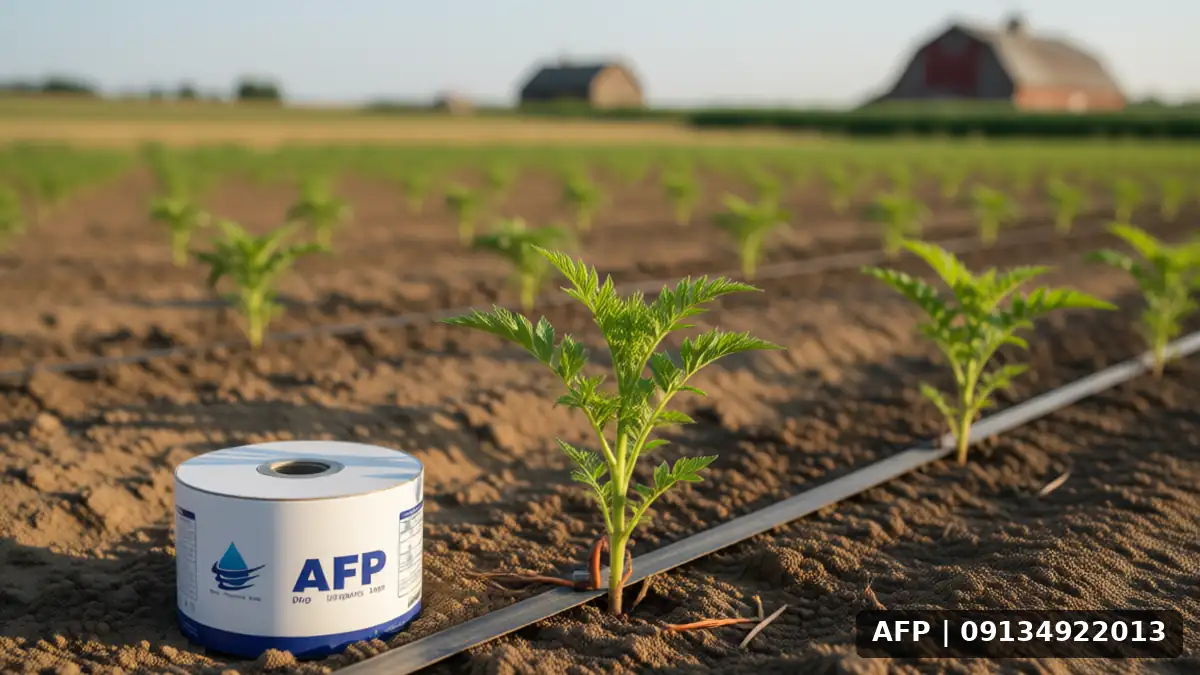
In drip irrigation systems, drip tape spacing in carrot cultivation is one of the fundamental pillars of irrigation engineering that directly impacts the quality of the wetting front and, consequently, the uniform growth of carrot stems and taproots. Many farmers select this spacing based solely on intuition or without hydraulic considerations, whereas optimizing this parameter can reduce water waste, prevent brown root diseases, and significantly increase commercial root volume. This section examines the precise technical principles and practical recommendations.
Assumptions and basic principles of drip layout for carrots
Carrots have storage roots that are deep-growing and highly sensitive to uniform moisture distribution in the rooting zone. Drip tape is the ideal option for this crop due to its ability to deliver water at low flow rates; however, if the tape spacing from the planting line or adjacent tapes is inappropriate, ‘dry spots’ or ‘over-wetted zones’ will occur. The goal of adjusting drip tape spacing in carrot cultivation is to create a wetting front overlap that covers the entire root-eligible soil volume.
- Carrot rooting depth: Typically 30 to 50 cm. Therefore, the drip line must be installed at a level where water penetrates slowly to depth, preventing severe water leaching from the root zone.
- Pressure and Flow Rate: The flow rate of the tubing drippers must be selected based on the design spacing so that the rate of water infiltration does not exceed the root zone.
- Lateral Root Development: Carrot roots tend to grow toward dry areas when moisture is scarce, leading to root deformation and stunted growth. Therefore, the drip line spacing must be designed to prevent such moisture stress.
In layout design, there are two main scenarios: Single-drip-line layout (one line centered in the row) and Dual-line layout (Two lines spaced from the row center). For commercial carrot production, specific layouts are recommended due to the cylindrical shape and root sensitivity to soil compaction and asymmetric moisture, as detailed below.
Technical Standards for Drip Tape Line Spacing in Carrot Cultivation
Impact of Line Spacing on Moisture Uniformity
Standard drip tape line spacing for carrots depends on several parameters: soil type, emitter flow rate, and target root diameter. In clay soils, water infiltration rate is low, so line spacing from the planting line must be reduced to prevent bed surface drying. Conversely, in sandy soils, infiltration is rapid, allowing spacing to be increased slightly to reduce energy consumption for deep infiltration.
Dimensional recommendations: The standard drip tape spacing from the carrot planting line ranges between 15 to 20 centimeters is recommended on both sides. When using dual-line tapes, the spacing between the two lines is set at approximately 40 to 50 centimeters (depending on row width). This spacing allows the two wet zones from either side of the tape to merge at the center of the row, where the main roots are located. If the spacing is too wide, a dry zone will remain in the center of the row, causing the main roots there to dry out. Conversely, if the spacing is too narrow, the concentration of moisture at the root surface can lead to rot and brown root diseases.
Role of Drip Discharge Rate in Determining Spacing
Tape spacing and drip discharge rate are directly related. The table below illustrates the interplay between these two parameters across different sections of the carrot layout. Using a standard discharge rate such as 1/6 or 1/8 liters per hour on drip tape requires precise spacing adjustments so that the rate of water penetration into the soil depth remains synchronized with the root growth rate.
To better understand moisture behavior under these conditions, it is essential to examine the emission rate of the irrigation drip tape as a preliminary criterion in design calculations, as tape spacing cannot be effectively implemented without understanding the actual field emission rate.
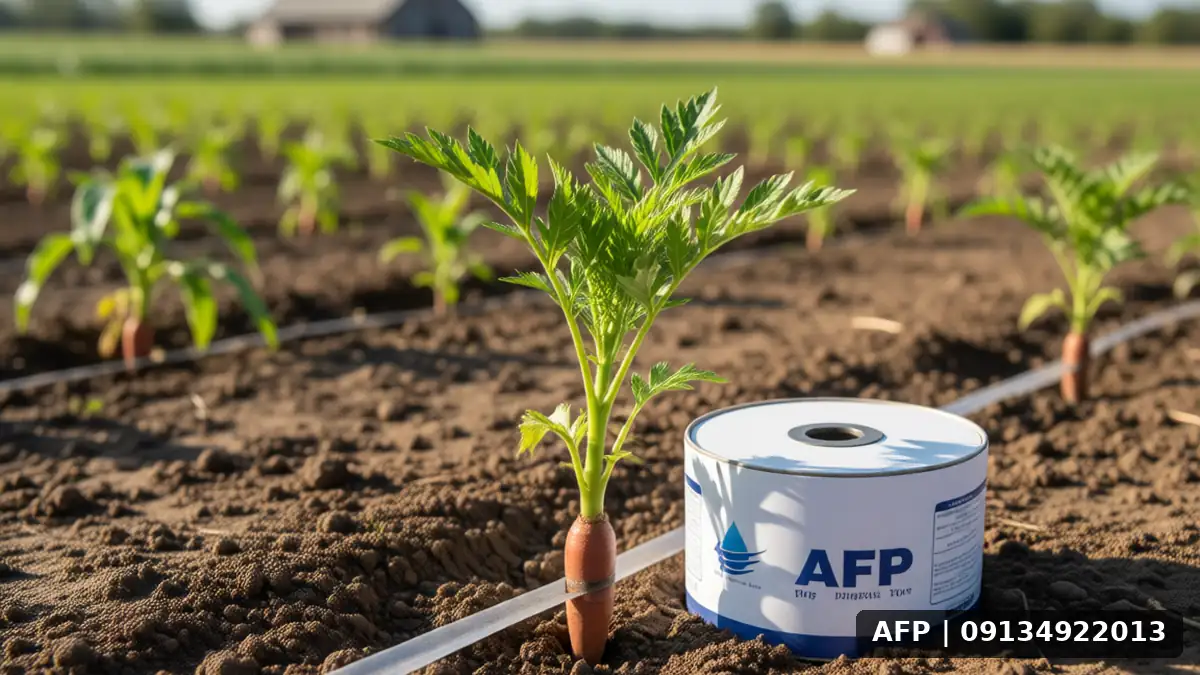
Practical operational points in carrot farms
Step-by-step guide to layout adjustment
- Measuring row width: Before installing the tape, accurately determine the carrot row width. The distance between two adjacent rows should be such that the drip tape spacing remains aligned and logical.
- Tape installation on the soil surface: Drip tapes in carrot crops are generally placed on the soil surface or at a maximum of 5 cm below the surface to ensure moisture reaches the root zone quickly and to prevent useless deep percolation.
- Using moisture sensors: Before finalizing the spacing, use soil moisture sensors at depths of 10, 20, and 30 centimeters to identify the connection point of the two wetted rings (from the two drip lines). The goal is for the moisture at the 20-centimeter depth to cross the dry boundary.
- Preventing clogging: A small distance between the drip line and the roots can cause soil clumps to fall onto the line emitters; therefore, the standard distance (minimum 15 centimeters) prevents direct contact between the root system and the line surface and reduces the need for periodic flushing of the line. For more details on this subject, refer to the drip line maintenance and costs section.
Impact on yield and commercial quality
Changing the drip line spacing in carrot cultivation is not just an irrigation parameter, but it directly affects the external shape of the commercial roots. Roots that grow in a dry environment are shorter, more crooked, and have a rougher surface. Conversely, the uniform wetted ring resulting from the standard spacing allows the root to grow steadily at depth and maintain a smooth, marketable surface. Additionally, proper moisture distribution prevents the growth of side shoots and secondary roots that compete with the main root volume. This is critical for farmers seeking maximum efficiency. To compare with other root crops, you can consult the guide Almond seed quantity per hectare Examine this to understand the importance of irrigation system alignment in various root crops.
Frequently Asked Questions
Question 1: Is drip tape spacing in carrot cultivation the same at all growth stages?
No, carrot moisture requirements vary across different stages. During initial germination (1 to 2 weeks), roots are thinner and more susceptible to moisture stress; therefore, keep the tape spacing slightly narrower (around 15 cm) to maintain higher surface moisture. In rapid growth stages (second month onward), the spacing can be increased within acceptable limits, adjusting the flow rate according to root growth speed.
Question 2: How does the use of plastic mulch affect spacing?
Using mulch increases the rate of water infiltration in heavy soils. In this case, the distance of the tape from the planting line can be increased by up to 2 cm, as deep infiltration energy is greater. However, do not forget the surface soil moisture above the thin roots; if roots are positioned above the mulch, consider a shorter spacing.
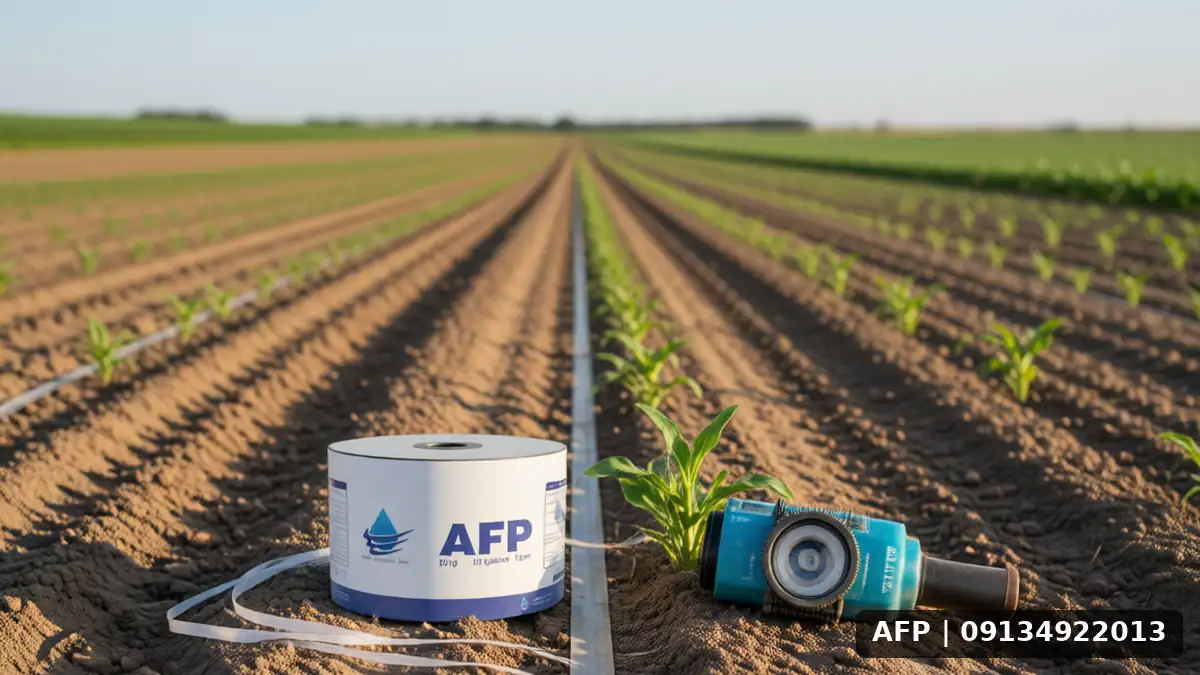
Question 3: What should be done if carrot roots reach the drip tape?
Root hardening on the drip tape can cause breakage of the emitters and contamination of adjacent areas. To prevent this, use a root barrier (compacted soil bed) for the tape and keep the tape at least 10 cm away from the main root center. Additionally, using multi-stage filtration is recommended to prevent the sedimentation of fine particles at the root-tape junction. For better system management, referring to the drip tape irrigation flow rate helps reduce root pressure on the tape by adjusting the pressure.
Conclusion and Final Recommendations
Optimization Drip tape spacing in carrot cultivation It is a dynamic process that must be customized based on each farm’s conditions (soil texture, climate, and even planting method). However, the basic principles, including maintaining a continuous wetted zone, preventing row center dryness, and maintaining a standard distance of 15 to 25 cm from the planting line, remain valid. Adhering to these standards not only reduces irrigation costs but also noticeably increases the commercial value of the product by improving the appearance of the roots. It is recommended to use digital moisture sensors in each growing season to directly monitor actual moisture behavior in the root zone. Additionally, for a better understanding of moisture dynamics and system design, studying the drip tape irrigation flow rate as a key reference in engineering calculations would be very useful.
Related articles: canola yield per hectare guide iraqi farmers، Drip Line Maintenance and Costs, mohdath intaj thur maksikhi li l hektar daleel shamil lil muzariin