Surface Irrigation in Melon Cultivation: A Comprehensive and Practical Guide
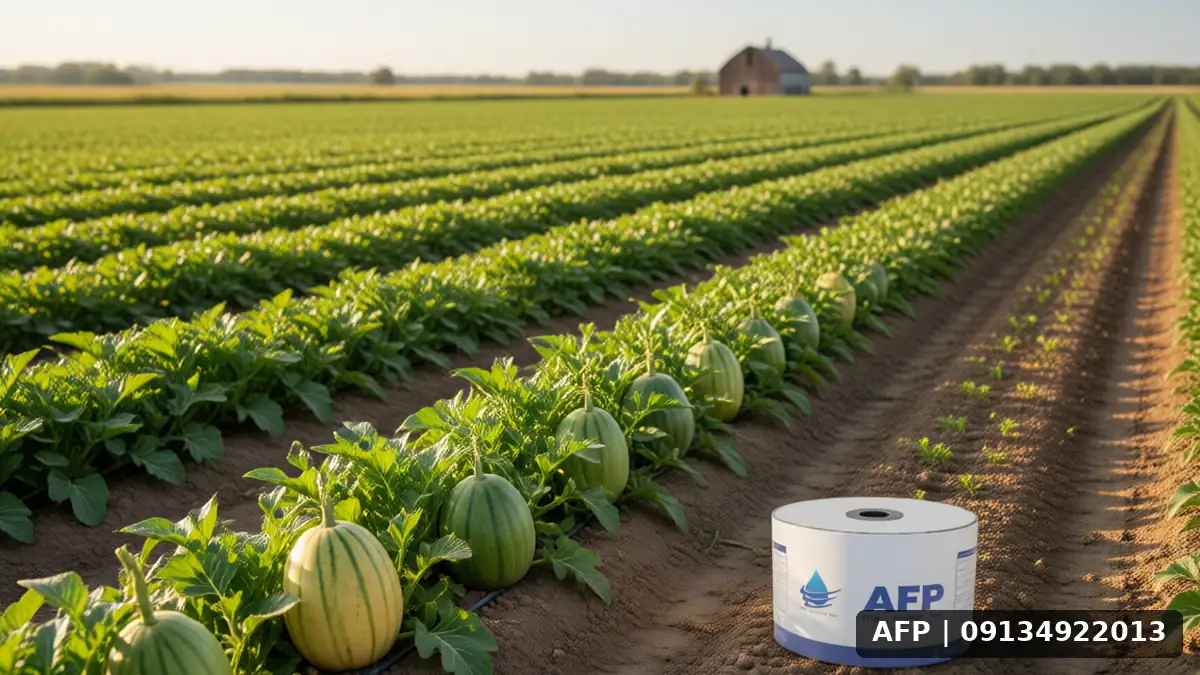
Melon is a high-value agricultural crop that is particularly sensitive to growing conditions, especially the precise management of water resources. Although pressurized irrigation technologies have made significant advances in recent years, in many regions of Iran, due to economic and geographical constraints, surface irrigation remains the dominant method for growing this crop. The primary challenge with this method is maintaining the delicate balance between the root zone’s water requirement and the risk of waterlogging or rot. While many farmers are aware of the importance of thoroughly inspecting the land before installing any irrigation system , in surface irrigation systems this step is even more critical, as even the slightest unevenness in ground slope can cause water to accumulate on one side of the field while leaving the other side dry. Therefore, the objective of this guide is to help farmers achieve the best results from the surface irrigation system for melon cultivation, without incurring high equipment costs, by explaining engineering principles and field experiences. Familiarity with these concepts not only helps preserve seed and fruit quality but also enhances plant resistance to pests and fungal diseases by reducing stress caused by moisture fluctuations. Furthermore, understanding the differences in water distribution across various systems can help better grasp how similar principles found in guides such as celery drip irrigation can contribute to a deeper understanding of water behavior in surface beds. Relying on scientific data and practical experience, this article will outline a roadmap for sustainable and more harmonious cultivation.
The importance of proper water management in melon cultivation
The melon root system is structured such that it requires stable moisture for the development of the root system, as well as relative drying of the upper soil layers for root aeration. Surface irrigation, due to deep water infiltration, directly affects the physical properties of the soil and plant rooting. In conditions where water is delivered without control, the washing of fine particles (clay) in loamy soils can lead to the clogging of micropores and a reduction in soil permeability. On the other hand, in sandy soils, infiltration speed is very high, and water may evaporate or drain away before reaching the deep roots. Therefore, knowledge of the field’s soil type is a prerequisite for any planning. The farmer must know how each centimeter of incoming water is distributed in the soil depth profile. This understanding is similar to the principles of Assessing the seed’s water absorption capacity and nutrient solution concentration where the synchronization between the seed’s water uptake rate and water application is the key to a strong seedling. In melon cultivation, this synchronization must be maintained throughout the plant life cycle, from land preparation to fruit management. Proper water management is not merely a tool for reducing consumption, but a tool for controlling vine growth and preventing flower drop. By precisely adjusting flow rate and timing, vine density can be optimized to ensure sufficient light for the photosynthesis of middle and upper leaves, preventing mutual shading of vines, which is a primary cause of reduced melon quality.
Principles of Surface Irrigation Implementation in Melon Farms
Cutting irrigation channels and precise grading
The key to successful surface irrigation lies in field geometry. The longitudinal and cross slopes of the field must be checked with millimeter precision. Using laser leveling for initial grading significantly reduces future maintenance costs. Main and secondary canals should be designed so that water flow velocity remains between 0.5 and 1 m/s; lower velocities cause suspended solids to settle and clog canals, while higher velocities lead to erosion of the canal bed and banks, creating water tunnels. In conventional fields, furrow widths typically range from 20 to 40 cm, and the spacing between planting beds must be calculated based on water infiltration rate. If the natural ground slope exceeds 3%, creating artificial terraces or surface platforms is essential to prevent centrifugal force from dominating water movement and to maintain uniform flow. Additionally, canal edges must be smooth and consistent to prevent water from spraying like an umbrella at uneven points, ensuring uniform contact with the bed.
Optimal irrigation scheduling
Irrigation scheduling in melons is directly linked to fruit quality. During warm seasons and periods of intense heat, irrigation frequency should be increased to prevent root temperature from exceeding tolerance limits and to avoid heat stress that halts apical meristem growth. Conversely, on cold nights with high relative humidity, excess irrigation can create a warm and moist environment favorable for phytopathogenic fungi. It is recommended to irrigate in the evening or early morning before sunrise to minimize evaporation from leaf surfaces and soil and to allow soil water to infiltrate the furrows deeply. This timing management has a close relationship with Considerations for planting density management and primary resources It has; because high-density planting requires precise moisture levels to prevent root competition. In this scenario, every drop of water must be used precisely to ensure both coverage and penetration depth. Continuous monitoring of seed and seedling conditions during the initial days also indicates that melon seeds are highly sensitive to drastic moisture fluctuations. Consistent irrigation acts as a stabilizing factor, playing a key role in establishing a strong and symmetrical root system.
Practical Tips and Reducing Sanitary Risks
Controlling Infections Caused by Surface Moisture
One of the most detrimental effects of surface irrigation in melon production is the splashing of water onto the leaves and lower stems of the plant. This creates fine water droplets on the leaves, which serve as an ideal medium for the proliferation of ooid plasmodia and spot fungi. To combat this phenomenon, use simple but effective techniques such as applying natural anti-moisture solutions or covering channel edges with compacted earth. This ensures water flows without local splashing or direct contact with the air layer near the leaves. Additionally, avoiding irrigation during peak summer hours and strong winds reduces the dispersion of suspended particles. Farmers should understand that canopy health guarantees the final yield. Any early infection by fungal diseases leads to the etiology of the entire field and a sharp decline in commercial quality. Therefore, prevention through the geometric management of channels is the cheapest and most effective method of disease control.
Soil Management and Drainage Improvement
Melon is a crop that requires excellent drainage and its roots will rapidly suffocate in heavy clay-rich soils. If your farm soil is compacted, deep plowing and manual drainage are essential before planting. A simple test to assess drainage is to place a Go Cup in the ground to observe water infiltration rate. If water remains on the surface after several hours, amendments such as mixing peat or compost into the soil are necessary. This approach is consistent with the logic increasing the yield of fruiting crops through growing medium management because both crops require a balanced growing medium to express their genetic potential. In sandy soils, although drainage is excellent, water retention capacity is low. Here, using organic matter to increase moisture holding capacity is key. By balancing soil structure, reliance on frequent irrigation can be reduced and plant stress minimized.
Supplementary Equipment and Strategies for Greater Efficiency
- Variable-speed pumps: For elevated farms, it is essential to use pumps with variable output to ensure uniform flow rates in upstream and downstream channels.
- Pressure regulators: To prevent breaking of the walls of secondary canals in areas with elevation differences, it is recommended to install pressure relief valves.
- Marker stakes: Using colored stakes to indicate areas with potential waterlogging or drought facilitates visual monitoring and rapid decision-making.
- Smart sensors: Although surface irrigation is an old method, installing soil moisture sensors at various depths transforms the guessing game of irrigation scheduling into data-driven precision.
Frequently Asked Questions (FAQ)
Can I combine surface irrigation with drip systems?
Yes, in advanced farms, drip systems are used for precise root-zone fertilization while surface irrigation is used for soil cooling and leaching on very hot days; however, this requires integrated water resource management to prevent flow interference.
What is the best soil type for melon in surface irrigation systems?
Sandy-loam soils with moderate to good drainage are ideal. Very heavy soils, due to the risk of waterlogging, and very light soils, due to high infiltration rates, require more chemical and physical amendments.
How can I reduce excess moisture without wasting water?
Using crop covers or anti-evaporation solutions on canal surfaces and creating artificial shade during peak summer hours can reduce water loss.
What should be done if the field slope is uneven?
Use terracing techniques with slopes of 1 to 3 percent to ensure uniform water flow and prevent dead zones where water does not reach or accumulates.
Summary
Surface irrigation for melon cultivation is a process in which physical variables such as slope, soil type, and timing complexly affect final product quality. By following canal engineering principles, managing plant surface moisture intelligently, and monitoring water application rates precisely, common damage to melons can be prevented, and a uniform crop with stable seeds and excellent quality can be produced. Learning and implementing these topics goes beyond just a technical tool; it is the key to opening the path toward more sustainable agriculture in sloping or resource-scarce lands. The strategies presented in this article can serve as a model for optimizing other water-sensitive crops, similar to approaches suggested in the shallot seed rate guide and methods for increasing yield to achieve maximum productivity. Ultimately, success in surface irrigation requires precision, patience, and continuous monitoring. Farmers who integrate these points into their work routine will observe a direct increase in economic efficiency and a reduction in crop loss risk.