Subsurface Irrigation for Onion Cultivation: Applications, Benefits, and Implementation Guide
Introduction to the importance of optimal irrigation in green onion production
Green onions are one of the most consumed side products in the food industry and for daily use in Iran. The high sensitivity of this crop to water stress and fungal diseases makes precise water resource management a vital factor. While traditional surface irrigation methods (flood irrigation) often result in the loss of more than 30% of water due to evaporation and deep percolation, Subsurface irrigation of green onions as a smart solution, focuses on precise rooting and maintaining moisture in the root zone.
The use of subsurface tapes or buried drip lines not only reduces labor costs but also improves the quality of the produced greens by increasing growth uniformity. In the following, we examine this technique from an expert perspective. The importance of this topic is deeply linked to understanding the relationship between hydraulic pressure and crop yield. Farmers can gain a better understanding of planting density and water requirements for similar vegetable crops by studying the comprehensive guide on Green bean seed rate per hectare This awareness forms the basis for designing more precise irrigation networks.
Technical principles of subsurface irrigation and the mechanism of action
Difference from surface drip irrigation
Unlike common drip systems that release water droplets on the soil surface, in the subsurface irrigationsystem, the band or pipe is buried in the soil at a depth of 15 to 25 centimeters. This standard depth coincides with the dominant root depth of chives in the plains of Iran. The main difference lies in the water distribution mechanism. In the surface method, the kinetic energy of the droplets causes soil particle breakdown and the formation of a compacted surface layer. In the subsurface method, water is slowly injected into the soil liquid phase through band holes. This process, without exerting mechanical stress on soil structure, allows for more uniform infiltration of salinity. Additionally, the lower soil temperature at depth causes the evaporation rate to become nearly zero. This phenomenon provides a high competitive advantage, especially in Iran’s hot climates. Farmers seeking to optimize pumping energy consumption can make a comparison of water requirements between forage and root crops by studying the guide on rapeseed seed rate per hectare. This comparison provides a deeper understanding of energy consumption in different systems.
- Reduced evaporation: Water reaches the soil liquid phase directly, eliminating solar evaporation effects. This directly affects the irrigation reliability factor.
- Weed Control: Because surface moisture is low, weed growth is reduced. This advantage decreases the need for herbicide use and lowers chemical costs.
- Moisture Stability: Severe dry and wet fluctuations are eliminated, which is critical for photosensitivity in chives. Moisture stability leads to more uniform plant growth and reduces waste during harvest.
Impact on Chives Yield and Quality
Field experiences show that chives cultivation using buried drip tape systems saves up to 25% of water in water-scarce regions. In moderate regions, it reduces storage waste by decreasing bulblet humidity-related contamination. This saving is not limited to reducing water consumption volume. Reducing leaf wetness-induced diseases is the main factor in improving the visual quality of the product. In export markets, uniform size and apparent health of chives directly affect the final price. Additionally, reducing the concentration of surface soil salts prevents salt deposition around the roots, which is of particular importance for Iran’s saline soils.
Practical Applications and Drip Tape System Planning
The correct selection of dripline is the common denominator for the successful implementation of dripline and crop irrigation . In onion seedling cultivation with row spacing of 30 to 40 centimeters, 20-centimeter lines are generally used. Selecting an appropriate operating pressure prevents the line from rupturing during burial. The working pressure must be adjusted so that it simultaneously withstands soil resistance without causing the line to deform. This adjustment requires initial hydraulic testing. In this regard, studying the measurement of dripline pressure can help in calibrating measuring equipment and ensuring uniform flow throughout the entire lines. Pressure uniformity is the key to the even distribution of water along the entire length of the line.
Appropriate burial depth in onion seedlings
- 15-20 centimeter depth: For light and sandy soils. Moisture at this distance reaches the shallow and spreading roots of onion seedlings most effectively. In these textures, high permeability causes water to spread more quickly.
- Depth of 20-25 cm: For medium to heavy soils. This depth prevents rapid surface drying and retains moisture. In dense soils, water infiltration is slower, so greater depth is needed to allow roots to access the primary moisture source.
Important note: Drip tape burial must be performed using special hand trenchers to avoid damaging the tape structure. Additionally, pre-burial leak testing is essential to ensure hole integrity; in this regard, familiarity with proper drip tape selection can prevent mid-season replacement costs. Selecting low-quality tape is one of the most common errors made by farmers, leading to hole clogging within a single season.
Practical tips for farmers: Installation and operation
Post-planting and tape protection
During the spring transplanting stage, ensure that the planter’s press wheels do not cut the subsurface drip tape. The best method is to use guided furrow openers or manual planting in the side rows. Also, prevent soil from falling onto the tape (due to tillage or plowing operations), as changes in tape depth disrupt the system’s hydrostatic pressure. Minor depth variations can create low-pressure or high-pressure spots in the network, leading to relative drought in some areas and waterlogging in others. This inconsistency is the main enemy of uniform spring growth.
Irrigation Schedule
Since the subsurface system reduces runoff velocity, the irrigation duration for each cycle may be shorter than with surface methods, but the number of cycles will increase. It is recommended to use soil-layer sensors and adjust water volume based on rainfall and air temperature. Using smart irrigation technologies, such as automatic timers, can maximize water use efficiency. These systems dynamically adjust scheduling based on ambient temperature and soil moisture saturation levels. This approach not only offers economic savings but also prevents physiological stress in plants.
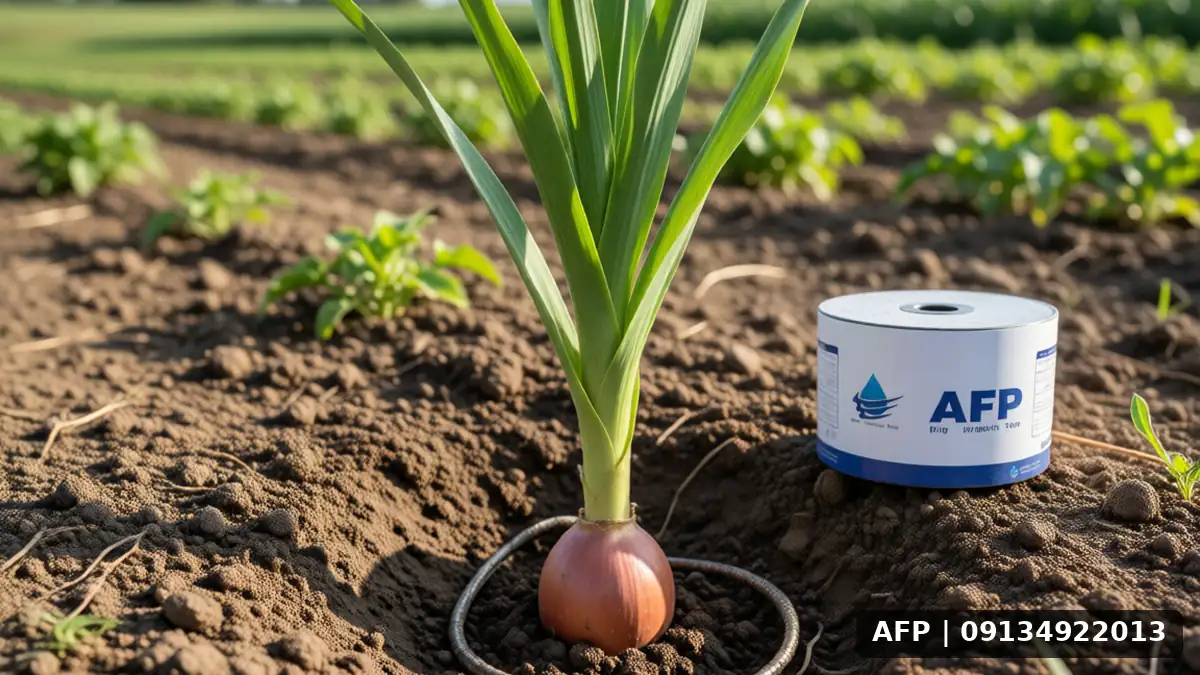
To ensure yield stability in consecutive years, it is essential to review methods for extending the useful life of drip tapes and maintaining network hygiene (filter washing and acid addition). Mineral deposition in tape emitters is a hidden enemy of subsurface systems. Since access to buried tapes is difficult, preventive maintenance is critical. Regular washing with acidic water adjusts soil and water pH and prevents clogging. This process protects the initial investment in equipment.
Frequently Asked Questions (FAQ)
Does subsurface irrigation damage onion green seedlings?
No, provided that the burial depth of the tape is above the onion seed level and the tape is not placed directly under the seed. This prevents seed rot and seedling damping-off. A vertical distance of 10 to 15 cm is safe. Maintaining this distance preserves relative soil freezing potential and prevents the formation of a heterogeneous moisture layer in the seed zone.
What is the initial cost difference between the subsurface system and surface drip?
The cost of tube tape is similar to surface drip; however, in the subsurface system, labor costs and physical tape wear are reduced because there is no need to collect and tie tapes at the end of the season. This advantage leads to return on investment within 2 to 3 years after planting. Reduced physical wear means an extended useful life of the equipment, which is highly significant in major planting cost analysis.
Is it permitted in intercropping of onion seedlings with other crops?
Yes, by adjusting the drip spacing, it can be combined with other growing commodities. For a more precise calculation of planting density, you can refer to the amount of carrot seed per hectare and other similar crops so that the network design is based on combined water requirements. This approach manages complex intercropping systems and prevents unlimited root competition.
Conclusion and future outlook
The use of subsurface irrigation for chivesis a smart investment for modern farmers seeking to increase yield per unit area. By adhering to band depth calibration principles and precise irrigation scheduling, water can be conserved while reducing bulbar fungal damage. It is recommended to consult a water engineer before starting work and to use standard equipment. Additionally, familiarizing yourself with maintenance principles, such as drip irrigation for squash can help you understand the lifecycle of buried and surface driplines. This cross-reference demonstrates that maintenance principles, regardless of the crop type, focus on the pipe structure of the drip line.
Related topics: To learn about planting principles and water requirements for orchard crops that can utilize buried driplines with similar systems, read the article Green bean seed rate per hectare + planting guide Recommended. This section provides a better understanding of the interaction between planting density and water flow distribution.