Rainfed Onion Cultivation: Challenges and Drip and Strip Tape Irrigation Solutions
Introduction: Revisiting Classical Onion Sprout Irrigation Methods
Due to its high sensitivity to water stress and its small root system, green onion has always been one of the most challenging vegetables in water and soil management. For years, rain irrigation (Rain Irrigation) using low-altitude sprinklers has been the dominant method in many gardens and small farms. This method has become established due to its natural appearance similar to rainfall and relatively low initial cost. However, with rising water prices, increased costs of chemical inputs, and global competition, farmers growing high-value commodities like green onion are seeking methods that reduce resource consumption while increasing yield.
In this section of the article, we intend to candidly dissect the layers of problems associated with rain irrigation in green onion cultivation. This is because many farmers believe that although this method is inexpensive, it carries significant hidden long-term costs, such as fungal diseases, high evaporation, and uneven moisture distribution.
Technical and Operational Challenges of Rain Irrigation in Green Onion
Green onion is a plant whose roots are predominantly located in the silt layer or shallow soil (up to a depth of 20 to 30 centimeters). This anatomical characteristic turns rain irrigation into an engineering challenge. We address the most important challenges below:
1. Proliferation of Fungal Diseases and Fusarium Wilt
- Common mistake: Many farmers believe that wetting the greens is beneficial. However, continuous moisture on chive leaves, especially in the late afternoon, creates an ideal breeding ground for the spores of Fusarium and Botrytis fungi.
- Consequences: Rainfall irrigation at inappropriate times drastically increases the plant infection rate, leading to a 20 to 40 percent yield loss in the final growth stages.
2. Evaporation and wind
Support for sprinkler systems that use small-diameter irrigation components requires stable wind conditions. In windy areas, water spray in fine droplets is carried out of the farm area by wind speed or lands irregularly on leaves. This phenomenon, known as ‘drift,’ can damage chive skin and cause black spots on the produce. Consequently, the system’s efficiency coefficient is significantly reduced.
3. Uneven soil moisture distribution
Sprinkler heads do not necessarily have equal spacing. Points closer to the water source receive more moisture due to higher pressure. This phenomenon is exacerbated on sloped fields where chives are grown. The result is that part of the field remains dry while another part becomes waterlogged. This causes tension stress and uneven growth.
Comparing Sprinkler Irrigation with Drip and Tape Systems
For a deeper understanding of this issue, we compare drip and tape (furrow) irrigation with the sprinkler method. In high-density, precision crops like green onions, our primary objective is to precisely manage moisture in the ‘fiber root’ zone, rather than wetting the foliage.
Advantages of Drip and Tape Irrigation for Green Onions
- Increased Efficiency: By concentrating water delivery in the root zone, water consumption is reduced compared to the sprinkler method. This directly affects increasing the yield and profitability of onions positively, although green onions are a vegetable and a secondary crop.
- Reducing Transpiration and Diseases: Because the soil does not become wet, the leaf surface remains dry, and root temperature is more stable. This feature helps reduce the use of fungal and chemical pesticides.
- Fertigation Management: In drip systems, precise fertilizer injection systems can be used. This capability helps deliver nutrients directly to the roots and minimizes nitrate leaching.
Practical Tips for Transitioning to Modern Irrigation Systems
If you decide to move away from sprinkler irrigation and adopt drip or tape irrigation, consider these practical tips:
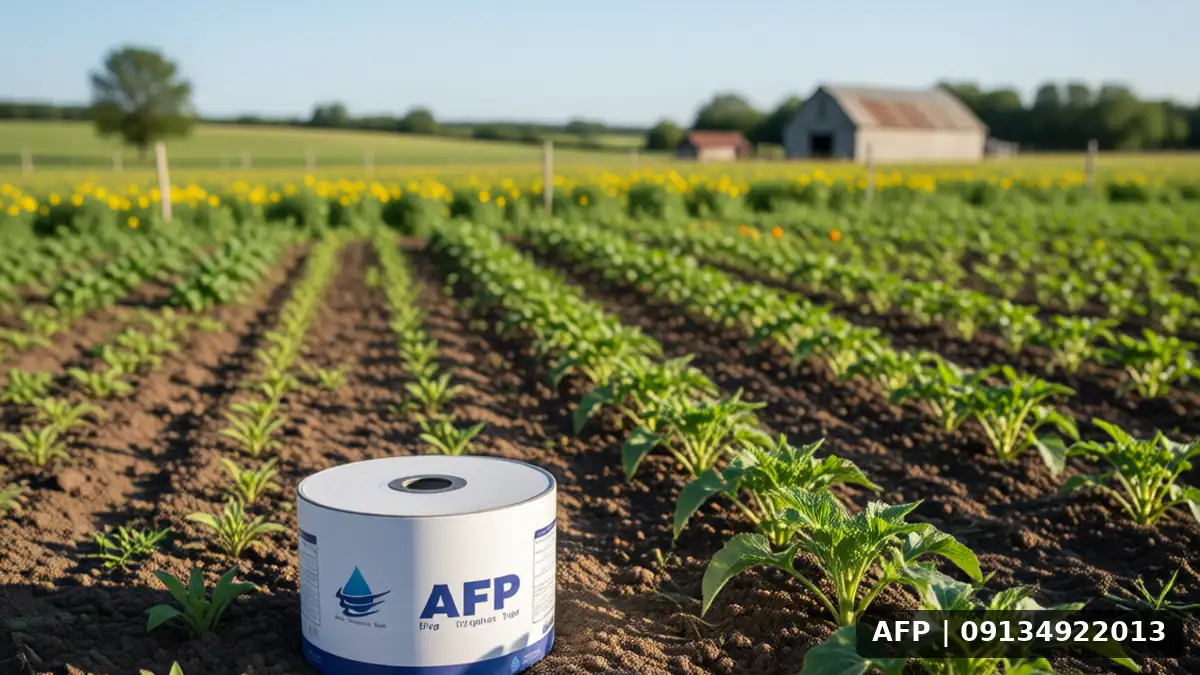
- Installing Tape Irrigation: For green onions, since the roots are close to the soil surface, the tape system works much more logically than an overhead drip system. The tape should be no more than 10 to 15 cm away from the planting line and the plant. This distance must be adjusted over time to accommodate the vertical growth of the plant.
- Selecting Dripper Diameter: Green onion is a small plant. Use drippers with low flow rates (for example, 2 liters per hour) to prevent waterlogging. Waterlogging causes root layering and reduces yield.
- Spacing Distribution: In a drip system, the spacing between drippers should be less than 10 to 15 cm. For green onions, considering the planting distance, a dripper spacing of 10 to 15 cm is the best option.
Similarly, similar principles can be applied to other root vegetables. For example, the yield of watercress per hectare is also affected by irrigation depth and precision. Although watercress is a larger plant, the principle of managing moisture for root development is well applied to it. For field crops and orchards as well, familiarity with the yield of soybeans per hectare and other crops provides a general view of water management in sequential cropping. For example, in other vegetable crops such as tomatoes, knowledge of Tomato seed per hectare It is essential for planning planting density and, consequently, the irrigation dose.
Frequently Asked Questions (FAQ)
Is it possible to convert a drip system to a sprinkler system mid-season?
Yes, if the field is equipped with a drip line, temporary sprinklers can be used at the end of the line. However, the use of drip tape is recommended because the cost of installing sprinklers is significantly higher than drip tape in high-density, thickly planted fields.
Is drip irrigation effective for young onions in heavy soils (clay)?
In heavy soils, permeability is low. However, drip tape, if operated with high precision and lower flow rates, can achieve higher efficiency than sprinkler irrigation even in clay soils, as it prevents deep waterlogging and targets surface roots.
What is the best time for drip irrigation of green onions?
The optimal time is early morning (between 5:00 and 8:00 AM) or late evening (after sunset). During these intervals, evaporation is minimized, and soil temperature is maintained at an appropriate level.
Conclusion and Final Recommendation
Green onion irrigation management is a precision art on a small scale. While sprinkler irrigation is a familiar traditional method, due to water wastage, the risk of fungal diseases, and management difficulties on uneven terrain, it is no longer the first choice for high-volume commercial crops requiring high efficiency.
The fastest way to achieve high profitability and reduce water consumption is the transition to smart drip or tape systems. These systems, by precisely controlling soil and root temperature, directly impact the quality and weight of each green onion plant. If you are looking to increase your efficiency, by studying other resources such as Tarragon yield per hectare and influencing factors, you can implement similar principles in other vegetable crops and create an integrated water management system across all your farms.
Investing in modern irrigation infrastructure is an investment in a sustainable and profitable future for your farms.