Irrigating Fruit Orchards in Lettuce Cropping: Challenges and Practical Solutions
Introduction to Irrigation Challenges in Lettuce and Fruit Orchard Cultivation
In modern agriculture, one of the most critical factors affecting crop yield and quality is water resource management. Lettuce, as a moisture-sensitive crop, requires precise timing and volume in irrigation. Simultaneously, the presence of fruit trees in adjacent areas or within integrated cropping systems introduces new complexities to irrigation management. These trees typically possess deep root systems and distinct water requirements that can disrupt soil moisture balance for lettuce, which is concentrated in the upper soil zone. Understanding these interactions precisely is the first step toward utilizing drip and tape-line irrigation systems.
Modern irrigation systems, such as drip irrigation, deliver water to the root zone with minimal evaporation and waste. However, when soil texture is non-uniform or fruit tree roots intermingle with lettuce roots, achieving even water distribution becomes difficult. The following section examines the technical details of these challenges and practical solutions.
Impact of Drip Irrigation Systems on Lettuce Growth Adjacent to Trees
Due to stable moisture distribution, drip irrigation is considered an ideal option for lettuce. However, when this system is used in fields where fruit trees are present, special attention must be paid to tree root patterns. Fruit tree roots tend to spread laterally and can compete with lettuce roots in the mid-soil layers. In such cases, if the spacing between emitters is uniform, soil sections near tree roots may remain dry or, conversely, become oversaturated, leading to lettuce base rot.
Establishing a Healthy Root Zone Pattern in the Soil
- Determining appropriate spacing: The spacing between emitters must be adjusted based on the penetration depth of tree roots to ensure water remains concentrated at the desired depth for lettuce.
- Use of appropriate filters: The presence of tree roots can lead to increased intrusion of suspended particles. Using disc or screen filters is essential to prevent clogging of the drip emitters.
- Monitoring fertigation pressure: If you use combined irrigation and fertilization (fertigation), you must ensure that the fertilizer concentration does not exceed the tolerance threshold of the sensitive lettuce roots compared to the trees.
To better understand nutrient and planting requirements, reviewing lettuce seed quantity per hectare and planting guidelines can help align plant density with the irrigation system. High lettuce density without adjusting drip emitter flow rates can create water channels in the soil that hinder water uptake for the trees.
Challenges of using ribbon drip in intercropping
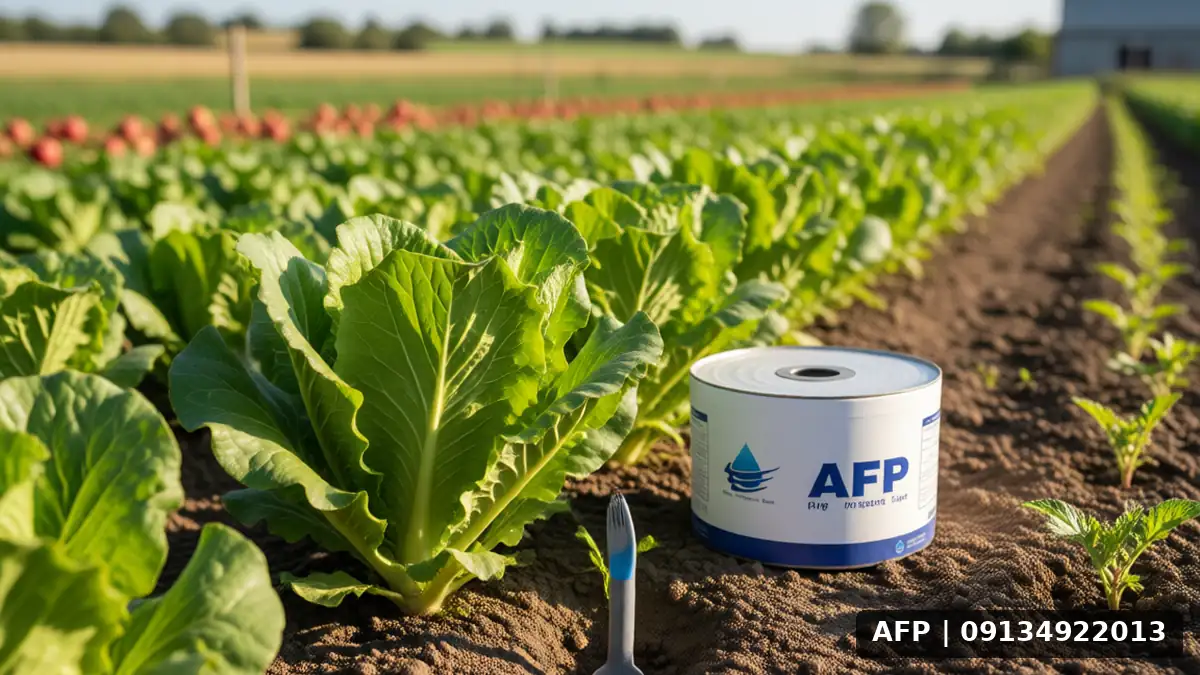
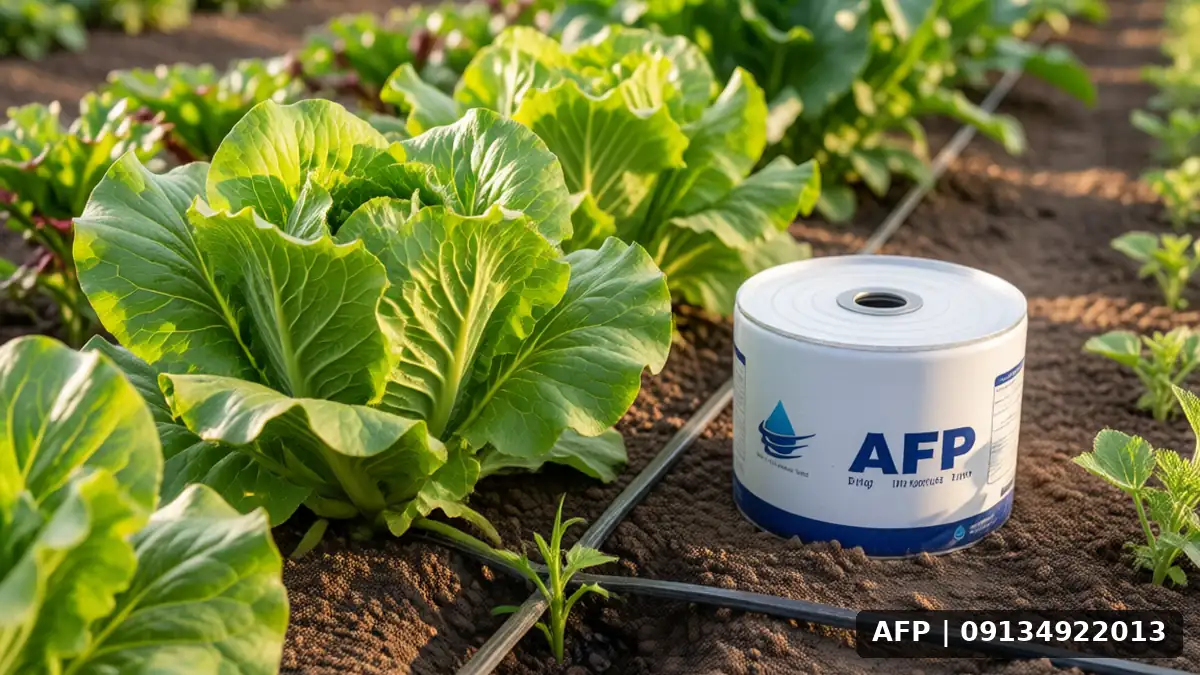
Ribbon Drip is an efficient method for crops with close planting spacing, such as lettuce. Ribbon drips typically range from 12 to 30 meters in length and are laid along lettuce rows. The main challenge in orchards with fruit trees is the ribbon passing through the tree root zone. If the ribbon is placed directly in the path of the vertical tree roots, accumulated salts around the ribbon can damage the tree roots, or conversely, direct salts toward the lettuce roots.
Additionally, the stability of the drip tape against wind and soil surface movement is important. In fields with loose soil, the drip tape may shift from its position, disrupting the wet-dry soil pattern. To prevent this issue, the use of specific clamps or protective underlays can be helpful. Understanding the section length of drip tape based on soil type and land slope is the key to the stability of this system.
Managing salinity and moisture at different depths
- Separation of main lines: It is preferable that the main lines for lettuce drip tape and orchard fruit tree irrigation systems be designed separately to allow for adjustable pressure and irrigation scheduling.
- Use of moisture sensors: Installing moisture sensors at the root depth of lettuce and the root depth of trees helps farmers prevent interference between the two moisture layers.
Practical tips for optimizing water use
It is not always logical to cover the entire farm with a single irrigation system. In mixed farms, it is possible to equip part of the drip system for lettuce and another part for trees with a nano irrigation system. This separation helps improve water efficiency. Additionally, choosing appropriate pipe materials plays an important role. Using industrial-grade PVC pipes or polyethylene materials increases resistance to UV radiation. To learn about various options, studying the guide for purchasing Layflat pipes and key considerations can be effective in selecting suitable equipment for each section of the farm.
Another consideration is the periodic calibration of drippers. Sediment deposition, which is more common in sandy soils, can clog the tape line. Backflushing the system before each irrigation season helps prevent severe clogging.
Frequently Asked Questions (FAQ)
Can tape line be used for fruit trees?
Yes, but with caution. Tape line is generally designed for crops with short planting spacing. For trees, it is recommended to use separate systems with larger-diameter outlets (such as 16 or 20 mm) to meet their high water demands.
What is the best time to irrigate lettuce near trees?
Early morning hours are best. This timing reduces surface evaporation and keeps moisture available to lettuce roots without creating prolonged wet conditions that favor root fungi.
What is the effect of land slope on the distribution of water from tape line?
On steep slopes, water tends to pool at the bottom of the drip line. To compensate for this, the drip pressure at the top and bottom of the line must be adjusted, or low-gradient pipes should be used.
Summary and conclusion
Irrigation in mixed cropping of lettuce and orchards requires a precise and dynamic approach. The main challenge is preventing root interference and managing moisture at different depths. Drip and drip tape systems are powerful tools, provided they are calibrated according to the local climate and soil type. Given the importance of proper nutrition alongside irrigation, consulting specialized resources such as Lotus seed rate per hectare for adjacent grain fields can be helpful. Although lettuce is a leafy vegetable, a general understanding of seed density and water requirements provides a better perspective on farm management.
Ultimately, continuous monitoring and recording of soil moisture data is the best way to increase yield and reduce environmental stress on plants. Combining technical irrigation knowledge with local experience is the key to success in these shared challenges.
Related articles: forage corn yield per hectare guide, Common bean seed rate per hectare + influencing factors, Wheat strip spacing time machine quantity