Fruit Orchard Irrigation in Allium Cultivation: A Comprehensive Guide
Introduction: The Importance of Integrated Water Management in Orchards
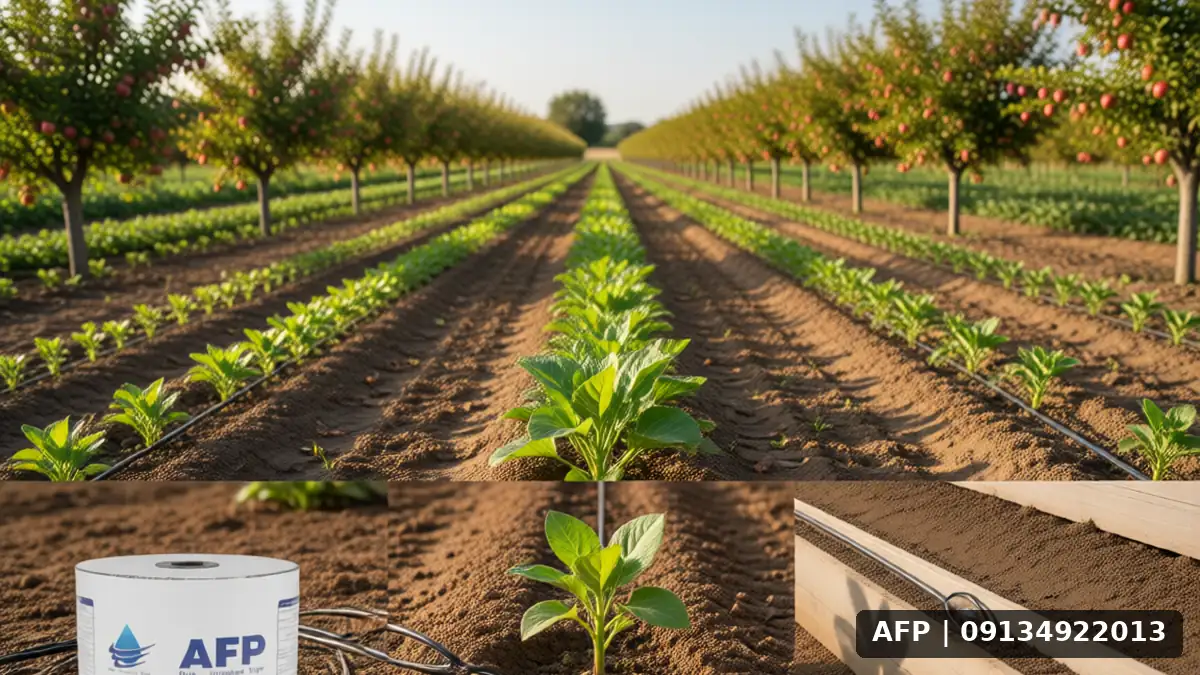
Modern agriculture requires a delicate balance; a balance between the economic productivity of fruit trees and the production of short-cycle leafy crops. In many orchards in Iran, utilizing the space between trees for planting vegetables and leafy greens (Intercropping) is a method that not only increases annual income but also prevents soil compaction. However, the main challenge is water management . Fruit trees require deep root establishment and stable moisture, while leafy crop cultivation requires frequent and superficial irrigation. Lack of coordination in the agricultural irrigation system can lead to stress in both sections. In this guide, the focus is on using modern ribbon and drip technologies so that you can have healthy and abundant leafy crops without damaging the tree roots.
Ribbon Technology in Fruit Orchards: Why It Is the First Choice?
Unlike drip irrigation, which is usually used for mature trees, ribbon systems (Ribbon) are an excellent alternative for growing young trees and creating irrigation channels between rows. This system controls penetration depth by spraying high-pressure water onto the soil surface. For leafy crop cultivation in narrow strips, ribbon systems have the capability to create localized moisture that is focused exactly in the root zone of leafy plants, without causing waterlogging at the base of the tree buds. This prevents root rot in trees. To adjust the appropriate ribbon pressure, which directly affects the water distribution range for leafy crops, you can refer to water pressure measurement for ribbons to optimize the pressure for your orchard’s conditions.
The Role of Drip Irrigation in Managing Tree Moisture
In orchards where trees have reached maturity and vegetable spacing is limited, a combination of trickle lines (for vegetables) and drip systems (for trees) is the most optimal configuration. Drip emitters must be installed on trees with appropriate flow rates to allow water to penetrate the soil slowly and deeply. This slow infiltration helps ensure that tree roots, which seek deeper nutrients, remain hydrated, while vegetables with shallow root systems benefit from the moisture provided by the trickle lines.
Practical Guide: Implementing Vegetable and Fruit Irrigation Systems
Step 1: Pressure and Flow Rate Balancing
- Determining Vegetable Flow Rate: Vegetable plants such as cucumbers and pumpkins require frequent watering (every 2 to 3 days). In hot seasons, the trickle line flow rate must be adjusted so that 30 to 50 cubic meters of water are consumed per hectare per irrigation cycle.
- Calculating for Trees: Orange and apple trees require more water but with fewer applications (every 5 to 7 days). If you use a shared line, you must use separate faucets to control the pressure for the vegetable zone and the tree zone.
Step 2: Selecting connectors and spacing
- The distance between drip tapes must not exceed 1.5 meters to ensure uniform moisture coverage.
- It is best for the drip tapes to be placed exactly under the tree’s root spread or 50 centimeters away from it to prevent damage from deep plowing when planting vegetables.
- Using flexible hoses (Mouzing) or high-pressure elbow connectors helps prevent damage to the system in case of breakage or displacement.
For large-scale vegetable farming, a deep understanding of planting density is essential. For example, in cucumber cultivation, proper seed spacing prevents water and nutrient waste. You can learn more by studying Cucumber seed rate per hectare and the carrot seed rate per hectare, calculate the required space per square meter more precisely and adjust the number of drip tape rows accordingly. This ensures that the water consumption is exactly proportional to the plant population and prevents root stress.
Key points for preventing root stress
Adjusting water supply based on growth stage
One golden principle in irrigating fruit orchards intercropped with vegetables is changing water flow rate . During the establishment stage of vegetables, water supply should be short but frequent to promote rapid rooting. However, as fruit trees approach the fruit formation stage, the water supply to trees must increase to ensure proper fruit development. If only vegetables are considered, tree fruit quality will decline; if only trees are considered, vegetables will dry out and wither. Precise regulation of system pressure and flow rate is fundamental to this balance.
Using appropriate leaching solutions
The drip line system requires proper drainage at the end of the line to prevent nitrate and salt accumulation in the vegetable area. For orchards on slopes, the drip line should be installed in a loop to ensure equal pressure at the beginning and end of the line.
Frequently Asked Questions (FAQ)
Does drip irrigation cause tree root rot?
No. If the drip line is placed exactly within the tree’s drip line and at the standard distance from the trunk (minimum 30 to 40 centimeters) and its flow rate is not excessively high, it prevents main root rot. The localized leakage from drip irrigation is usually superficial, and with good soil drainage, it prevents the tree’s roots from remaining waterlogged.
When is the best time to plant vegetables alongside trees?
Depending on the vegetable type, generally after the main crop harvest or during off-season periods. However, regarding irrigation, it is better to have a separate water delivery plan from the time of vegetable planting. For information on planting other crops, also review comprehensive guides such as green bean seed quantity.
How can I reduce high water consumption in drip irrigation?
Using narrower strips (e.g., 10 mm) instead of 15 mm strips can reduce consumption, provided that water pressure is sufficient. Additionally, applying mulch (such as straw or wood chips) in vegetable areas can reduce evaporation by up to 30% and eliminate the need to increase irrigation duration.
Conclusion
Using modern irrigation systems such as drip tape in fruit orchards intercropped with vegetables is not just a technical choice but an economic necessity. By adhering to principles of correct pressure, flow rate, and spacing, you can maximize soil capacity. The key to success is continuous monitoring and adaptability to climatic conditions. Remember that any change in density of vegetable planting directly affects the tree irrigation system. By ensuring integrated resource management, you can cultivate globally competitive, high-quality produce at a desirable economic scale in your orchard. For further reading on other specialized topics such as Quinoa seed rate per hectare or other crops, please refer to the specialized sections of the drip irrigation website.
Related articles: Measuring water pressure for drip tape, Ideal wall thickness of the drip irrigation line type