AFPTI Strip Spacing in Wheat Cultivation: Recommended Standards
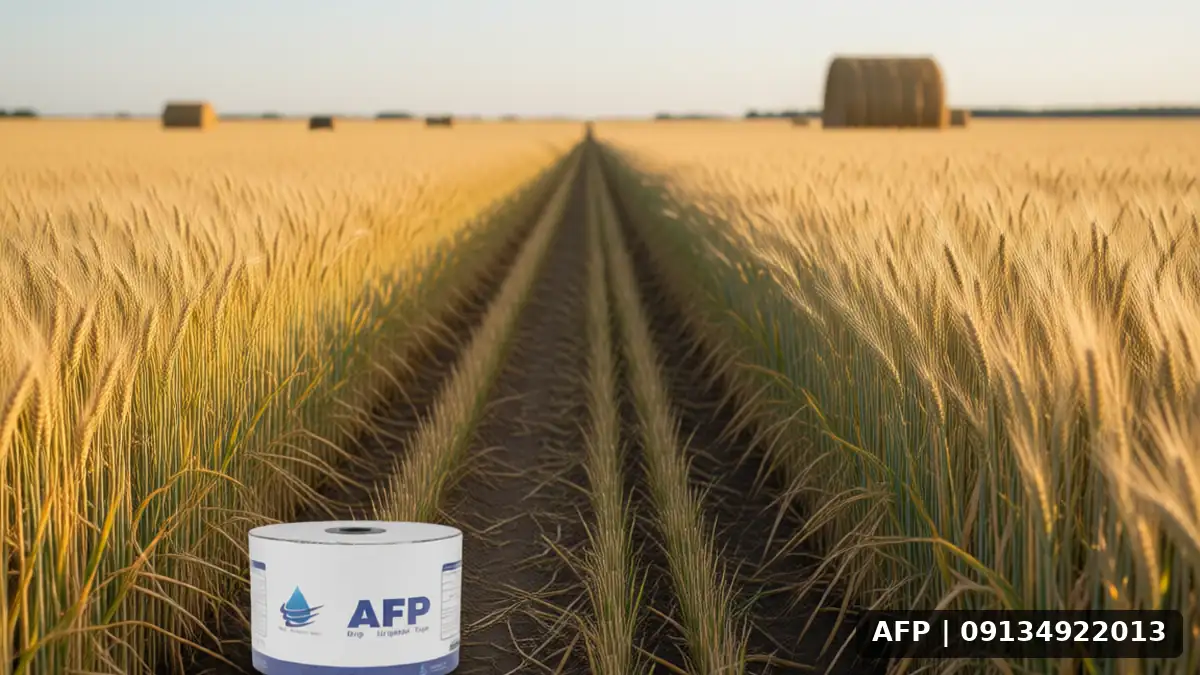
Introduction: The Importance of Optimizing Drip Tape Spacing in Wheat
In recent years, the transition from conventional flood irrigation to pressurized irrigation, specifically Drip Tape systems, has fundamentally transformed the management of agricultural water resources. For cereal crops like wheat, the correct selection of Drip Tape Spacing in Wheat not only directly impacts initial investment costs but is also a determining factor in the uniform distribution of moisture in the root zone. Wheat, being a crop with a vigorous root system and relatively limited horizontal spread, requires high precision in the layout of irrigation components to prevent water stress and achieve maximum yield.
In this regard, understanding the relationship between row spacing, tape diameter, and flow rate is essential for every farm manager. Adhering to recommended standards ensures that the minimum water volume is used to achieve maximum root coverage within the active root zone. Below, we examine the key parameters based on precise planting and irrigation principles.
Additionally, studying Recommended Row Spacing Standards for Sugar Beet can provide a better understanding of the differences between row and seed crops in selecting irrigation equipment.
Technical principles for determining drip tape spacing in wheat
Impact of planting layout on spacing selection
The most critical factor in determining drip tape spacing in wheat, sowing pattern, and furrow spacing. In modern wheat cultivation methods, furrows are typically sown at intervals of 15 to 20 cm, or occasionally up to 30 cm. In drip tape systems, placing the tape exactly in the center between two furrows (inter-furrow) or alongside the furrow are two common approaches. If the furrow spacing is 15 cm, it is generally not recommended to place one drip tape for every two furrows; rather, the tape spacing must be such that their wetting patterns overlap.
Calculating the soil wetting pattern
The wetting pattern refers to the diameter of the circular area into which moisture penetrates from the drip tape to a specific distance in the soil. This pattern depends on three main factors: soil type (fine-textured or coarse-textured), emitter discharge rate, and irrigation duration. For wheat, which has high sensitivity to drought stress during growth stages, the soil in the center between two drip tapes should not be allowed to dry out completely. Therefore, the tape spacing must not exceed the sum of the wetting radii of two adjacent tapes. In loamy and clay soils where water infiltration is more vertical than horizontal, the tape spacing should be less than the theoretical limit to maintain root zone coverage at depth.
Recommended Standards for Spacing Between Drip Lines
Based on field experience and agronomic research, for crops with furrow spacing of 15 to 20 centimeters, using drip lines spaced 50 to 70 centimeters apart (in consecutive rows) is generally more efficient than spacings of 100 to 120 centimeters, unless the root system is very shallow. If furrows of 25 to 30 centimeters are used, a 1-meter spacing between drip lines can be standard. This decision must also align with the type of drip line (porous or non-porous); non-porous lines (Porosity) provide more uniform distribution and can be used at slightly larger spacings.
Practical Tips for Installing and Managing Drip Lines in Wheat Fields
Drip Line Burial Depth and Protection Against Damage
One of the main challenges in wheat is the plant’s deep rooting and the activity of small particles in the soil. To increase the lifespan of the equipment, the drip line must be installed at a depth that is below the primary seed rooting depth yet close enough for the roots to access it. A depth of 10 to 15 centimeters is usually the optimal balance point for wheat. Also, in fields where thatch layering (Lawn) is common, using Methods for Increasing Efficiency and Protecting Drip Lines can prevent clogging of the drip line’s holes by sedimentation.
System Pressure Regulation and Output Uniformity
Throughout the field, pressure drop causes the output flow rate of drippers at the beginning of the field to differ from that at the end. This leads to a difference in the wetted zone and, consequently, uneven moisture in the wheat. For wheat, which is a pruned crop, moisture heterogeneity can cause irregular flowering and a reduction in grain quality. It is recommended that the maximum pressure drop along the drip tape be less than 20% of the system’s atmospheric pressure. Using hydraulic calculators and selecting drippers with an appropriate output flow rate for the main pipe diameter prevents this problem. In this regard, awareness of drip tape clog removal and repair techniques is essential for annual maintenance.
Fertigation management with drip tape
Wheat is a high nitrogen input consumer. Combining drip tape with precision fertigation ensures that nutrients are placed exactly within the plant’s root zone, increasing their uptake. Drip tape spacing in wheat must be such that the roots are located in the path of water and nutrient flow. If the spacing is excessively large, part of the crop ends up in moisture ‘dead zones,’ reducing fertigation efficiency. This method can be similar to the standards of the comprehensive drip tape irrigation guide for onions where simultaneous management of water and fertilizer is key.

Comparison with other grain crops
To better understand the position of wheat, we can reference other crops. While row spacing is clearly defined in sugar beet cultivation, wheat is sown with a more continuous seed distribution. Therefore, the drip line spacing for wheat should focus on root zones. In contrast, crops such as Chickpeas Which have deeper root systems may require different depth settings. Wheat, due to its shallower roots, is more sensitive to fluctuations in surface moisture, making drip lines the best option for controlling this.
Frequently Asked Questions about Drip Line Spacing in Wheat
Does drip line spacing in wheat vary by soil type?
Yes, it varies significantly. In sandy and light soils, water infiltration is faster and more horizontal, so the spacing between lines can be slightly wider (e.g., up to 1.5 meters). However, in clay and heavy soils where infiltration is slower and more vertical, the spacing between lines should be narrower (e.g., 50 to 60 centimeters) to prevent dry zones between the lines. Always perform a soil infiltration test before determining the final spacing.
What is the impact of drip line spacing in wheat on installation cost?
The smaller the spacing between tape lines, the greater the number of lines per hectare, which increases the cost of drip tape. However, on the other hand, water and pump energy consumption can be optimized, and the risk of drought stress is reduced. There is an economic break-even point where, in semi-arid climates, a spacing of 70 to 100 centimeters typically provides the best balance between cost and yield. In rain-fed regions, wider spacings are more acceptable.
Is it possible to relocate drip tape in wheat fields?
Yes, mobile (relocatable) drip tapes are very common in wheat. These tapes are collected before harvest and reinstalled for the next season. In this case, maintaining consistent drip tape spacing across seasons is of paramount importance, as minor variations can affect plant growth patterns. The use of guide rails or GPS-based planting systems can increase accuracy.
When should two drip tapes be used in a single row of wheat?
If the wheat furrow spacing is very wide (more than 40 centimeters) and you intend to irrigate deeper roots as well, you can place two tapes closer together (for example, 20 centimeters) near the furrow to improve vertical and horizontal moisture coverage. However, in standard wheat cultivation with 15-20 centimeter furrow spacing, one tape between the furrows is sufficient.
What is the impact of this method on wheat yield compared to rainfed irrigation?
Research shows that drip strip irrigation at optimal spacing can achieve yield equal to or greater than rainfed irrigation while reducing water consumption by 20 to 30 percent. This is due to reduced water evaporation and deep leakage. Additionally, uniform wheat growth leads to increased resistance to lodging, as plants grow in an environment with stable moisture.
Summary and final recommendations
Appropriate selection Strip spacing for wheat This is a multi-variable process that requires knowledge of soil, climate, and planting system type. There is no fixed number for all farms, but a range of 50 to 100 centimeters can be used as a logical starting point for most conditions. It is recommended to start with a narrower spacing in the first season and adjust settings based on observed soil drying patterns at field mid-life.
Ultimately, combining drip strips with proper fertilization management and equipment maintenance is the key to achieving high-quality wheat and desirable water-use efficiency. Attention to system pressure and installation accuracy is just as important as choosing strip spacing. To expand your knowledge in irrigation engineering, studying Drip Irrigation: Characteristics and Disadvantages can also strengthen your critical perspective on other methods and make your final decision more solid.