Center Pivot Irrigation for Saffron Cultivation: Key Benefits
Introduction: Why Is Central Irrigation Important for Saffron?
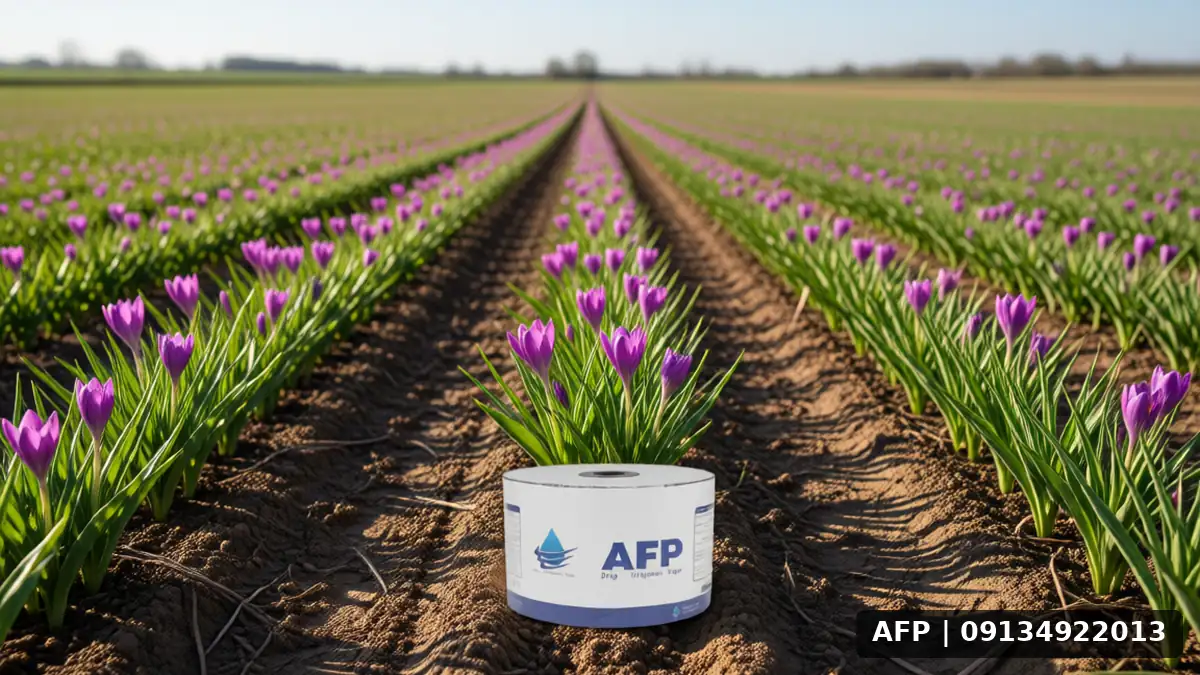
Saffron is one of Iran’s most valuable export commodities, requiring precise water resource management and crop care. In the dry and semi-arid climates of many saffron-growing regions, adopting optimized irrigation methods is of particular importance. Central Irrigation As a subset of pressurized irrigation, this method provides precise and controlled water delivery at the plant’s root zone. By modifying common systems, it ensures water is delivered directly to the root zone, reducing surface evaporation.
In this article, we focus on saffron cultivation to examine the key benefits of central irrigation. We address not only the technical aspects but also provide practical implementation strategies, enabling farmers to increase farm efficiency with minimal risk.
Operating Principles of Central Irrigation in Saffron Farms
Differences from Drip and Tape Irrigation
Central irrigation generally refers to systems that deliver water under logical pressure from a central source or main pipe to specific points at the plant’s root distance. Compared to Yield management in other vegetables, irrigation management in saffron requires higher precision. Saffron plants are highly sensitive to root scorch and waterlogging. Radial irrigation, by dividing the farm into smaller sections, allows for better control of pressure and flow rate.
One of the key advantages of this method is flexibility in adjusting water volume. Unlike drip lines, which operate linearly, radial irrigation can be applied from multiple directions or in variable patterns around saffron plants. This feature is critical for fields with varying topography. By using pressure-regulating valves (PRVs) at radial points, pressure drop caused by long pipe runs can be compensated for, ensuring uniform irrigation.
Impact on water infiltration depth and root establishment
Saffron is a plant with a relatively deep root system (roots can reach depths of 40 cm or more). Radial irrigation, by delivering small but frequent volumes of water, promotes deeper moisture penetration. This is a significant advantage over surface irrigation, which only moistens a few centimeters of soil. By encouraging roots to grow deeper, the plant’s resilience to drought stress is increased.
Key advantages of radial irrigation in saffron fields
Significant reduction in water usage
The most significant advantage of center-pivot irrigation is water conservation. In Kerman and Fars provinces, where water scarcity is a critical issue, this method can reduce water consumption by up to 30 to 50% compared to flood irrigation. By minimizing evaporation and deep percolation into soil layers difficult for plant roots to access, the efficiency of every drop of water is increased.
Reduced weed growth
Surface soil moisture is a primary driver of weed growth. In center-pivot irrigation, the soil surface remains relatively dry while only the root zone is moist. This directly reduces the growth of competing weeds, the need for herbicides, and cultivation costs. This advantage, combined with Management of cover and border crops can improve farm operational space.
Salinity management and reduced fungal diseases
Saffron is highly sensitive to root and fungal diseases, which are exacerbated by high relative humidity. Center-pivot irrigation reduces foliar and surface soil moisture, creating an environment unfavorable for the proliferation of these fungi. This is particularly important in the weeks following flower harvest, when the plant is recovering.
Practical points for implementing and installing a sub-surface drip irrigation system
System design and component selection
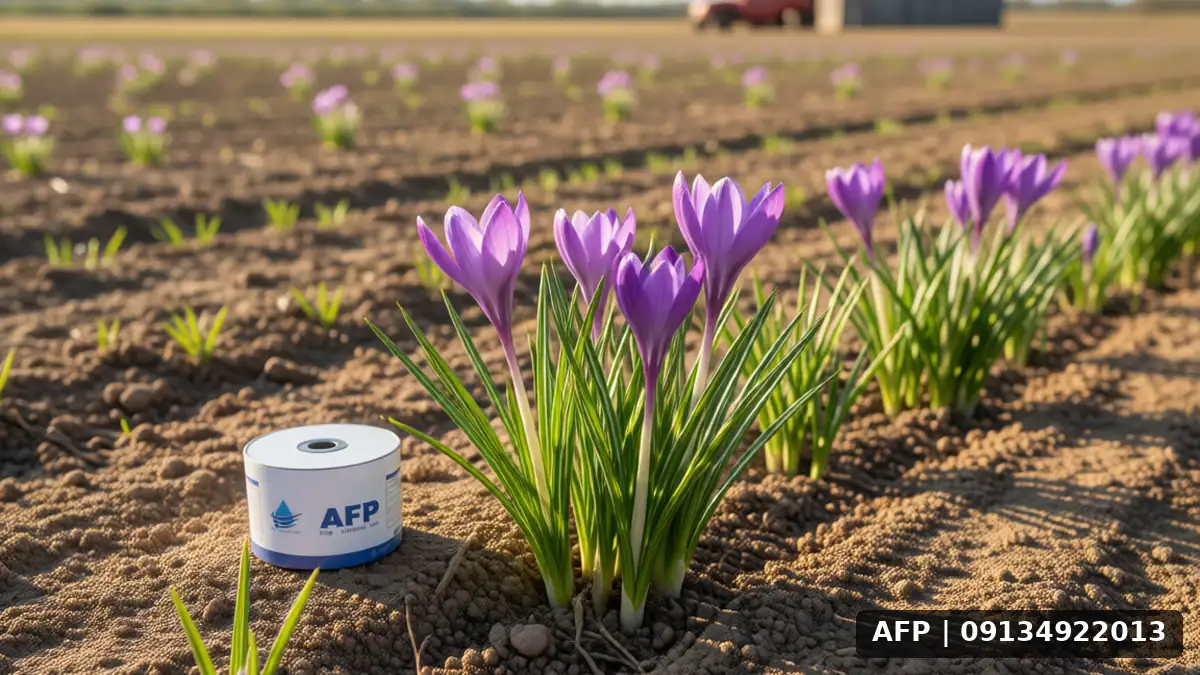
- Determining emitter spacing: For saffron, a distance of 30 to 40 centimeters from the center of the plant is usually suitable for placing the sub-surface drip emitters. This distance should be adjusted based on soil type (clay, sandy, or loamy).
- Selecting pipe diameter: Using polyethylene (PE) sub-surface drip emitters with standard wall thickness for pressure resistance and UV protection is essential. In this regard, you can refer to the installation guide for water delivery pipes of type as a basic reference and adapt its calculation formulas to the sub-surface drip system.
- Precision filtration: Saffron is sensitive to clogging of irrigation diaphragms. You must use a disc or mesh filter with an appropriate mesh size (in the range of 120-200 mesh).
Irrigation scheduling based on growth stage
It is not only about how you irrigate, but also when and How much watering is required. Saffron has different water needs during the patu growth stage (after winter dormancy) and before bulb flower bud formation. In cold seasons, central pivot irrigation must be adjusted for water temperature and irrigation timing to prevent thermal shock to the roots.
Another key point is system integrity. Ensure secure connections of pivot joints and the use of standard fitting connections. Minor leaks at pivot points can lead to localized root rot. If technical details need to be reviewed, study tipe strip yield modeling can review similar hydraulic equations for pivot pipes.
Answering Frequently Asked Questions (FAQ)
Is pivot irrigation suitable for all saffron climates?
Yes, but its parameters must be localized. In very drier regions, you may need a higher volume and more frequent irrigation, while in wetter regions, less frequent irrigation with controlled volume is sufficient.
What is the initial cost of center pivot irrigation?
Costs vary depending on the field size and equipment quality. However, considering water savings and reduced long-term costs for pesticides and labor, the return on investment usually occurs within the next 2 to 3 seasons.
Is it possible to combine it with fertilization?
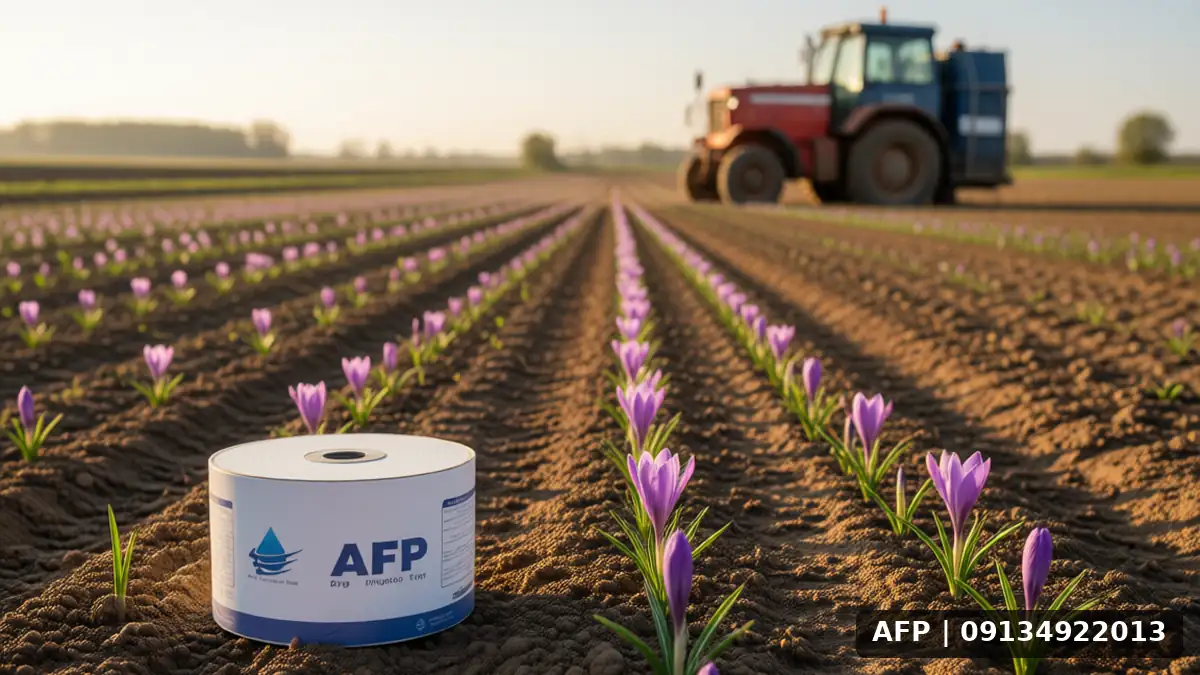
Yes, one of the major benefits of center pivot pressurized irrigation is the ability to fertigate. Liquid or soluble fertilizers can be delivered directly to the roots through the pivot lines, increasing their absorption.
Conclusion and path forward
Implementation Center pivot irrigation In saffron farms, this represents a significant step toward precise and sustainable agriculture. Although the installation phase may require higher technical knowledge and precision, the benefits—including water conservation, reduced plant stress, and improved bulb and flower quality—are highly noticeable. We recommend conducting a trial on a small section of the farm and calibrating pressure and flow parameters before full-scale installation.
For a better understanding of how precise management impacts final yield, studying related articles on factors affecting garlic harvest and other sensitive crops can provide a broader perspective on root zone management in micro-element cultivation. Ultimately, by combining center pivot irrigation with proper treatments, you will transform your saffron into a high-yield, sustainable crop.