Rainwater Harvesting and Runoff in Eggplant Cultivation: A Comprehensive Guide
Introduction: Why Is Surfacirrigation Important in Eggplant?
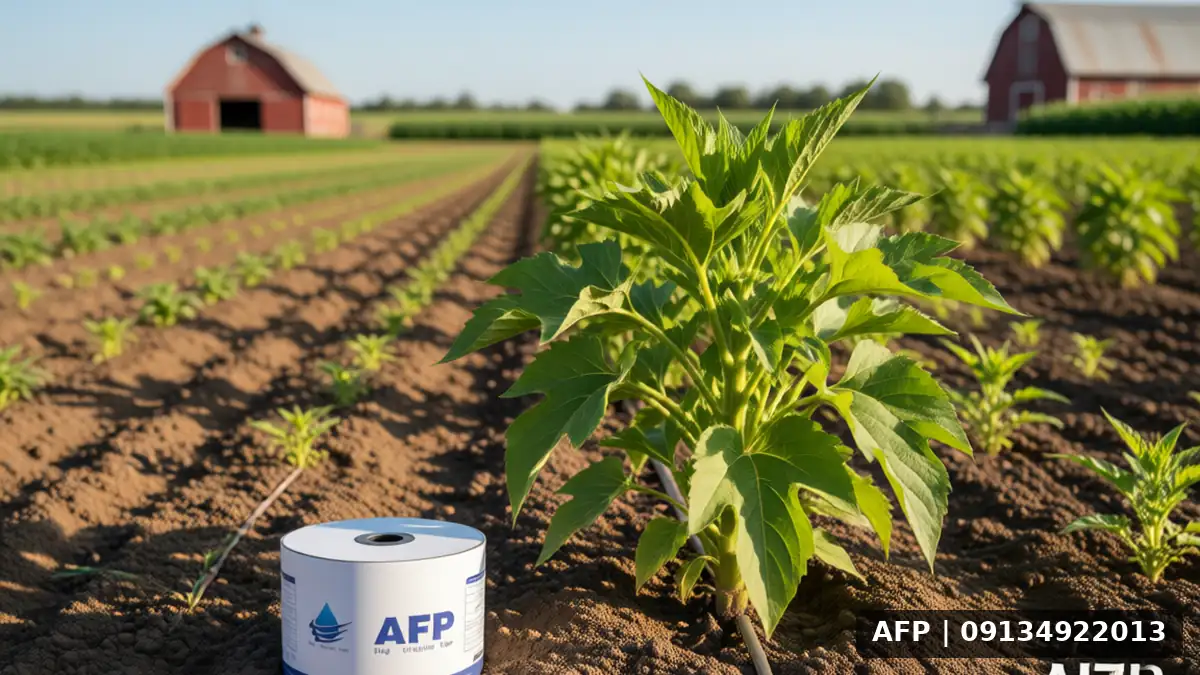
Eggplant is one of the most widely used garden and field crops that is highly sensitive to soil moisture conditions. In recent years, with rising water resource costs and increased operational expenses, selecting the appropriate irrigation method has become a critical challenge for farmers. Surfacirrigation As an old but still highly demanded method, it has maintained its position in many regions due to its high flexibility and relatively lower costs. In this article, we aim to examine this method and its implementation in eggplant cultivation in a specialized and practical manner, so that farmers can make better decisions with full awareness.
Technical Principles of Surfacirrigation
Surfacirrigation is a process in which water is delivered to the bed or planting strip via head gates, channels, or guide pipes, and is distributed evenly along the field by gravity and flow dynamics. In eggplant cultivation, planting lines are typically arranged on level beds, and water is introduced at the top of the bed. The key to success with this method is controlling the flow velocity of water to prevent soil erosion and uneven water collection. Eggplant is sensitive to deeper roots and stable moisture in the surface layer; therefore, precise adjustment of the water volume and inflow discharge rate is critical.
Advantages and limitations of the flush method in eggplant
- Lower initial cost: Compared to drip and tape systems, it does not require more complex infrastructure.
- Flexibility in implementation: It can be adjusted based on changes in field conditions and soil.
- Water use challenge: Higher water losses due to evaporation and uncontrolled deep percolation compared to drip.
- Salinity risk: Accumulation of food materials and salts at the end of the strip without proper management.
Comparison of wash irrigation with tip strip and drip
The farmer’s task is to determine which method is more economical for their specific conditions? While Rain irrigation with wash suitable for flat lands and soils with natural drainage, modern systems such as tip strip and drip offer higher precision in the distribution of water and food materials. If you are looking for a significant reduction in water consumption and increased yield, familiarizing yourself with the engineering principles of smart tip strips can broaden your perspective. In comparison, tip strips prevent surface evaporation due to direct connection to the root, and feed the eggplant seed directly with adequate moisture. However, wash irrigation remains an acceptable option in large fields with limited budgets, provided that the appropriate seed amount for the specific physiology is coordinated with wash cultivation conditions to reduce chemical stress on the plant.
Step-by-step guide for implementing wash irrigation of eggplant
Correct execution of wash irrigation requires precise planning. The following key practical points are provided to increase efficiency and reduce losses:
- Bed preparation: Eggplant beds should be constructed uniformly without significant depressions or slopes to ensure a consistent water flow. Bed height is typically recommended between 15 and 20 cm.
- Inlet grade adjustment: Use adjustable grades to synchronize the water inflow rate at the head of the border with the border length. The upstream section of the border receives more moisture than the downstream end; this difference must be compensated by adjusting irrigation timing.
- Drainage management: Bed boundaries must provide a path for excess water discharge. Water accumulation at the end of the border leads to eggplant root diseases.
- Irrigation scheduling: Conduct irrigation during the cool hours of the day (early morning or evening) to minimize damage from evaporation and eggplant leaf scald.
Optimizing water use in flush irrigation
One of the main criticisms of flush irrigation is water loss. To address this issue, integrated techniques can be employed. Using drip tape alongside traditional systems is a way to reduce water volume. Additionally, surface mulching of ridges with organic materials protects eggplant roots from drying out and reduces evaporation by 40 percent. This allows flush water to penetrate deeper and remain available to the roots instead of evaporating.
Impact of flush irrigation on eggplant quality
Eggplant quality is directly related to the irrigation pattern. Severe fluctuations in soil moisture, which often occur in flush irrigation, can lead to strip rot and fruit cracking. To maintain quality, it is recommended to use shorter irrigation strips to increase moisture uniformity along the entire strip. Furthermore, many producers are currently moving toward smart systems for more precise control over processes. Studying drip tape and smart engineering can be a good guide for understanding flow control algorithms that are even feasible in semi-mechanized flush systems.
Frequently Asked Questions (FAQ)
Is flush irrigation suitable for eggplant in sandy soils?
In sandy soils, water infiltration is fast and the risk of nutrient leaching increases. In this case, it is better to use smaller water volumes with more frequent irrigation. Where possible, combining flush irrigation with a drip system for root-zone feeding is recommended to prevent a decline in eggplant quality.
How often should eggplants be irrigated using wash irrigation?
The number of irrigations depends on the climate and season. Generally, 2 to 3 times a week is recommended in spring and 3 to 4 times in summer. However, the primary criterion is soil moisture. Using a moisture meter will allow you to make more precise decisions.
How can I prevent soil erosion with wash irrigation?
The flow velocity must be below the erosion threshold. Creating temporary dams at the end of the strips and using crop residue cover will prevent soil washing. Additionally, the correct application rate per hectare maintains soil and water balance.
Conclusion and Final Recommendations
Choosing between wash irrigation, drip, or furrow systems for eggplants is a decision based on budget, soil type, and economic goals. Wash irrigation remains a notable option for large farms looking to manage fixed costs, provided that its execution principles are adhered to. By combining traditional irrigation knowledge with modern tools, such as smart drip systems or furrow feeding, optimal conditions for increasing yields can be created. It is recommended that you trial a test field using both methods and compare the eggplant quality and water usage before changing systems.
Related Articles: Maintenance of D988 Tape Drip Line Costs, How much does tape drip line cost per hectare?, 3-inch poly pipe, potato drip tape complete guide