Tip Strip Spacing in Spinach Cultivation: Recommended Standards

Introduction to the Importance of Tape Irrigation Spacing in Spinach Cultivation
Spinach is a crop that, due to its rapid growth and frequent harvest cycles, requires precise water resource management, making it a primary challenge in its cultivation. In drip and tape irrigation systems, determining the appropriate spacing between rows and the correct layout of tapes directly impacts plant quality and the economic efficiency of the farm. Many farmers face issues such as stem rot, uneven growth, and water waste due to incorrect spacing selections. In this guide, with a focus on technical standards and practical tips, we will examine Tape Irrigation Spacing for Spinach to clarify the path toward optimal planting.
Technical Fundamentals of Row Layout in Spinach Farms
Impact of Root Depth on Spacing Selection
Spinach roots are primarily concentrated within the top 30 to 40 cm of the soil. Therefore, the tape irrigation spacing must be adjusted so that the wetting zone fully covers the root depth range without unnecessary overlap with the adjacent row. In light, well-drained soils, wider spacing can increase the risk of nutrient leaching, whereas in heavy soils, narrower spacing may lead to waterlogging and root decay. This delicate balance requires precise analysis of the growing medium and soil type.
Dimensional Standards for Tape Irrigation Spacing
- Spacing between rows: For broad-leaf spinach varieties, spacing of 50 to 80 cm is generally recommended. This spacing allows the drip line to be placed in the center of the row, ensuring uniform water distribution around the base of the plant.
- Type of line: Using a drip line with a small outer diameter (8 to 15 mm) and a dropper bore size (15 to 20 mm) is ideal due to spinach’s need for uniform, gentle moisture.
- Wetting coverage: An appropriate flow rate (1.5 to 2.5 liters per hour) helps widen the wetting zone, thereby reducing the required spacing between lines.
To better understand the layout, refer to technical resources on line spacing in similar crops Please refer to this, as the mathematical principles of water distribution in parallel rows are generally applicable to many leafy vegetables.
The role of soil type in optimizing drip tape spacing for spinach
Clay and Sandy Soils: Two Different Stories
In sandy and light soils, high drainage causes moisture to deplete rapidly. In this situation, it is recommended to use larger inter-row spacing (around 80 cm) and adjust the drip tape for frequent irrigation at the lowest possible flow rate. Conversely, clay and heavy soils have slow drainage; therefore, narrower spacing (50 to 60 cm) prevents root waterlogging and fungal growth in the root zone.
Impact of Salinity and Soil EC on Layout
If your spinach farms are dealing with high relative salinity in the water or soil, the drip tape spacing must be adjusted to allow for the leaching of nutrients. This means that sometimes an additional tape per row or wider-than-standard spacing is required to prevent the leached zone from irrigation water from interfering with the adjacent tape and to reduce chemical interference in the root zone.
Practical tips for maximizing drip tape irrigation efficiency
Correct installation and leveling of drip lines
One of the biggest mistakes in determining drip line spacing for spinach is improper tape installation during planting. Drip lines must be placed exactly along the row, flush with the soil surface or buried 0.5 cm deep. If the distance between the line and the plant is too short (e.g., less than 5 cm), moisture contacts the base of the greens directly, doubling the risk of fungal diseases. If the distance is too long, water accumulates in the center of the row, leaving lateral roots dry.
Pulse irrigation technique and salinity management
- Irrigation timing: In hot weather conditions, spinach responds better to pulse irrigation (multiple small doses per day) than to a single large application. This method allows drip lines, spaced at standard intervals, to maintain uniform moisture throughout the root zone.
- Monitoring drainage EC: By monitoring the electrical conductivity (EC) of drainage water exiting field drains, you can optimize drip line spacing. High output EC indicates the need to increase leaching fraction, requiring a review of the line layout.
- Insulation: Applying lining to the bottom of main channels prevents water leakage in areas with shorter spacings and allows drip tape to operate under appropriate pressure.
If you are using subsurface systems, layout principles will differ; however, for surface drip tape, adhering to standard surface spacings is critical. You can learn more about subsurface irrigation to better understand the differences between these two systems.
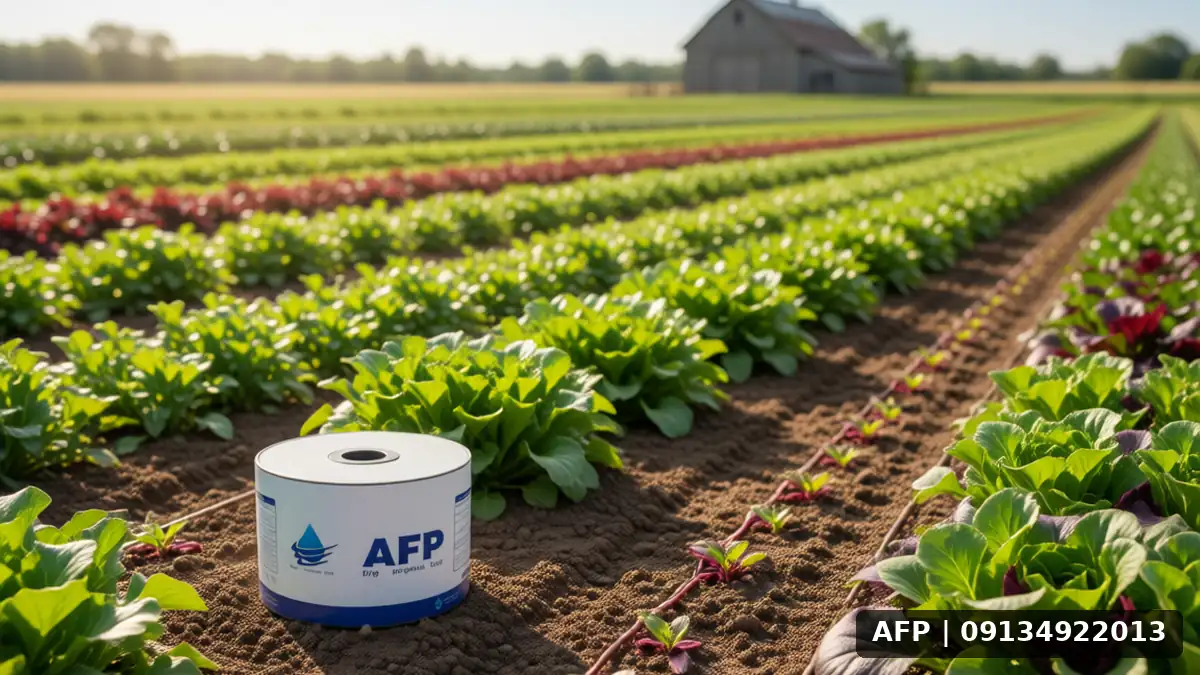
The Impact of Drip Tape Spacing on Spinach Yield and Quality
There is a direct relationship between drip tape layout and final crop quality. When the spinach drip tape spacing is correctly calculated, uniform plant nutrition ensures that leaf dimensions and plant weights are consistent at harvest. Variation in size within a row directly affects the commercial value of the product. Additionally, maintaining adequate moisture in the root zone reduces plant environmental stress and leads to lower consumption of chemical fertilizers, as nutrients are easily delivered to the roots by the drip tape water flow.
Frequently Asked Questions (FAQ)
What is the ideal drip tape spacing for spinach under drought conditions?
Under drought conditions, it is better to reduce drip tape spacing and use tapes with lower flow rates and higher emitter density to deepen the wet zone and prevent water loss due to surface evaporation. This encourages the plant to develop deeper roots.
Is it possible to use drip tape in cross-row layouts?
Yes, in very large farms, a cross-tape layout is sometimes used to ensure irrigation coverage for the edge sections of rows. This method requires precise pressure calculations to ensure the main and cross tapes do not operate simultaneously and affect the system pressure.

How does drip tape spacing affect weeding?
As drip tape spacing increases, weeds grow faster in the spaces between rows. Therefore, the standard spacing should be selected to ensure that, alongside irrigation, sufficient space is available for plowing or herbicide application between rows without damaging the drip tape.
Summary and final recommendations
Management Spinach drip line spacing A dynamic process that requires continuous monitoring. Considering soil type, water salinity, and climatic conditions, you can optimize the layout for each season. Using precision technologies for irrigation not only reduces energy and water costs but also ensures uniform quality, increasing the chances of better market sales for the produce. Farmers can utilize related resources such as the guide to calculating crop quantity per hectare and cultivation improvement management to fully manage the entire crop chain from seed to harvest. Ultimately, the correct execution of drip lines and adherence to the mathematical principles of layout are the keys to success in producing high-quality, high-yield vegetables.
Related articles: Celery drip irrigation: A comprehensive guide to watering, spacing, and key points