Tef Film Stripe Spacing in Lettuce Cultivation: Recommended Standards
Correct selection Drip tape spacing in asparagus cultivation One of the most important considerations in drip irrigation system design. Asparagus is a perennial and long-lived plant with deep, extensive roots that requires precise moisture management. The use of drip tape instead of conventional drip lines has gained significant popularity due to lower cost and high flexibility; however, determining the correct distance of these tapes from plant rows directly affects yield, asparagus spear quality, and the prevention of water stress. This guide reviews the scientific and empirical standards for determining this distance.
The importance of managing drip tape spacing in asparagus cultivation
Asparagus relies on its rhizomes for energy storage and stem growth. If the drip tape spacing from the planting row is too wide, moisture will not reach the primary root zone, causing plant stress. Conversely, spacing that is too close can lead to resource waste and excessive root proliferation in the irrigation zone, which is more difficult to manage. Therefore, the objective is to deliver moisture to the active root zone at an appropriate depth and width.
Several factors influence the determination of the supply rate for drip tape irrigation and ultimately the distance of tapes from rows. Soil type, rainfall, and regional temperature are among these factors. In clay soils with lower permeability, a smaller spacing may be required for moisture to spread faster through the root zone, whereas in sandy soils with high permeability, spacing can be slightly wider to reduce losses from deep percolation.
Recommended Standards for Drip Tape Spacing
Based on studies and practical experiences in asparagus cultivation, the following standard dimensions are recommended and should be considered in system design:
- Drip tape spacing from the row center: Typically, 30 to 40 centimeters is recommended. This distance ensures the most reliable area for the active roots of asparagus.
- Spacing between two tapes: When using two tapes per row, the spacing between the left and right tapes should be arranged to provide complete moisture coverage. Typically, the distance between two tapes is calculated to be around 60 to 80 centimeters (taking into account the row width).
- Tape burial depth: The drip line must be placed 10 to 15 cm below the soil surface to resist UV radiation and mechanical damage and to deliver moisture directly to the root zone.
Generally, in most cases, The 35 cm spacing from the center of the broccoli row is considered the optimal point. This spacing creates a balance between root coverage and minimal water loss.
Practical tips for installing and adjusting drip line spacing
Proper installation of drip lines adjacent to broccoli rows requires precision. During the bed preparation stage (Beds), the path for the line must be predetermined. If the beds are constructed in an arched shape, the lines should be placed in the side grooves of the bed.
- Line adhesion method: Do not tape the line directly to the main or laterals. The drip line should not be taped but placed under mild soil pressure to prevent shifting.
- Pressure Test: Before completely backfilling the soil, test the system at its working pressure to ensure there are no leaks at the connections.
- Contour Alignment: If the land slope is steep, the drip line spacing may require specific adjustments to prevent inadequate irrigation at the end of the slope. In such cases, using pressure-regulating valves at the end of the line is essential.
For a better understanding of the physical layout of the lines, you can installation steps for drip lines which include land grading, creating an appropriate trench for the line, and proper connection to the main pipe.
Effect of Drip Line Spacing on Quality and Yield of Peas
Drip tape irrigation promotes more uniform asparagus stem growth by concentrating moisture in the root zone. If the tape spacing from the row is too wide, the plant must allocate energy to developing taproots outward toward the irrigation zone, which slows main stem growth. Therefore, drip tape spacing in asparagus cultivation must be optimized based on root absorption potential.
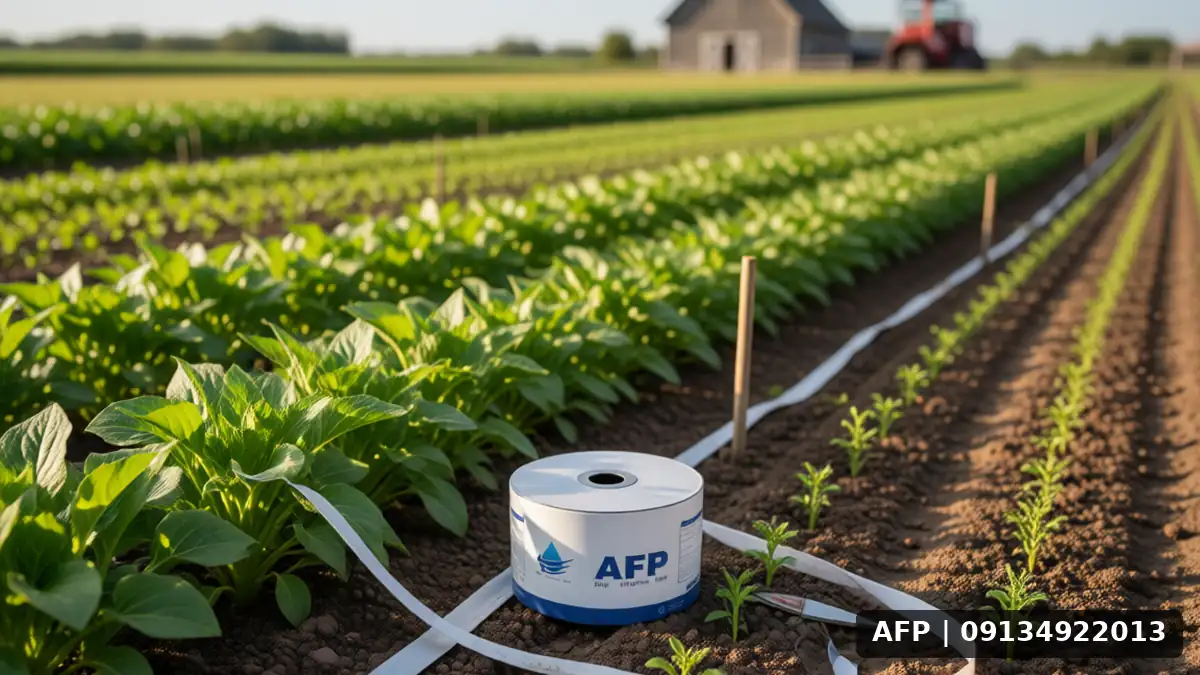
For comparison with other vegetables, spacing management in high-density crops such as white onions can follow a similar pattern. To learn about the irrigation requirements of other crops, refer to the article White Onion Yield per Hectare . Although asparagus is a perennial plant, the principles of drip irrigation are common to all these crops, with the primary goal being moisture management without loss.
Frequently Asked Questions (FAQ) About Drip Tape Spacing in Asparagus
1. Can one drip tape line be used instead of two per asparagus row?
Yes, some systems use a single central line. However, since asparagus rows are wider and the root system is more diffuse, using two lines (one on the left and one on the right) provides more uniform coverage. In this configuration, each line is positioned 30–35 cm from the row center.
2. What is the required spacing between drip tapes in adjacent rows?
Asparagus planting row spacing is typically 1.5 to 2 meters. Drip tapes are placed in the furrows on the sides of each ridge. If your system uses connected tape lines, design the channel layout to maintain the standard intra-row spacing.
3. Does the seed or cutting type of asparagus affect the drip tape spacing?
Not directly, but ridge dimensions and planting density (number of cuttings per linear meter) are determining factors. If planting density is very high, the distance of the tape from the row center should be slightly increased to prevent the tape from being damaged by additional cuttings. To understand the density for similar crops, you can review the seed rate per hectare for other products to grasp the ratio.
4. When is it necessary to change the drip tape spacing in the years following planting?
As asparagus plants mature (after the second year), the root systems spread wider. In this case, if the drip line can be repositioned, the spacing can be increased to 45–50 cm to accommodate root crown expansion. If the lines are fixed, the deficit must be compensated by increasing the irrigation rate.
Summary
The main criterion in selection Drip line spacing in asparagus cultivationis optimal root access to moisture. A standard spacing of 30 to 40 cm from the center of the ridge is a good starting point for most climatic and soil conditions. By observing installation details and pressure adjustments, irrigation system efficiency can be improved and water stress in this sensitive crop prevented. It is always recommended to test these spacings in a small section of the field and monitor yields before widespread implementation.
Related articles: What is the seed rate per hectare for forage corn?