Comprehensive Guide to Drip Irrigation in Saffron Cultivation: Prerequisites, Technical Principles, and Practical Water Management
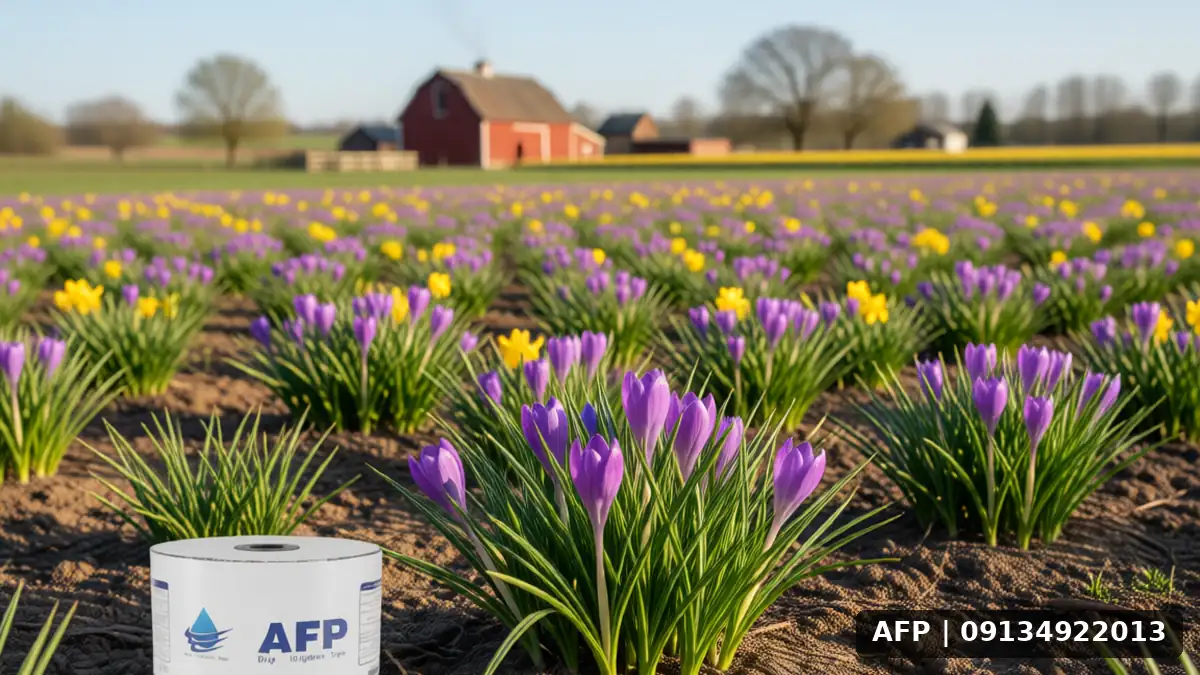
Introduction to Node Irrigation in Saffron Cultivation
Saffron, as one of Iran’s most sensitive and valuable economic crops, requires precise and intelligent water resource management in addition to specific climatic conditions. Among modern irrigation methods, node irrigation—an intelligent combination of drip and tape systems—is considered an ideal option for this sensitive crop due to uniform moisture distribution and significant reduction in water loss. In this method, water flow pressure at connection points or nodes is regulated and controlled to prevent unbalanced water accumulation in specific soil zones, ensuring that the delicate saffron roots have uniform access to moisture. This system induces controlled moisture stress, compelling saffron plants to spread their roots to search for moisture, which results in a larger root system and improved nutrient absorption. In this article, we examine all technical and practical aspects of implementing this system to provide a comprehensive guide, enabling farmers to invest with greater confidence and achieve maximum yields from their saffron fields.
Technical Prerequisites for the Proper and Optimal Implementation of Node Irrigation
1. In-depth Understanding of Soil Properties and Field Topology
The most critical step in any irrigation design is accurately understanding the cultivation site. Before installing any node system, analyzing soil physical properties—including water infiltration depth, soil particle type, and drainage—is essential for determining the optimal planting depth for saffron plants. Topographically, lands with slopes of less than 15% are better suited for the correct and stable operation of node systems. This is because significant elevation differences cause pressure instability and reduced water distribution accuracy at the lower points of the system. On sloped lands, precise calculations are required to balance pressure along the lines, and in some cases, using pressure regulators or dividing lines at different elevations becomes necessary to compensate for pressure loss. Additionally, identifying rocky or stony areas on the land beforehand is necessary so that water movement paths in the soil can be predicted and nodes placed in the correct locations to prevent water accumulation in specific areas.
2. Accurately determining the operating pressure and suitable flow rate
Nodular irrigation inherently requires precise and continuous pressure regulation. Excessive pressure can damage the delicate saffron roots and cause uneven water distribution on the root zone, while insufficient pressure limits the irrigation coverage and leads to deep soil dryness. The recommended flow rate is generally between 4 and 8 liters per hour per node, varying with planting distance. Selecting the correct flow rate requires field trials and calculating the crop’s water requirements at each growth stage. It is important to note that saffron requires higher moisture during the initial sprouting phase to facilitate terroir movement toward the soil surface, but once the flowering stage is reached, precise moisture management is critical to prevent flower rot. Therefore, flow regulators must be calibrated with high precision to ensure water delivery matches the plant’s physiological needs at all growth stages.
3. Advanced Filtration and Water Resource Management
One of the main challenges in drip and line drip systems is the clogging of emitters. Using appropriate filters, such as silicone, disc, or fine-mesh screens, is essential to prevent suspended particles from entering the system. Additionally, treating and stabilizing incoming water sources can prevent long-term sedimentation. Installing washing equipment and regularly monitoring water quality significantly extends the system’s useful life. Leveraging principles of direct farmland irrigation for the benefits and drawbacks of filtration can be useful, but line drip requires higher precision. Two-stage filtration (once at the tank inlet and once before entering the main pipe) is recommended to prevent final clogging of fine line drip emitters. Also, adding a small amount of chlorine to control algae and bacteria in irrigation lines, especially in surface water, is part of the system’s sanitary management.
Practical Tips for Operation, Maintenance, and Monitoring
Regular Repairs and System Cleaning
Regular inspection of slits, drippers, and nodes to control water distribution accuracy is a primary prerequisite for any modern irrigation system. Line flushing using chemical or physical shock every 6 to 12 months, depending on water quality, is recommended. To ensure proper node performance, one-sided high-pressure backflushing can be utilized during dry periods or at the end of the crop cycle to remove potential sediments. Training staff to identify signs of clogging and leakage is also of special importance. Proper maintenance includes visual inspection of nodes at the beginning and end of each irrigation period to identify and resolve any water output inconsistencies early. Additionally, maintaining and regularly washing filters is essential to preserve filtration accuracy and should not be considered secondary.
Smart Irrigation Timing and Moisture Management
Saffron tissue culture, especially in spring, is sensitive to moisture fluctuations. Executing node-based irrigation in the evening is the optimal time to reduce water loss due to evaporation during high-temperature daytime hours. Using soil moisture sensors to monitor conditions at depths of 20 to 40 cm helps prevent over-irrigation and root rot. Monitoring hydrometric pressure and changes in saffron leaf color can also serve as auxiliary indicators for deciding on irrigation timing. With smart sensors, the irrigation profile can be updated based on climatic and moisture data. This data-driven approach prevents irrigation based on fixed schedules and ensures water is applied only when the plant requires it, thereby reducing total water consumption and increasing product quality. Additionally, temporarily suspending irrigation before flowering to create mild moisture stress and stimulate blooming is a subtle management nuance that is better controlled with node-based systems.
Positive Impact of Node Irrigation on Saffron Growth and Quality
Unlike traditional methods that often lead to saffron corm decay, node irrigation provides uniform moisture distribution. This not only promotes better corm growth but also ensures the long-term lifespan of plants and product sustainability in subsequent years. Additionally, reduced soil surface salinity stress, caused by moisture concentration in the root zone, decreases fungal diseases and improves root system development. Precise moisture control directly positively impacts saffron aroma, color, and essential oil content. The essential oil obtained from saffron irrigated via node methods is more uniform and high-quality due to consistent growth and simultaneous flower maturation. A reduction in diseased and weak plants is also evident due to optimal root management.
Frequently Asked Questions (FAQ)
Is node irrigation suitable for arid climates?
Yes, this system, with its optimized water consumption, is highly suitable for arid and semi-arid regions such as Iran. By adjusting pressure and flow rate, water usage can be reduced and production efficiency increased. In fact, the higher the water stress, the more critical precise node management becomes. This method allows farmers in water-scarce areas to achieve maximum productivity with minimum resources.
What is the spacing between nodes in saffron cultivation?
Node spacing depends directly on the spacing of planted corms. Typically, a spacing of 20 to 30 centimeters between corms requires node installation at similar intervals. One node is suitable for one or two corms, depending on the size of the root zone. Denser plantings require smaller nodes. Precise adjustment of node spacing is key to ensuring appropriate water distribution in the space between plants, preventing intense root competition.
What are the quality standards for drip tape systems?
When selecting drip tape and drip irrigation systems, the material quality of the pipe (such as polyethylene with UV stabilizer) and the manufacturing precision of the emitters are critical. It is recommended to review the technical specifications of drip systems and methods for optimizing water resources. Resistance to pressure and temperature variations are also key selection factors. Understanding Technical specifications of drip tape irrigation helps you select the optimal pipe and emitter combination for your specific farm conditions. Product durability and the manufacturer’s warranty are also important criteria.
Conclusion and final recommendations
Implementing node irrigation in saffron cultivation is a prudent investment, particularly given water scarcity and rising production costs. Adhering to technical prerequisites such as understanding topology, pressure regulation, and appropriate filtration prevents water loss and ensures crop sustainability. Correct long-term operation not only increases yield but also preserves saffron quality and reduces labor costs. We recommend consulting reliable sources using scientific and experiential data before implementation to ensure decisions are based on solid evidence. Continuous monitoring and learning from farm data is the key to long-term success in saffron irrigation management. With proper implementation, this system can make a significant difference in product quality and quantity.
Related articles: chickpea seed per hectar iraq, mohdath intaj thur maksikhi li l hektar daleel shamil lil muzariin, Advantages and disadvantages of direct field irrigation, Canola seeding rate per hectare: Comprehensive guide + influencing factors