Surface Irrigation for Basil Crop: Applications and Key Considerations
Introduction: Why surface irrigation still maintains its role in basil cultivation?
Basil is one of the most widely used plants in the food, pharmaceutical, and fragrance industries. Due to its high requirement for stable soil moisture, it is considered a water-sensitive crop. In regions of the country with sufficient water availability and land suitable for gentle slopes, surface irrigation is still used as one of the primary methods for supplying water to this crop. Although it is older than modern systems, this method remains widespread in conventional and semi-industrial basil cultivation due to its low installation cost and operational simplicity.
Concept and principles of surface irrigation
Surface irrigation refers to the distribution of water across the field surface in a uniform manner with controlled slope. In this method, water flows through the beginning of the irrigation furrow or basin and supplies the plant roots via infiltration into the soil. In basil cultivation, where the vegetative period is typically 30 to 45 days, precise management of the timing and quantity of water in each irrigation cycle is critical. If water remains on the surface for too long, basil roots will quickly suffer from waterlogging, leading to root rot.
Conversely, methods such as drip tape, which operate precisely in a drip-like manner, are better options for industrial farms with sloped land or water scarcity. However, where surface water resources are abundant and the land is flat, surface irrigation can be the most efficient choice.
Applications of surface irrigation in basil cultivation
Regions with abundant surface water resources
In the northern and northwestern regions of the country, particularly in areas with wetlands and seasonal rivers, holy basil is widely cultivated. In these regions, using surface water for holy basil irrigation is not only economically optimal but also exerts less pressure on groundwater resources. Under these conditions, holy basil benefits from improved root nutrition due to the deep percolation of water into the soil.
Intercropping with other plants
Some holy basil farms cultivate this plant intercropped with other species such as white onion or other vegetables. In this case, surface irrigation allows for the regulation of slope and depth, ensuring controllable water delivery to all plants within the strip. However, this requires precise strip design and spacing to ensure that competing crops do not suffer damage despite similar irrigation conditions.
Reduction of installation and maintenance costs
One key advantage of surface irrigation is the reduced need for advanced infrastructure. For small-scale and semi-commercial basil cultivation, investing in drip or trickle systems may not be economically justifiable for medium-scale farmers in terms of return on investment. Surface irrigation, with its lower cost and simpler maintenance, is an acceptable option for these sectors. However, farmers should have sufficient information about purchasing drip irrigation components and supplementary equipment in case an upgrade is needed.
Practical tips for properly implementing surface irrigation for basil
Designing furrows and appropriate gradients
Correct furrow shaping is the most critical step before starting basil planting under surface irrigation. Furrows should align with the natural or graded land slope. The ideal gradient for basil is typically between 0.1% and 0.3%. If the slope is too low, the water transit time increases, raising the risk of waterlogging. Conversely, if the slope is too steep, water flow velocity increases, reducing the uniformity of water distribution along the furrow length.
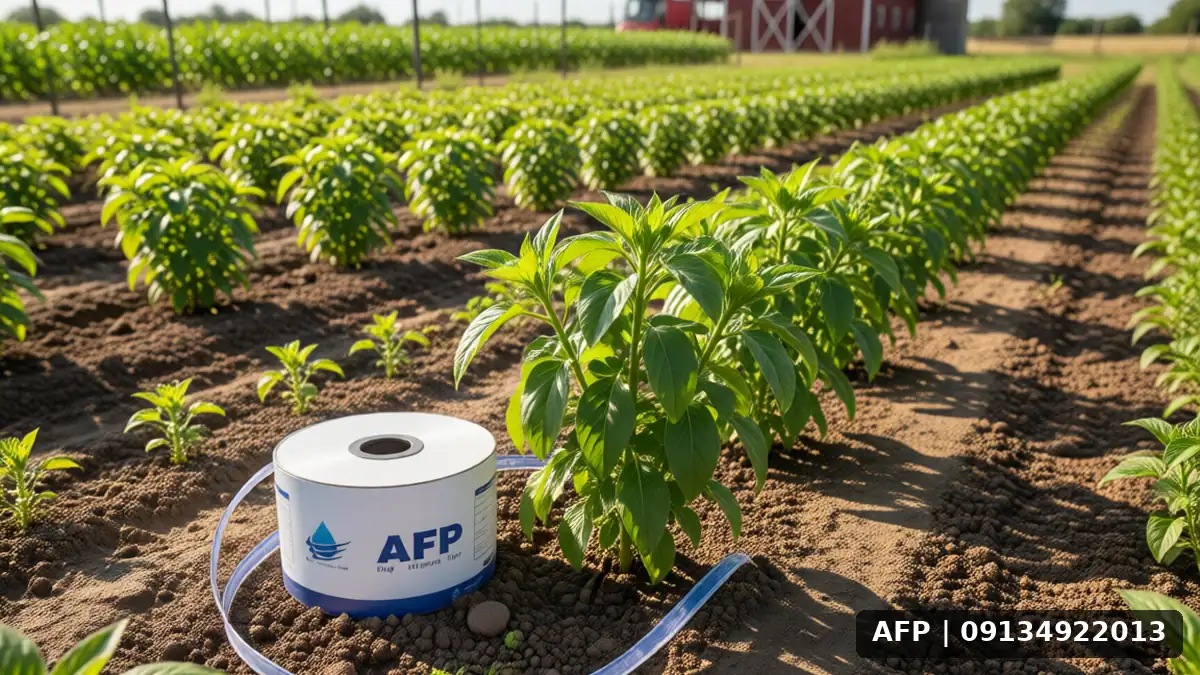
- Furrow width: Typically, 5 to 10 cm is suitable to ensure water moves at an appropriate speed.
- Furrow spacing: Depending on the root depth of basil and soil type, a depth of 30 to 50 centimeters is recommended.
- Strip length: A maximum length of 100 to 150 meters is recommended for surface strips unless the slope is very gentle.
Water timing and quantity in each irrigation cycle
Basil requires less water during the first weeks of growth and reaches maximum growth pressure in weeks 3 to 5. During this period, a full irrigation cycle of 2 to 3 hours is generally required 1 to 2 times per week. Utilizing the estimated yield per hectare can assist in planning water consumption and managing basil growth. Excessive water supply at this stage leads to reduced essential oil quality and increased physiological disorders.
Comparison of surface irrigation and tape drip irrigation in basil cultivation
For informed decision-making, it is essential to understand the differences between surface irrigation and tape drip irrigation. Tape drip systems consist of fine emitters that supply only the water required by the roots at closer intervals to the plant. This method offers higher efficiency in industrial basil farms equipped with smart management systems. However, surface irrigation may offer advantages for light-textured soils and conditions where basil roots penetrate deeper, due to the deeper infiltration of water. It is recommended to study various irrigation systems to better understand the methods and select the optimal combination for your farm.
Cost and yield
Frequently asked questions about surface irrigation for basil
Can surface irrigation physiologically damage the roots of tulsi?
Yes, if water timing and volume are not precisely controlled. Frequent waterlogging creates an anoxic environment around the roots, promotes pathogen growth, and reduces nutrient uptake. Controlling the slope and furrow length is essential to prevent this issue.
Under what conditions is a furrow tip system preferred?
A furrow tip system is a better option when the land is sloped, water depth needs to be controlled, or the farm is large-scale and industrial. It also provides more optimal water use in water-scarce regions.
Can two irrigation methods be combined in a single tulsi field?
Yes, in large fields, some sections can be irrigated via surface methods while others use furrow tips. This combination should be designed based on a detailed water distribution map and contour layout of the farm.
Conclusion
Surface irrigation for basil cultivation, particularly in regions with surface water sources and flat land, remains a reliable and cost-effective method. The key to success with this method lies in the proper design of furrows, slope control, precise scheduling of irrigation cycles, and avoidance of over-irrigation. In addition to this method, familiarity with modern options such as tape and drip irrigation helps the farmer select the optimal combination based on farm conditions and resources to optimize per-hectare crop performance.
Related articles: basil harvest yield per hectare guide, buls akhdar mawsout haqtara, wheat irrigated yield per hectare iraq