Basil Seed Quantity per Hectare: A Comprehensive Guide
Introduction: The Importance of Accurate Basil Seed Rate Determination
Basil is a popular medicinal and ornamental plant with high demand in both domestic and international markets. To achieve successful cultivation of this plant, understanding the amount of basil seed per hectare is the first and most critical step. Many novice farmers believe that sowing more seeds yields more produce, but this misconception can lead to plant competition, poor growth, and increased production costs. Accurate seeding rate determination not only reduces seed costs but also improves final leaf quality by providing sufficient space for root and stem development. In this guide, we review basic calculations and drip and tape irrigation adjustments to optimize basil cultivation.
Why is Basil Planting Spacing Critical?
Basil requires adequate light and air circulation for proper shaping. If the spacing between plants is too narrow, shading from one plant to another leads to etiolation, resulting in tall, thin plants with weak tissue. Conversely, if the spacing is too wide, soil coverage is insufficient, allowing weeds to grow. Therefore, balancing seed calculation per unit of area is key to success.
Basic Calculations for Determining Basil Seed Amount per Hectare
To determine exactly how much seed you need, you must use standard agricultural formulas. These calculations vary based on the planting method (soil or tray) and bed dimensions. Generally, basil seeds are very small and lightweight. Typically, 3 to 5 kilograms of seed per hectare is recommended, although this figure may vary.
Standard open-field cropping
In traditional open-field farming, the following spacings are recommended to calculate the seed rate per hectare for basil:
- Distance between rows (Row to Row): 40 to 50 centimeters. This spacing is suitable for machinery traffic and access to the plants.
- Distance between plants (Plant to Plant): 20 to 25 centimeters. This spacing allows plants to canopy and be optimal for ornamental and economic purposes.
With these spacings, the estimated number of plants per hectare will be approximately 80,000 to 100,000. Assuming a 15 to 20 percent safety factor for seed loss and poor germination, you will need about 4 kilograms of quality seed per hectare.
Basket cropping and intensive cultivation
In basket cropping, resource management is more difficult and space is limited. In this case, shorter spacings can be used, but care must be taken to ensure adequate ventilation for the green space. The use of hybrid or improved seeds can help reduce seed consumption, as they have higher germination rates. In this section, mention of increasing yield through appropriate seed selection is useful, as the principles of seed selection for basil are similar to other Apiaceae plants.
The role of drip irrigation and strip tip in seed and growth management
Irrigation is not just important after planting; it begins at the moment of sowing. The use of pressurized irrigation systems such as drip and strip tip provides precise moisture control, which directly affects the uniformity of basil seed germination per hectare.
The impact of uniform moisture on yield
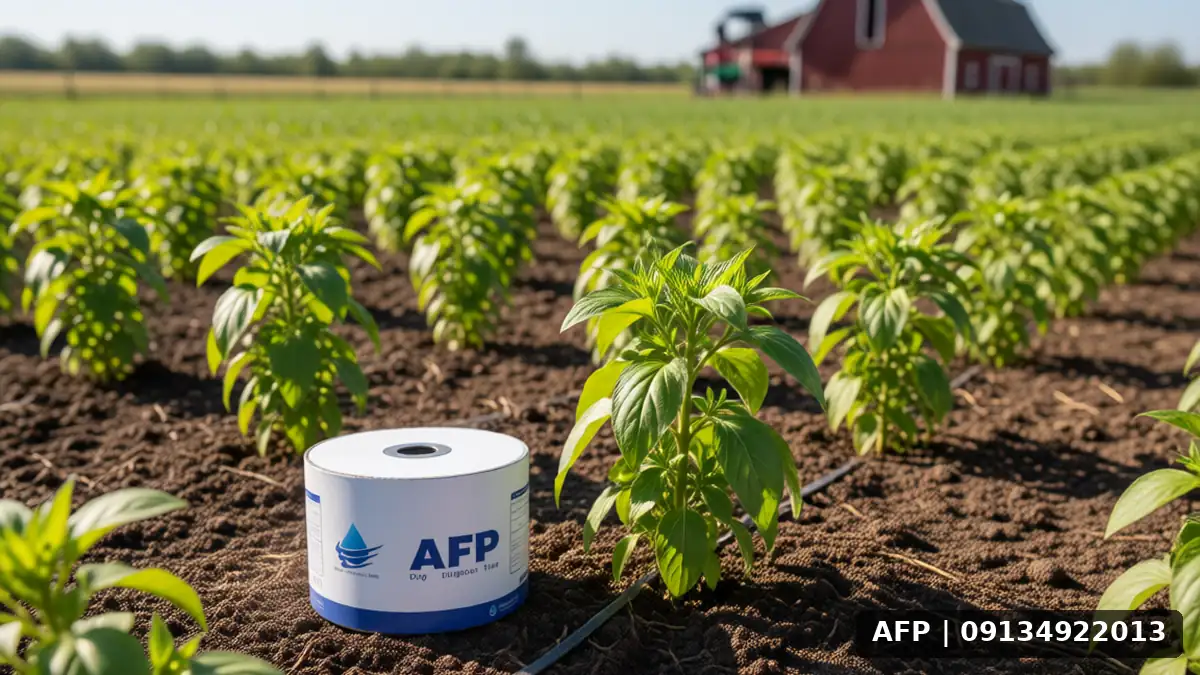
If flood irrigation is applied, small basil seeds may settle at different soil depths, causing uneven plant distribution. However, with drip irrigation, moisture is created within a specific radius of the root zone. This allows plants to establish well at defined intervals and reduces competition for water. In practice, the irrigation system must be designed to coordinate with seed spacing. For example, if the emitter spacing on a Tef strip is 25 centimeters, ensure that water delivery is sufficient to promote uniform growth of plants in each row.
Combining Seed Rate and Irrigation System: A Look at Other Crops
The principles of calculating seed rate for basil share similarities with other crops. For a better comparative understanding, you can examine seed rates for tree crops; although the scale differs, the logic of managing growth space remains consistent. Additionally, planting legumes such as beans also requires precise seed adjustment; however, due to basil’s sensitivity to excessive moisture and fungal diseases, it demands greater orderliness in seed arrangement.
Practical Solutions for Tef Strip Irrigation of Basil
- Drip Line Installation: Bury the drip line exactly in the center of the row to ensure uniform water distribution. For additional guidance, review the key pre-installation tips for drip lines to prevent emitter clogging.
- Emitter Configuration: Use emitters with a flow rate of 1 to 2 liters per hour. Although basil is a vigorous plant, excessive wetting promotes stem rot.
- Pressure Management: The system pressure should be between 0.5 and 1 bar. This low pressure is suitable for drip lines and prevents excessive moisture accumulation.
Practical Tips to Maximize Efficiency
In addition to mathematical calculations, the following qualitative factors play a role in determining the success of the basil crop:
- Soil preparation: Basil requires well-drained soils with a neutral pH. Compost should be added before sowing to allow nutrients to release.
- Germination temperature: Soil temperature must be above 15 degrees Celsius. Sowing during cold days leads to reduced germination rates and subsequent seed wastage.
- Weed management: Because basil seeds are small, mulching can suppress weeds and retain moisture. This reduces the need for thinning excess seedlings or re-sowing.
- Comparison with other crops: If your farm uses a mixed cropping system, pay attention to the yield of alfalfa per hectare can help manage crop rotation and plant substitution cycles. Basil is often used as an intercropping plant in some mixed cropping systems.
Frequently Asked Questions (FAQ)
1. What is the best time to sow basil seeds?
Sowing basil seeds in spring (from late April) and summer (December to March) is generally recommended. However, if you use a greenhouse, you can also plant for winter, but you must manage the temperature to ensure proper seed moisture absorption.
2. Can I sow bare basil seeds?
Yes, pelleted seeds make sowing easier, whether mechanized or manual, as they are easier to handle with planters. Bare seeds require mixing with sand or gypsum to increase volume and improve dispersion. This technique helps you control seed density and prevents clumping in one spot.
3. How should I adjust the irrigation heads?
Irrigation heads must not be in direct contact with the seeds. The distance from the head to the plant (after initial growth) should be approximately 10 to 15 centimeters. If the head is too close to the seed, water pressure may cause the seed to shift. It is recommended to slightly adjust the line or install the heads precisely in the correct direction after germination.
Conclusion: The Key to Success in Seed Management
Determination Basil Seed Quantity per Hectare It is a dynamic process that requires observation, learning, and adjustment. Starting with 4 kg of seed per hectare is a good initial benchmark, but it must be modified based on farm conditions, soil type, and drip irrigation system performance. By integrating stand density calculations with the principles of tape line irrigation, not only will production costs be reduced, but the quality and yield of your basil will reach a level attractive to high-demand markets. It is always recommended to set up a field trial with different stand densities (e.g., 3, 4, and 5 kg per hectare) before large-scale planting to find the best scenario for your specific conditions. Attention to detail in tape line pipe installation can make the difference between an average crop and an ideal one. By studying Comparison of Advantages of Tape Line and Drip Irrigation, ensure that your selected system is in full harmony with your basil seed.