T-Strip Spacing in Rapeseed Cultivation: Recommended Standards and Practical Tips
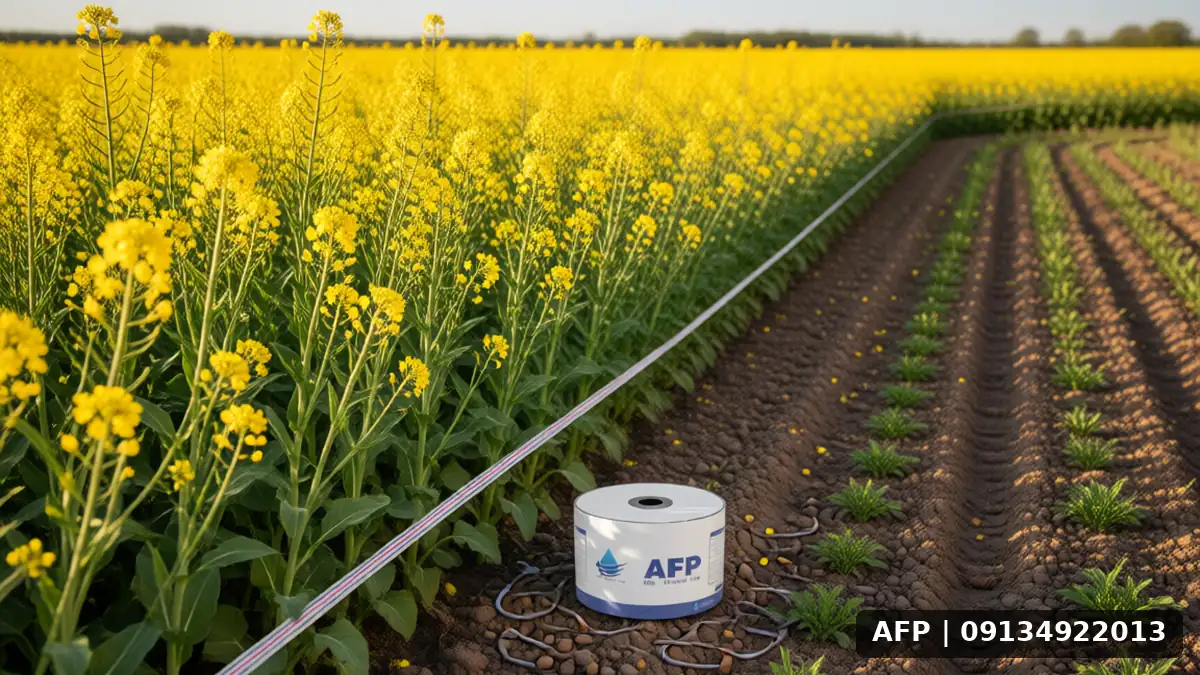
Selecting the dimensions of tape drippers and the spacing between them is one of the most important technical decisions in designing a drip irrigation system for canola cultivation. Correct determination of the tape drip line spacing in canola cultivation not only affects the stability of yield performance but also directly impacts economic efficiency and the sustainability of regional water resources. Given the sensitivity of canola roots to water stress, particularly during early vegetative stages and grain filling, uniform moisture distribution in the Root Zone through correct line spacing is of paramount importance.
Fundamentals of Tape Drip Line Spacing in Canola Cultivation
Canola (Brassica napus) is a crop that requires relatively stable moisture but is sensitive to agricultural drainage and oxygen deficiency. Therefore, tape drip line spacing must be adjusted so that roots can access adjacent lines without causing salinity or drainage issues. Typically, in row canola cultivation, the spacing between tape lines aligns with the planting row width. If canola is planted in rows 40 to 60 centimeters wide, the tape line spacing is generally recommended to be equal to or slightly greater than the row width to ensure adequate wetted area coverage.
Impact of Water Infiltration Depth on Spacing Determination
The core parameter for determining spacing is the vertical and horizontal water infiltration radius. In drip irrigation, water is released from the tape dripper pores and infiltrates the soil in a cup-like shape. For canola, the primary root depth ranges between 40 and 100 centimeters. If the line spacing is less than twice the vertical infiltration radius, surface salinization and root rot are hazardous; if it is greater, dry zones form between the lines. Consequently, calculating Surface Salinity and Root Zone Depth is a prerequisite for determining spacing.
Recommended Standards and Technical Dimensions
Based on field experience in Iran’s cold regions, particularly Khorasan, Azerbaijan, and the Western provinces, the standards in the table below are recommended for determining ridge-to-ridge spacing in rapeseed cultivation. These spacings are adjusted for medium-textured (loam) soils; narrower spacings are required for heavy (clay) soils, while wider spacings are recommended for light (sandy) soils.
It is important to note that in a drip tape system, the spacing between tapes is usually equal to the planting row width. Therefore, farmers can adjust the spacing of the drip tapes simultaneously by adjusting the row width for canola. The common standard for canola planting is a row width of 50 to 60 centimeters; in this case, the drip tape spacing will also be 50 to 60 centimeters, which fully aligns with the root development capacity of canola.
The role of drip tape spacing in optimizing water use
One of the main objectives of using drip irrigation is to reduce water consumption. However, if the drip tape spacing is inappropriate, instead of achieving savings, growers may face root loss in the dry zones between tapes. Using hydraulic software to simulate water infiltration and optimize spacing is an effective step in this process. For example, if the drip tape spacing for canola is less than the optimal range, severe surface salinity and reduced yield may occur at the end of the growth season. Conversely, if the spacing is too wide, a significant portion of the root-zone moisture in the dry areas between tapes is wasted. This directly affects the economic efficiency of the crop. To better understand concepts such as corn seed rate per hectare which indicates production stability, drip tape spacing can be considered an indicator of irrigation stability. The production stability of canola directly depends on the quality of moisture distribution.
Examining environmental variables affecting spacing
In addition to soil type, climatic conditions and the level of evapotranspiration also play a role in determining the tip strip spacing for canola cultivation. In hot and dry regions, despite the increased water requirement, the strip spacing should not be automatically increased, as increased evapotranspiration causes areas between strips to dry out faster. Therefore, in these regions, it is recommended to reduce the number of strips or increase the flow rate of each strip, provided that salinity persistence is prevented. This point is observed in the design of irrigation networks, such as the use of 90 mm plastic pipe guide in drip irrigation the system flow rate is determined based on the water conveyance capacity.
Practical tips for installing and executing tip strip spacing
Installing drip strips with the correct spacing is only half the battle; the other half is their proper execution and persistence throughout the growing season. During installation, care must be taken to ensure that strips lie flat on the ground without wrinkles. The pressure in the main line must be adjusted so that the flow from the drip strip holes is uniform; because pressure fluctuations change the water infiltration radius and consequently alter the effective strip spacing. This is particularly important in confined slopes. On sloping fields, upper strips face lower pressure, which may result in less water infiltration and increased salinity persistence. To compensate for this problem, flow regulators can be used, or the strip spacing can be slightly reduced on steep slopes to maintain yield persistence.
Additionally, in the design of drip irrigation strip installation method It is important to note a subtle point: drip tapes are usually temporary and are either removed or left in the ground at the end of the season (if they are not damaged). In rapeseed, a biennial crop (in winter sowing) or an annual crop (in autumn sowing), the stability of the tapes throughout the growth season (usually 120 to 150 days) is critical. Therefore, using high-quality and durable tapes helps maintain the drip tape spacing in rapeseed planting by reducing losses.
Frequently Asked Questions (FAQ)
Must the drip tape spacing in rapeseed planting be the same as the planting row width?
In most cases, yes, due to root stability and to facilitate machinery use. However, in light soil, the spacing can be adjusted to be slightly less than the row width to reduce salinization.
How can I determine if my tape spacing is appropriate?
By excavating at the root zone in mid-season and observing moisture infiltration between the tapes. If roots are cracked in the dry areas between the tapes, the spacing is too wide. If roots are rotting near the tape, the spacing is too narrow.
Is it possible to change the drip tape spacing in rapeseed planting mid-season?
No, this is a very difficult and costly process that usually harms crop stability. Therefore, this decision must be made before planting, with knowledge of soil conditions.
How can I prevent salinization in the rows closest to the drip line?
By using water with suitable salinity, reducing the drip flow rate, and increasing irrigation frequency. Additionally, reverse osmosis (in case water purification or salinity reduction is required) can be used to improve root zone water quality.
What role does drip tape spacing play in rapeseed yield stability?
Incorrect spacing leads to moisture deficit or salinity accumulation, both of which result in reduced grain size and, consequently, lower yield stability. Rapeseed yield stability is directly dependent on the quality of the root zone.
Conclusion
Determination Drip line spacing for canola cultivation It is a multivariable process involving soil type, climate, water quality, and operational sustainability. Correct implementation of this spacing requires technical awareness and consistent installation and maintenance of the irrigation network. By using the standards provided in this article and considering local conditions, farmers can ensure the sustainability of their canola yield. It is recommended to consult an agricultural, water, and soil specialist before changing drip line spacing and to use mainline balance design per hectare to optimize the main and sub networks, ensuring irrigation system sustainability.
Related articles: Yield of D8AFD8B1 bell peppers per hectare