Onion Maintenance with Drip Tape: Key Notes and Drip Irrigation Principles
Introduction to Onion Cultivation Using Drip Tape Systems
Onion is a fundamental vegetable in human nutrition that is highly important in cold and semi-cold regions. From a technical perspective, onions have a shallow and broad root system and generally cannot tolerate flooding irrigation. In recent years, the global approach to onion cultivation has shifted from rain and flood irrigation to drip tape systems. This shift is not solely due to water conservation; the primary objective is to create a uniform environment for root growth and reduce fungal diseases, whose main source is excessive and inconsistent moisture around the bulb. Drip tape systems, through precise and controlled water distribution, maintain soil moisture within the root zone, preventing fluctuations between dryness and saturation.
This section of the article reviews all maintenance challenges associated with onion cultivation using drip tape, so that with familiarity with technical details, you can make better decisions for your farm. Utilizing this technology requires technical knowledge, as a mistake in installation or pressure adjustment can lead to bulb rot or a reduction in final product size.
Technical Parameters for Selecting Drip Tape for Onions
Selecting the appropriate type of drip tape is the first step in proper onion cultivation. Unlike tomatoes or cucumbers, which have tall vines, onions are crops with high planting density. Therefore, the spacing between planting rows (Row Spacing) in onion cultivation typically ranges between 25 and 30 centimeters. This makes the selection of drip tape with the appropriate diameter and emitter spacing critical.
- Tape Diameter: For onions, 16 or 19 mm tubes are commonly used. Thicker tubes are more suitable for viscous liquids, but standard tubes are sufficient for onions, which require gradual water absorption.
- Emitter Spacing: Typically, 20 or 30 cm is used. This distance must align with the planting furrow spacing to ensure water is delivered directly into the center of the furrow.
- Tube Structure: Channeled tubes are recommended for sandy soils, while smooth polymer (Laminar) tubes are suggested for finer-textured soils. Given that onion farm soils are often sandy loam, channeled tubes provide better protection against emitter clogging.
It should be noted that tube-drip tubing must be removed from the field and stored after the onion cropping cycle ends. This point will be explained in more detail in subsequent sections on equipment maintenance. However, to better understand how the irrigation system affects other vegetable crops with shallow root systems, studying the article Comprehensive Guide to Cucumber Drip Irrigation can clarify technical similarities, as both cucumber and onion require uniform moisture.
Irrigation scheduling and soil moisture management
Onions have varying water requirements at different growth stages. Proper drip tape cultivation of onions requires an understanding of these stages:
- Initial Establishment: During the first 2 to 3 weeks after planting, the young plant has weak roots. Irrigation should be applied with low volume and high frequency (every 1 to 2 days). Drip tape pressure must be kept to a minimum during this stage to prevent seed or transplant displacement.
- Vegetative Growth: As leaf area increases, water demand rises. During this stage, soil moisture should be maintained at 60 to 70 percent of field capacity. Drip tape use during this period enables simultaneous fertigation, which is essential for onion nutrition.
- Bulb Swelling: This is the most critical stage for quality. Sudden reductions in water can cause the onion bulb to decrease in size. Conversely, excessive moisture leads to leaf growth and a smaller bulb. It is recommended to reduce irrigation rates by up to 50% during the final two weeks before harvest to firm the onion skin and improve post-harvest storage life.
Managing pressure behind the drip line is also crucial. Due to their fine roots, onions are sensitive to high water pressure. Therefore, operating pressure should not exceed 1 to 1.5 bar. Using appropriate pressure regulators at the main line heads ensures uniform water distribution along the entire length of the line.
Soil Optimization and Contamination Prevention
One of the main advantages of drip lines is the ability to keep the soil surface between rows dry. This feature simplifies onion management with drip irrigation by reducing fungal diseases. Fungi such as Botrytis and Sclerotium which cause onion rot, grow rapidly in moist atmospheric environments. With drip irrigation, only the root zone is wet, while the soil surface remains dry.
However, this condition can create an opportunity for some pests. Certain soil-dwelling pests may move toward the drip line in search of moisture. To address this, it is recommended to use plastic mulch or a light plastic cover for the onion rows. Additionally, soil amendment by adding compost or vermiculite can improve soil drainage. If neighboring fields are growing bulb crops such as chickpeas, plant waste management also becomes important. For information on the growing conditions of other legumes that may be in your crop rotation cycle, you can review the article Recommended seed rate for Mura bean variety per hectare Ensure an appropriate density in communal farms.
Fertigation management via drip tape
Immediate and direct root feeding is one of the most effective methods in drip systems. Onion is sensitive to nitrogen, potassium, and sulfur. In a drip tape system, you can inject water-soluble fertilizers at low, repeatable doses. This practice reduces salt accumulation around the roots compared to flood irrigation. A key point in maintaining onion with drip tape is preventing fertilizer salt deposition in intermediate zones; therefore, do not forget to run a flush irrigation cycle after each fertilization period.
Common pests and diseases and control solutions
Every irrigation system introduces its own specific ecosystem. In the case of drip tape, the main risk is Emitters clogging (Clogging) Clogging can be physical (fine particles) or biological (algae and bacteria). To prevent this issue, the water filtration system (filter siphon or disc) must be flushed monthly.
Soil-borne fungal diseases in onion, such as Sclerotinia, are more common in the absence of adequate drainage. Although drip irrigation helps, vertical drainage (drains) should also be used in heavy or compact soils. Additionally, some pests, like Thrips, which are very harmful to onion, grow in specific environmental conditions. Although these pests are controlled with chemical pesticides, regular irrigation reduces root stress, thereby increasing the plant’s resistance to infection. To better understand the pest cycle in modern systems, studying sources such as the guide on controlling soil flies and six-legged pests can be helpful, as some soil pests are shared between these two systems.
Practical tips for physical maintenance of the drip tape
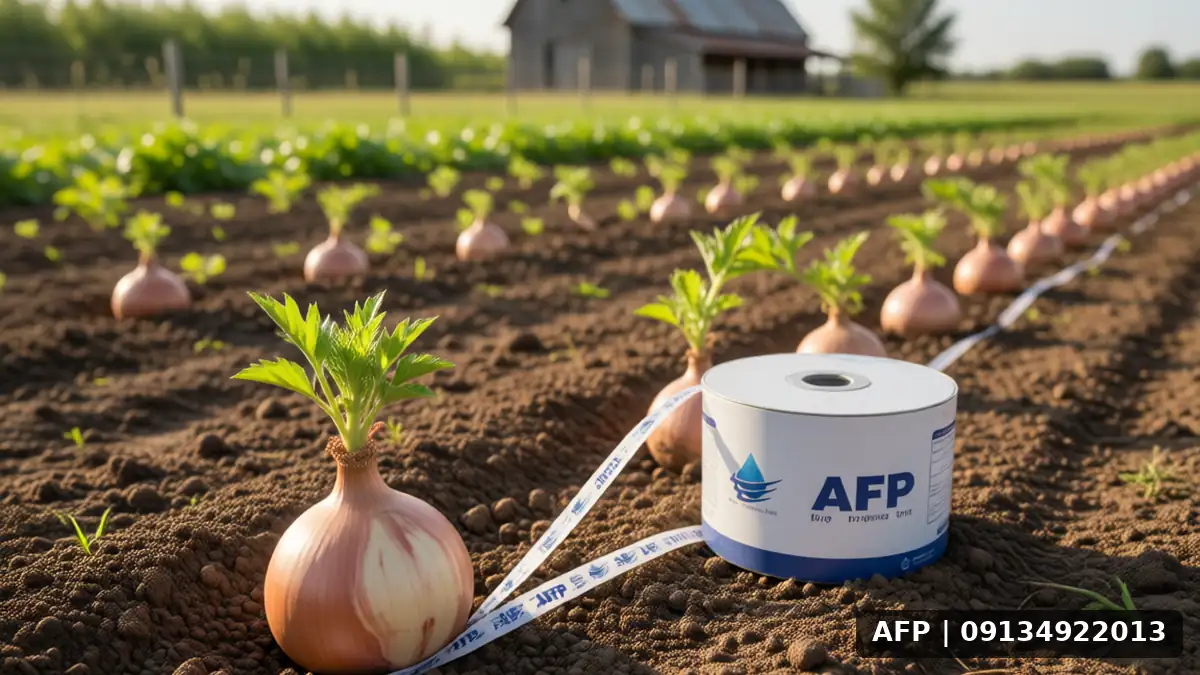
Drip tape is usually disposable, but in multi-year systems, maintenance of the tape involves removing, closing, and reopening it for subsequent seasons. Onion is a crop for which disposable tapes are commonly used, as the tape is buried in the soil and is removed and collected after the onion harvest. If you want to use the same tape for the next planting, you must follow the steps below:
- Water Flush: Before closing the headers, water at an appropriate pressure and temperature should be passed through the tape to flush out internal deposits.
- Cleaning: The drip tape must be submerged in a diluted water or acid solution (depending on the type of scale) and washed.
- Drying: The drip tape must be dried in the shade. Direct sunlight will degrade the tape polymer.
- Folding and Sealing: Tapes should be folded into neat rolls with minimal pressure to avoid stressing the emitter holes and causing blockages.
Remember that onion is a fast-growing crop. Therefore, if your drip tape has multi-season threading, you must definitely retrieve the previous one. Failure to retrieve the tape and its accumulation in the soil are major factors in yield decline in subsequent years. This point is crucial in onion cultivation using drip tape.
Comparative review with subsurface irrigation
Some farmers use subsurface irrigation to reduce evaporation. Is this method better for onions? Subsurface irrigation delivers water directly to the root zone and reduces evaporation to near zero. However, onion is a bulb crop that grows at the soil surface. Water delivery via subsurface pipes can alter soil moisture around the bulb and exacerbate bulb rot at harvest. On the other hand, surface drip tape provides more control at the bulb level. For a more detailed comparison, you can refer to the article Subsurface irrigation of plants to understand why this method is generally less popular than drip tape for bulb crops.
Frequently Asked Questions (FAQ)
Does drip tape cause onion rot?
No, as long as soil moisture does not exceed 90% of field capacity. In fact, the moisture fluctuations resulting from low and frequent drip irrigation help prevent fungal rot. Rot occurs when prolonged flooding affects the bulb.
What is the optimal harvest time for onions in a drip system?
Harvest timing depends on local conditions, but it is generally when 70% to 80% of the leaves have yellowed and fallen (laid down). In drip systems, irrigation should be stopped or significantly reduced 10 to 15 days before harvest to allow the onion skin to dry and become firm.
What should the distance be between the drip line and the onion bulb?
Typically, the drip line is placed 10 to 15 cm from the furrow center (2 to 3 cm inward from the planting furrow edge). This distance may vary depending on soil type. In fine-textured soils, place the line closer to the bulb; in sandy soils, place it slightly farther away to keep moisture concentrated in the root zone.
Summary and Final Recommendations
Using drip irrigation in onion cultivation is a long-term investment to improve quality and reduce operational costs. Maintaining onions with drip irrigation requires attention to three key areas: first, proper pressure and flow rate calibration; second, precise management of fertilizers and moisture; and third, physical maintenance of the lines after harvest. By following these principles, you can achieve yields equal to or even higher than those from sprinkler irrigation, even under water-scarce conditions.
For farmers planning to expand their farms, considering strategic crop rotation is also important. Onions can be included in a one-year rotation with many other crops. Understanding the performance of other crops on your farm aids in better planning. For example, if your farm includes other legumes, reviewing the article on lentil yield per hectare can help you optimize the yield of the next crop in the rotation using the same irrigation system. Success in modern agriculture is the combination of science with experience and the intelligent use of technology.