Comprehensive Guide to Measuring Plate Tip Bands for Farms: Calculation Principles and Practical Tips
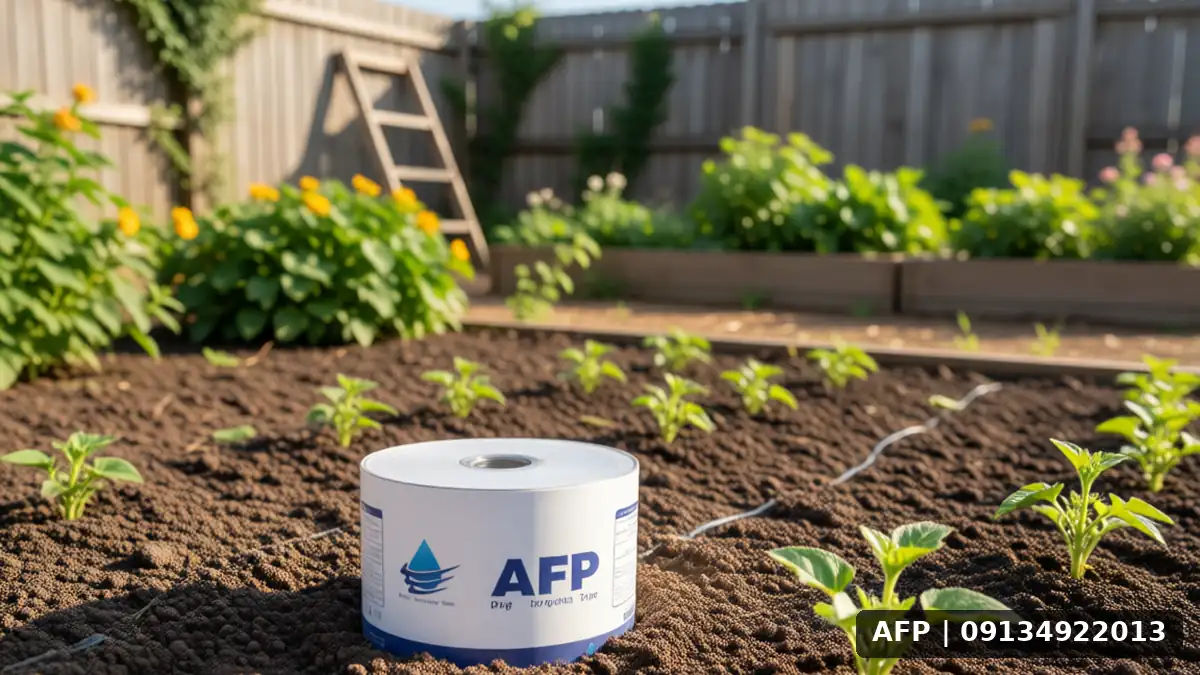
Drip irrigation, as one of the most effective methods for water conservation, has gained a special position in modern agriculture. Among the types of equipment in this system, plate-type drip tape has attracted the attention of many farmers due to its high durability, reusability, and better safety against mechanical damage. However, one of the most important issues that we often face during initial installation is the correct measurement of plate-type drip tape for the farm and its adaptation to the conditions of the cultivation bed. In this guide, with an applied and specialized approach, we examine the technical dimensions, related calculations, and implementation points to have greater accuracy in selecting this equipment.
Why is choosing the appropriate size of plate-type drip tape critical?
Plate-type drip tape has a fundamental structural difference from ordinary drip tapes. In this type, the emitters are arranged in a line as hard and durable plates, a feature that makes the system more resistant to thermal contraction and expansion and mechanical pressures. Nevertheless, if the distance between emitters and the plate width are not correctly calculated for the farm dimensions and crop type, problems such as uneven water distribution, root rot, or waste caused by uncontrolled weed growth will occur. In other words, measuring plate-type drip tape for the farm does not just mean measuring length, but includes determining the effective plate width, the distance between emitters, and water shaping in the planting strip.
Technical factors affecting dimension determination
- Irrigation belt adequacy: The spacing between emitters must be designed to cover the entire irrigated crop band. In multi-row crops, wider bands with larger plates may be required.
- Soil type: In sandy soils with high drainage rates, closer emitter spacing and a higher flow rate per emitter are recommended to allow water to infiltrate more deeply. Conversely, in clay soils with low drainage rates, wider spacing and lower flow rates can prevent waterlogging and root rot.
- Reduced evaporation: Plate-type emitters reduce evaporation compared to upstream nozzles due to their proximity to the soil surface and direct coverage. However, the plate dimensions must be adjusted according to the weed cover within the crop row.
Practical measurement steps and initial calculations
To perform this stage correctly, it is first necessary to draw an accurate field map. Subsequently, the dimensions of each crop row (length and width) must be specified. A practical checklist is provided here:
- Determine the planting band width: Measure the distance from the center of the planting row to the center of the next row. This distance must be compatible with the effective width of the tape drip head.
- Calculate the dripper spacing: Determine the spacing based on soil type and the desired flow rate (e.g., 2 to 8 liters per hour). For example, in sandy soil with a flow rate of 4 liters, a spacing of 25 to 30 centimeters may be suitable.
- Number of drippers per tape drip head: Check the physical dimensions of the tape drip head. If the tape drip head has 4 drippers, ensure that the spacing between these drippers is compatible with your planting band width.
It is crucial to note that selecting the appropriate tape drip irrigation system is not based solely on the type of tape drip head, but must account for a combination of flow rate, system operating pressure, and farm water pressure. Since tape drip heads generally operate at lower, steady working pressures, the hydraulic calculations of the system should be adjusted accordingly.
System performance evaluation and comparison with field data
Determining the correct dimensions without sufficient environmental and crop data is insufficient. For example, in tomato farms with specific row spacing and planting density, selecting a drip tape with a narrower width and higher flow rate is often more effective. Additionally, it should be noted that some crops, such as tomatoes, which require precise irrigation during sensitive stages, are more sensitive to uniform water distribution at the root zone. The table below shows a general comparison of different conditions and recommended drip emitter spacing:
In addition to soil, biological factors also play a role. For example, examining the total clover seed quantity per hectare for cover and weed management can affect the need for full strip coverage by the plates. If vegetative cover in the strip is lower, the risk of evaporation and surface decomposition increases, requiring plate strips with broader plates and higher discharge rates.
Operational points in the installation and maintenance of plate strip drip systems
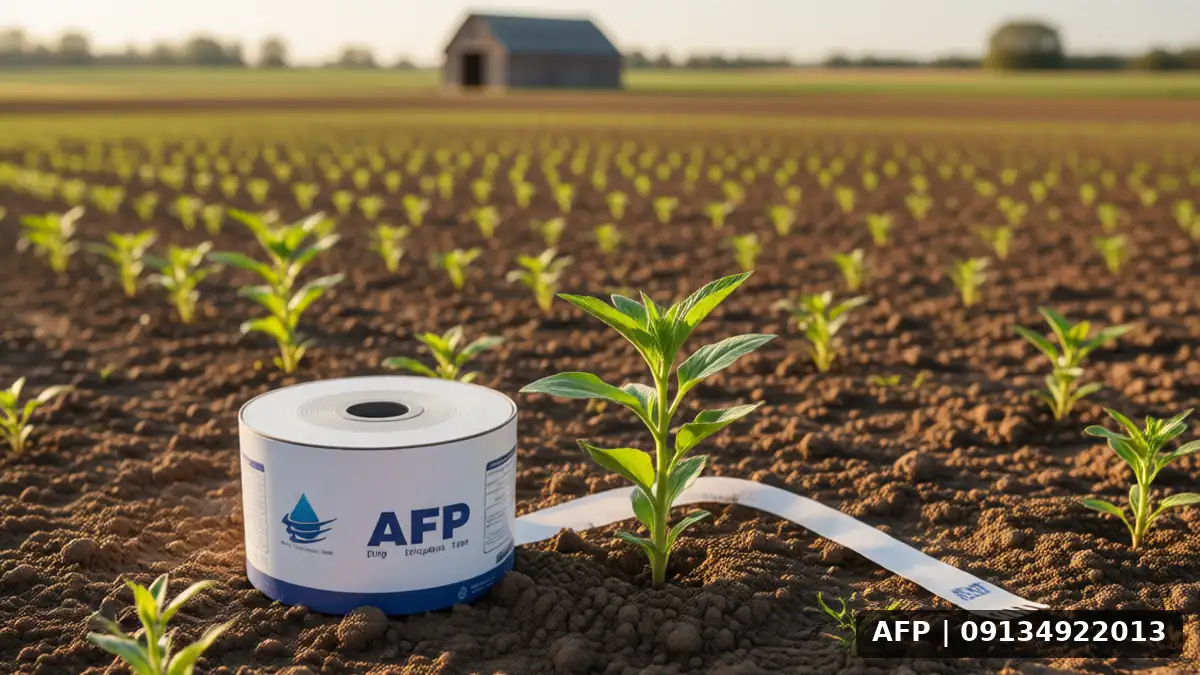
Many malfunctions in plate strip drip systems are not due to plate quality, but rather to improper installation and failure to adhere to measurement principles. During installation, ensure that plates are positioned at ground level and at an appropriate distance from the plant canopy. The distance between the plate and the plant canopy should not exceed 10 to 15 cm, as reducing this distance decreases water efficiency in the root zone.
Common Risks in the Measurement Stage
- Error in determining strip length: If the tape strip is shorter than the farm’s length, it requires segmentation and joining multiple strips side-by-side, which increases connection costs and the risk of leakage.
- Ignoring slope: In sloped fields, plate-type strips must be installed in the direction of the slope to prevent one-way water flow and moisture accumulation at the bottom. Slope calculations should be performed before purchasing the strips.
- Incorrect connection to the main pipe: It must be ensured that the main pipe diameter is compatible with the number of connected plate strips to keep pressure drop at the end of the strips within acceptable limits.
Frequently Asked Questions About Measuring Plate-Strip Type
Is the registered plate tape drip system suitable for greenhouse cultivation?
Yes, due to its lower flexibility and high durability, it is economically efficient and long-lasting for repeated use in greenhouses. However, the plate dimensions must be precisely matched to the plant height and greenhouse row spacing.
How can I measure the water distribution accuracy of the registered plate tape drip system?
The best method is to use cylindrical containers placed at equal intervals along the plate. Based on the principle of seed count per hectare, which relates to water and herb balance, the amount of water collected in the containers over a fixed period should be uniform. If the flow difference between the start and end of the plate tape exceeds 5%, the system requires pressure adjustment or tape division.
How does sampling harvest data affect the selection of plate size?
Harvest data, such as stevia yield per hectare, indicates the need for uniform water delivery along the entire length of the plate. If yield is lower in specific field sections, those areas may require tape plates of different dimensions or varying spacing.
Summary and Final Recommendations
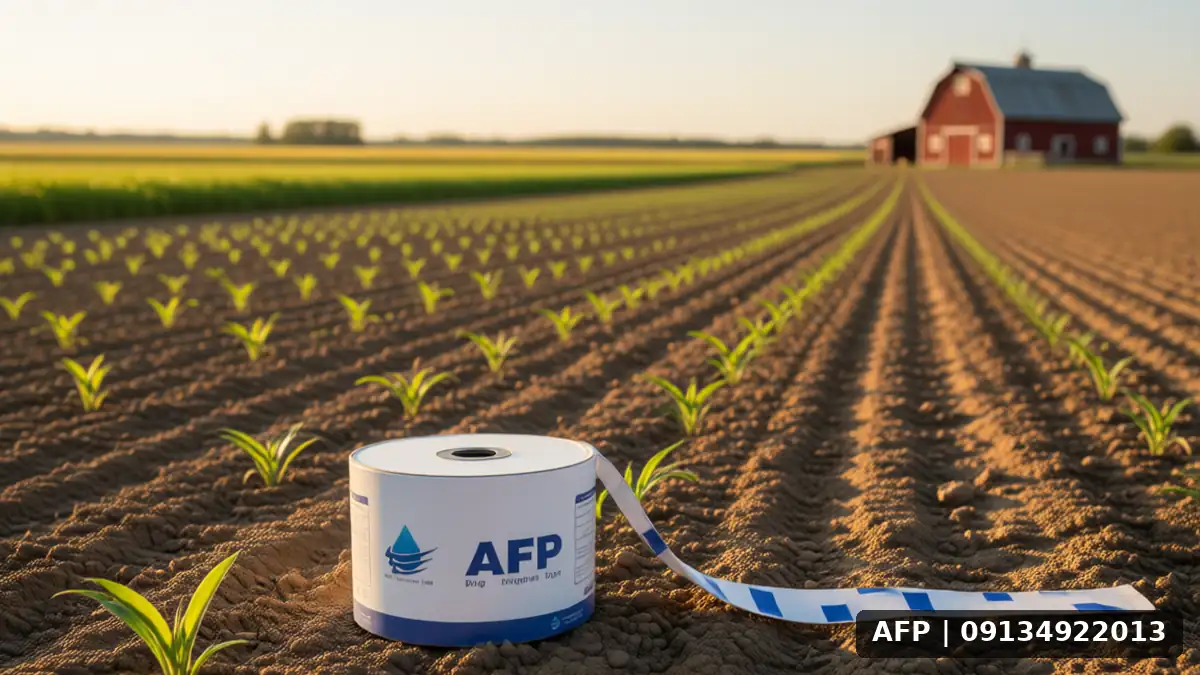
Finally, Sizing a flagged drip line for a farm is a multidimensional process that requires a combination of hydraulic science, soil science, and plant requirements. To achieve optimal results, it is recommended to engage reputable consulting firms for preliminary calculations and irrigation map preparation before purchasing equipment. Additionally, understanding irrigation principles with modern techniques and aligning them with the region’s climate conditions can significantly increase the economic efficiency of the drip irrigation system. Remember that the flagged design of the drip line ensures safety and durability, but only if its dimensions are selected and installed with precision.
Related articles: mikorit khomi yufa hamadoni dar hektar, Yield of honeydew per hectare + influencing factors, How to select the appropriate drip irrigation line