90mm Collapsible Hose Cost in Farms: Accurate & Practical Estimation
Introduction: The Importance of Accurately Estimating 90mm Foldable Pipe Costs in Irrigation Projects
In designing drip and tape irrigation systems, selecting the appropriate main and sub-pipe sizes is a primary challenge for engineers and farmers. 90mm foldable pipe holds a unique position in many fruit and vegetable farms due to the optimal balance between transportable flow rate, pressure loss, and cost. However, many users focus solely on the unit price per meter of pipe, whereas the final cost of an irrigation system depends on a combination of factors including pipe length, connection types, pressure distribution, and terrain conditions. This article aims to provide a practical framework for estimating the cost of 90mm foldable pipe by analyzing technical and economic details and offering a practical guide for optimizing irrigation budgets.
Main Components of Estimating 90mm Foldable Pipe Costs
To obtain an accurate estimate of the cost of 90mm foldable pipe, it must be divided into distinct sections. These sections include the cost of raw materials, the cost of fittings and connections, installation and execution costs, and ancillary costs such as maintenance and periodic repairs. The following section examines each of these components.
1. Raw Material Costs (Pipe Rolls and Fittings)
Foldable pipe in various dimensions is supplied in long rolls. When estimating, the total required pipe length must be calculated, allowing for connection margins and cutting waste (approximately 3 to 5%). The price of 90mm foldable pipe in domestic markets varies based on the polymer material (PE or PVC), wall thickness (e.g., 2.5mm), and pressure standard (e.g., 5 or 10 atmospheres). Purchasing from a reputable retailer and verifying the technical data sheet (datasheet) is essential to ensure quality compatibility with drip emitters and tape.
2. Fittings and Couplings Costs
Flexible pipe connections are typically made via crimping or using elbows and couplings. Each elbow or coupling has a separate cost, and overlooking these expenses can increase the final estimate by 10 to 15 percent. In large systems, using crimped or mechanical connectors instead of simple fittings increases the cost but significantly improves system durability and safety. For information on the best installation and maintenance methods for drip tape systems, refer to the article on key tips when using drip tape irrigation.
3. Installation and Construction Costs
Installing flexible pipe requires specialized equipment such as automatic and manual crimpers, polishing tools, and precise cutting instruments. Although many farmers install the pipe themselves, hiring specialized labor is recommended for large projects or when using crimped connections. Installation costs depend on terrain complexity (hilly or flat) and the need for excavation or surface laying.
Technical Analysis: Why 90 Millimeter?
The selection of main and sub-main pipe sizes is based on required flow rate and allowable pressure drop. A 90-millimeter flexible pipe is commonly used as a lateral pipe in drip irrigation systems for orchards or as a primary pipe in vegetable farms with medium planting spacing. At this size, the water flow velocity in optimal conditions (approximately 1 to 2 meters per second) creates an appropriate pressure drop, which is ideal for uniform droplet distribution or drip tape connection.
The Impact of Wall Thickness on Cost and Useful Life
The thickness of the pipe wall is a key variable in cost estimation. Pipes with thinner walls (e.g., 2 mm) are cheaper but are not recommended for higher pressures or operation under unstable water conditions (such as industrial desalination water or wells with pressure fluctuations). Conversely, pipes with a wall thickness of 2.5 or 3 mm have a higher initial cost but offer better resistance to internal pressure, UV, and mechanical wear. To understand the relationship between wall thickness and performance in drip systems, study the optimal wall thickness of drip irrigation lines can provide a more precise technical perspective.
Practical estimation: a hypothetical example for a one-hectare farm
Assume a one-hectare farm with a 5 m x 5 m layout (400 trees or shrubs), where 90 mm folded pipes will be used as the main sub-line. For each row, the pipe length is approximately 100 meters. With 20 rows, the total required pipe length is 2,000 meters.
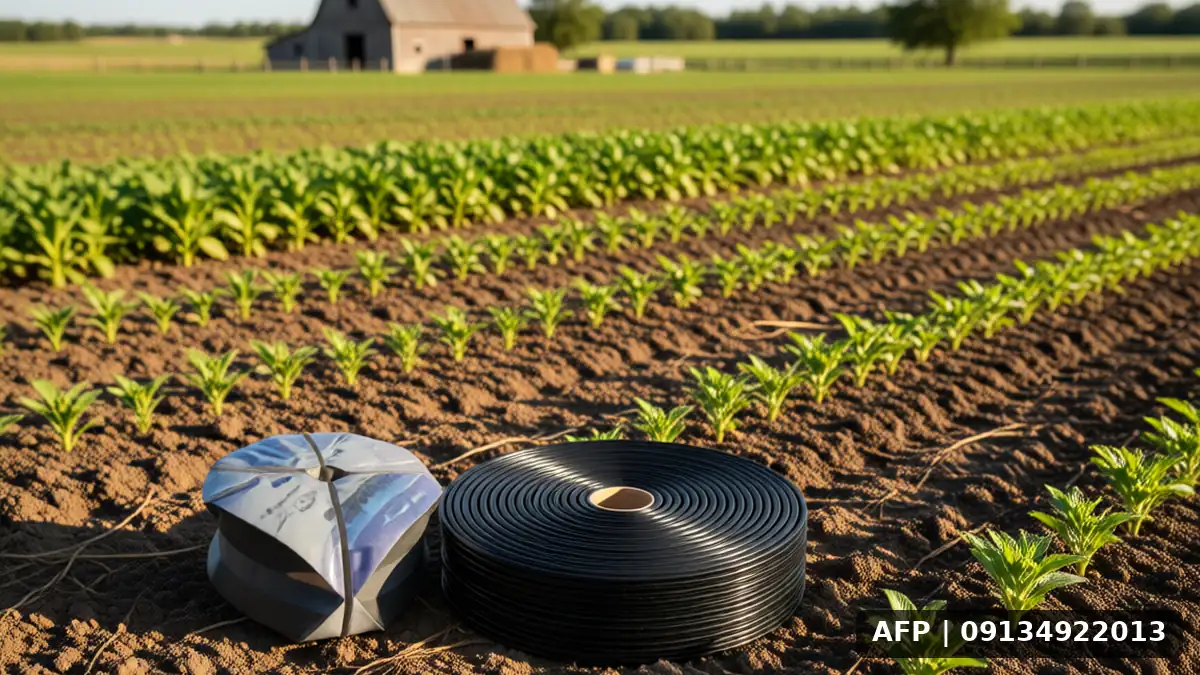
- Pipe cost: If the price of 90 mm folded pipe (2.5 mm) is 50,000 tomans per meter, the total pipe cost will be 100,000,000 tomans.
- Fitting Cost: For each row, use two 90-degree elbows and one coupling. Total elbows: 20 × 2 = 40 units. If the price per elbow is 20,000 Toman, the cost for elbows is 800,000 Toman. For the couplings (one required every 100 meters), 20 couplings at 15,000 Toman each adds 300,000 Toman.
- Waste: A 5% allowance is added for cutting and material loss. This equates to an extra 100 meters of pipe, costing 5,000,000 Toman.
The total cost of these components is approximately 106,300,000 Toman for raw materials. Note that this covers only pipes and fittings, excluding the central pump, tank, filter, and main valves. When calculating the farm’s overall budget, this should be combined with the cost of central equipment (which typically accounts for 40 to 60% of the total pipe cost).
Practical Tips to Reduce Costs and Improve Efficiency
To better manage the cost of 90mm polyethylene (PE) pipe, applying several practical guidelines can significantly reduce the final cost and improve system efficiency:
- Optimizing Row Layout: Reducing pipe length through appropriate tree or shrub layout can decrease the total pipe length. Cross or diamond layouts can sometimes result in lower costs.
- Using drip tape as the pipe outlet: In combined systems, using drip tape with lower pressures can reduce the need for larger, more expensive pipes. However, 90 mm flexible pipe remains suitable as the main outlet for transporting water to drip tapes. For more information on drip tape technology and its benefits, see the article Drip irrigation strips in Dehok: Optimal agricultural solutions for a sustainable future reference.
- Bulk purchasing and checking seasonal prices: Plastic material prices are subject to fluctuations in oil prices and production costs. Purchasing during the low-demand season (usually early spring) can lead to 10 to 15 percent discounts.
- Assessing the possibility of using high-quality used pipes: In some cases, collapsible hoses that have remained from integrated projects without physical or chemical damage are offered at more attractive prices. However, pressure testing and residual life assessment must always be performed.
Comparison with Other Irrigation Methods
One of the reasons for choosing the 90 mm collapsible hose is its comparison with conventional methods such as flood or furrow irrigation. In flood irrigation, cumulative costs of labor, soil erosion, and high water consumption are significantly higher than the maintenance costs of piped systems. Nevertheless, flood irrigation remains a lower initial cost option where water availability is high. However, from the perspective of overall farm efficiency, investment in a piped system quickly pays off through water savings and increased yields. To better understand the differences between irrigation methods, review sprinkler or furrow irrigation can provide a comparative perspective.
Frequently Asked Questions (FAQ)
Is the 90 mm collapsible hose suitable for large farms (over 5 hectares)?
In very large farms, larger main pipes (110, 140, or 160 mm) are typically used for the main outlet, with 90 mm hoses serving as laterals in subsequent tiers. Therefore, yes, this size is useful in the lateral lines of large farms, but the main outlet should not be 90 mm unless the total flow rate is very low.
What is the expected service life of a 90 mm flexible pipe under normal conditions?
With proper installation and protection from direct UV light (e.g., burial or shading), the typical service life of PE plastic pipes is 15 to 25 years. If the pipe is exposed above ground, its lifespan is heavily dependent on climatic factors and may be reduced to less than 5 years.
How can we align flexible pipe cost estimates with current market prices?
Since plastic material prices fluctuate, the best approach is to use percentage-based estimates. Pipe and fittings typically account for 60 to 70 percent of the total irrigation system cost. Once you receive real-time quotes from suppliers, you can update the budget based on the calculated length.
Conclusion and final recommendations
Estimating the cost of a 90 mm flexible pipe is a dynamic process that requires staying current with market conditions and attending to technical details. By accurately analyzing the required length, selecting the correct wall thickness, and optimizing the layout, you can minimize unnecessary expenses. Remember that the initial cost of an irrigation system is part of the total crop production cost, which is gradually recovered through reduced water consumption, increased efficiency, and lower labor costs. For those in the system design phase, it is recommended to have a precise engineering plan reviewed by a specialist, taking into account operational pressures and required flow rates, before making a purchase. Additionally, understanding related topics, such as seed quantity per hectare, can assist in better planning for green spaces and the number of irrigation points. Ultimately, investing in pipe quality and proper installation is the key to long-term sustainability and return on investment. Lentil tonnage D8AFD8B1 per hectare