T-Drip Band Spacing in Vegetable Cropping: Recommended Standards
Introduction to the Importance of Drip Tape Layout in Vegetable Cultivation
Selection Drip Tape Spacing in Vegetable Cultivation It is not merely a simple dimensional measurement, but an agricultural-engineering decision that directly impacts final costs, uniform moisture distribution, and consequently, final crop quality. Due to rapid root growth and high sensitivity to localized water deficit, vegetables require a precise drip layout. This precise layout keeps active plant roots continuously within the moist zone and prevents water stress during critical growth periods. In commercial farms, even minor deviations from spacing standards can lead to uneven nutrient distribution and reduced fruit or leaf weight and size. Therefore, a correct understanding of hydraulic dynamics and their relationship with soil type and cropping method is a prerequisite for the successful implementation of the irrigation system.
The most standard method is the use of polyethylene (PE) pipes with varying thicknesses of 15, 20, or 25. These pipes must be positioned exactly within the active root zone to ensure that water is not wasted in unproductive soil. In this section, we review the basic principles of layout, followed by technical details. It should also be noted that the correct placement of the tape is directly related to the emitter spray pattern (single-sided or double-sided), which will be addressed in subsequent sections.
Drip Tape Spacing Principles Based on Vegetable Type
Not all vegetables are the same; therefore, the distance between two irrigation tapes will not be identical. Determining the appropriate spacing requires knowledge of the plant genotype and its root crown depth. Generally, there are two main scenarios: leafy vegetable cultivation (such as spinach and lettuce) and fruit vegetable cultivation (such as cauliflower and pumpkin). Each of these categories has different physiology that must be considered when calculating tape spacing.
Impact of plant geometry on root crown depth
For vegetables such as bell pepper or tomato, which have deeper and more extensive root systems, row spacing is typically set at 60 to 70 cm to ensure complete root coverage. Conversely, for vegetables such as lettuce or spinach, which have shallower and denser roots, a spacing of 40 to 50 cm is more optimal. If the spacing is too wide, the central areas between two rows remain dry, forcing the plant to expend energy searching for water. On the other hand, if rows are too close, waste and rot caused by high root-zone moisture increase, raising the risk of fungal diseases.
To familiarize yourself with more precise standards, you can refer to the article Bell pepper yield per hectare and Guide to tomato seed rate per hectare Refer to articles that thoroughly examine planting layout and its relationship to drip line spacing. These articles provide root system details for each plant to enable more precise calculation of line spacing.
Effect of soil type on permeability
Soil type (clay, silt, or sand) affects the water infiltration radius from the tubes. In fine-textured soils, the infiltration radius is shorter, requiring reduced line spacing. Conversely, in clay soils, water infiltrates more slowly, allowing for slightly increased spacing to prevent adverse root saturation. A thorough soil type analysis before purchasing tubes is essential to prevent lateral leakage. The role of soil in drip system performance is covered in detail in Importance of soil type for drip lines is explained in detail.
Practical calculations and tube size selection (circumferential thickness)
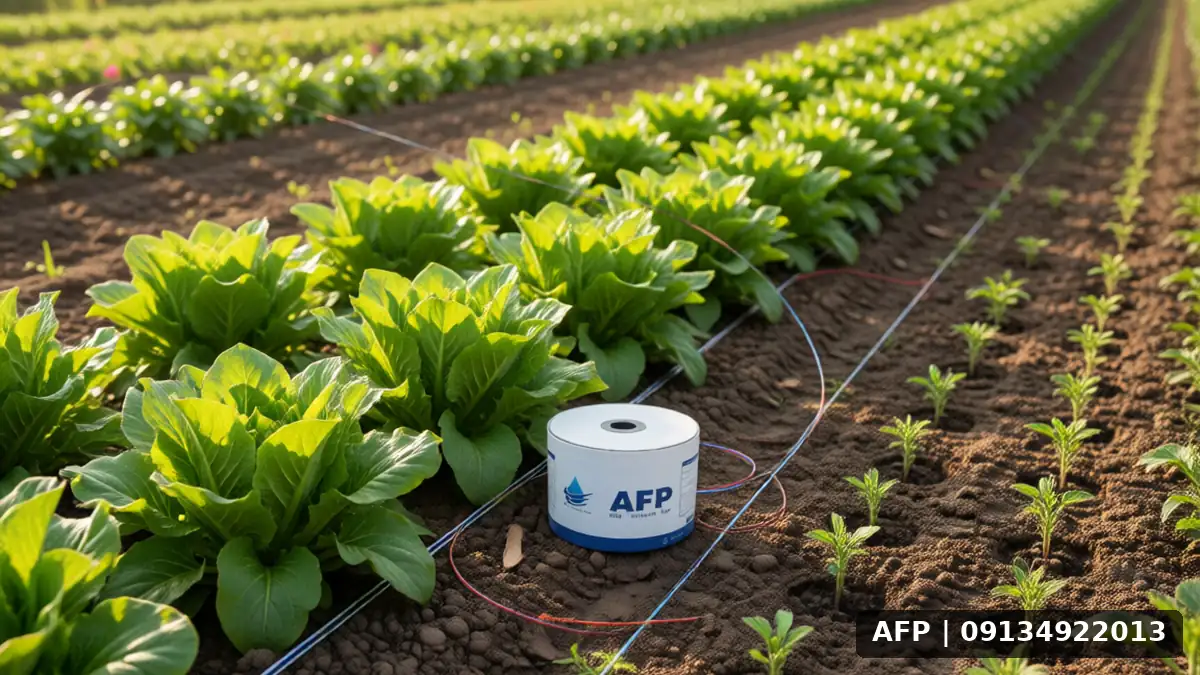
After determining longitudinal spacings, the tube thickness (circumferential depth) must be calculated. 15 mm tubes are generally recommended for small and medium vegetables because they have low internal pressure and ensure uniform flow. If line spacing throughout the growing row is wide, 20 or 25 mm tubes should be used to prevent pressure drop at the end of the line. However, a key consideration is that excessive tube thickness increases costs and reduces system flexibility. Additionally, correct tube thickness directly affects internal flushing at the end of each irrigation cycle; thinner tubes are prone to sediment accumulation if not properly flushed.
- 15 mm pipe: Suitable for spacing under 15 m and small, densely packed vegetables.
- 20 mm pipe: Most common option for commercial vegetable farming with 30 to 45 m spacing.
- 25 mm pipe: For long, gently sloping planting areas that require higher pressure durability.
Precisely calculating the water requirement per hectare is the key to success. To learn about Drip line output Based on the output of each emitter, you can use standard tables. Selecting the appropriate internal diameter affects the final pipe cost per hectare; the guide Drip line cost per hectare can help you have a more accurate budget and avoid purchasing excess pipe, which leads to hidden costs.
Effect of land slope on drip line installation
In sloped areas, drip line spacing must be calculated with greater caution. Slope causes water to accumulate at the lower end and less moisture at the upper end. In these conditions, using thicker pipes and reducing line spacing can be helpful. Also, selecting pipes made of rot-resistant polyethylene is important. The anti-cavitation property of the drip line and its production standards are also vital in achieving constant pressure along the entire length of the pipe. In steep slopes, even a one-meter difference in elevation can result in several times difference in flow rate between the first and last emitters, which requires precise system adjustment.
Frequently Asked Questions (FAQ)
What should the spacing between drip lines be for lettuce cultivation?
Due to the shallow root system of lettuce, a spacing of 40 to 50 centimeters is usually recommended. Using 15 mm pipes provides very good moisture coverage and keeps costs optimal. Changing this spacing can lead to uneven growth of the stalks.
Can drip tape be installed on both sides of the planting row?
Yes, this method (bipolar) is common in vegetables such as zucchini or cucumber. The distance between the two tapes must not be less than 60 centimeters to minimize waste and fungal diseases. In this layout, precision in aligning the tapes is very important to prevent the creation of dry central spots.
What is the effect of a steep slope on tape spacing?
On slopes exceeding 15%, it is necessary to reduce the spacing between tapes and increase the pipe thickness to prevent pressure drop at the lower elevation. Stronger filtration should also be used to minimize clogging of tapes in the sloped area. The use of vaseline or special adhesive is also recommended to prevent deformation of the tape on slopes.
When should drip tape be replaced?
Drip tapes are typically two-season products (4 to 5 months). If the pipe texture has softened and the drip holes have become clogged or irregular, it should be replaced. Reusing old tapes generally significantly reduces efficiency.
Summary
Determination Drip tape spacing in vegetable cultivation It is a dynamic process directly linked to plant genotype, soil type, and land slope. For small-scale crops, shorter spacing and thinner pipes are more suitable, while for taller vegetables with deep roots, standard 50 to 70 cm spacing with 20 mm pipes is more commonly used. Always install a 10-meter section before laying the tapes to test water infiltration in the soil. This simple step can prevent resource wastage and reduce overall farm yield loss. Ultimately, proper pipe maintenance and the use of suitable filters are the two pillars of long-term durability for drip systems in vegetable cultivation.