Tee Tape Spacing for Legumes: Recommended Standards
Introduction: The Importance of Precise Drip Tape Spacing in Legume Crops
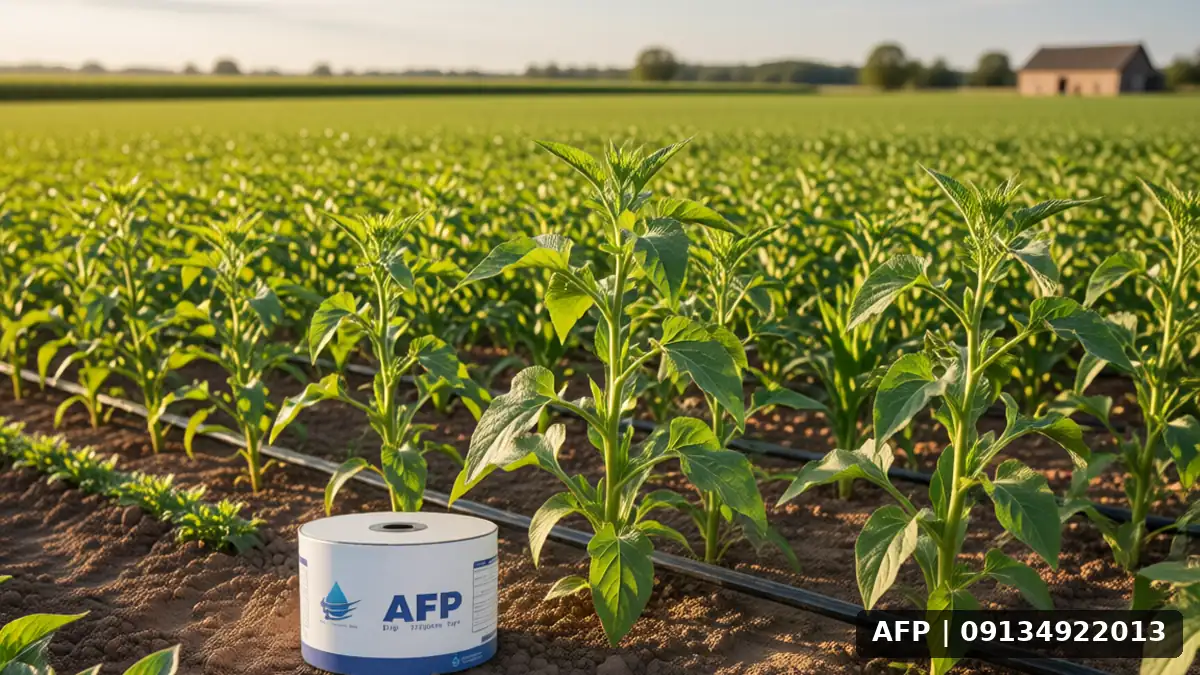
In recent years, drip irrigation and specifically systems based on drip tape have become one of the primary methods for water supply to cereal and legume crops in arid regions. Legumes, due to their moderate water requirements and root sensitivity to waterlogging, are crops that can achieve higher efficiency compared to soil irrigation using drip tape. However, the main question every farmer faces is determining the appropriate drip tape spacing for legumes This spacing is not merely a fixed number, but a variable determined based on root depth, soil type, dripper discharge rate, and row layout.
Incorrect spacing determination can lead to two major problems: either a significant portion of the soil between rows remains dry, preventing lateral root growth, or excessive moisture causes root rot and increased weed growth in the inter-row spaces. This article examines the recommended standards for row layout and drip tape spacing in legume fields.
General Principles of Drip Tape Spacing in Legume Row Layout
To correctly understand the tape drip line spacing, one must first consider the root system structure of legumes. Legume roots are typically active to a depth of 30 to 45 cm, with lateral spread varying from 20 to 50 cm around the planting site depending on soil conditions. Therefore, the goal of tape drip irrigation is to ensure that the wetted zone around the emitters covers the root zone without causing unnecessary overlap with the adjacent row line.
Impact of soil type on spacing selection
- Sandy and light soils: Vertical water infiltration is high, and lateral moisture spread is limited. Under these conditions, the legume tape drip spacing should be narrower to retain moisture at the surface and direct it toward the roots. Typically, tape drip lines are applied as a single line in the center of the row or as two symmetrical lines at a distance of 15 to 20 cm from the planting site.
- Loam and light loam soils: There is a good balance between infiltration and lateral spread. The tape drip spacing can be slightly wider. For legume cropping systems with row widths of 60 to 90 cm, placing the tape drip lines at a distance of 30 to 40 cm from the planting line is considered the golden standard.
- Clay-loam and heavy soils: Water infiltration is very slow, and there is a risk of waterlogging. In this case, it is necessary to use emitters with lower flow rates and increase the distance between opposing tape lines to prevent moisture accumulation.
Always ensure that the spacing of the drip tape for faba beans does not exceed half the width of the root coverage zone. In other words, if the faba bean row width is 90 cm, the distance between the drip tape on one row and the drip tape on the adjacent row must not exceed 45 cm, unless the drip emitter flow rate is very low.
Determining drip tape spacing based on emitter flow rate
One of the key parameters often overlooked in calculating the drip tape spacing for faba beans is the emitter flow rate. There is a direct relationship between flow rate and appropriate spacing:
Practical formulation of spacing
As a rule of thumb, the allowable distance between symmetric drip tapes within a row or between rows equipped with drip tape decreases proportionally with flow rate. For example, if using emitters with a flow rate of 2 liters per hour, the wetted circle is smaller, and the faba bean drip tape spacing should be approximately 30 to 40 cm. However, if the flow rate is 4 liters per hour, moisture distribution is wider, and the spacing can be increased to 50–60 cm.
For a more precise calculation, water allocation and irrigation duration concepts can be used. Drip tape spacing should be adjusted so that the irrigation time required to achieve desired root moisture does not exceed a standard irrigation cycle.
Adapting faba bean drip tape spacing to climatic and regional conditions
Fava bean drip tape spacing is not a fixed parameter nationwide. In hot and dry regions with high evaporation, soil moisture is lost more rapidly. In these areas, fava bean row layout should be arranged to achieve mutual shading during the late growth stage. This requires narrower row spacing and, consequently, closer drip tape spacing.
Conversely, in wetter regions, wider row spacing can be used. Under such conditions, sampling the drip tape system in the field before the main planting is of utmost importance to prevent system failure due to soil saturation.
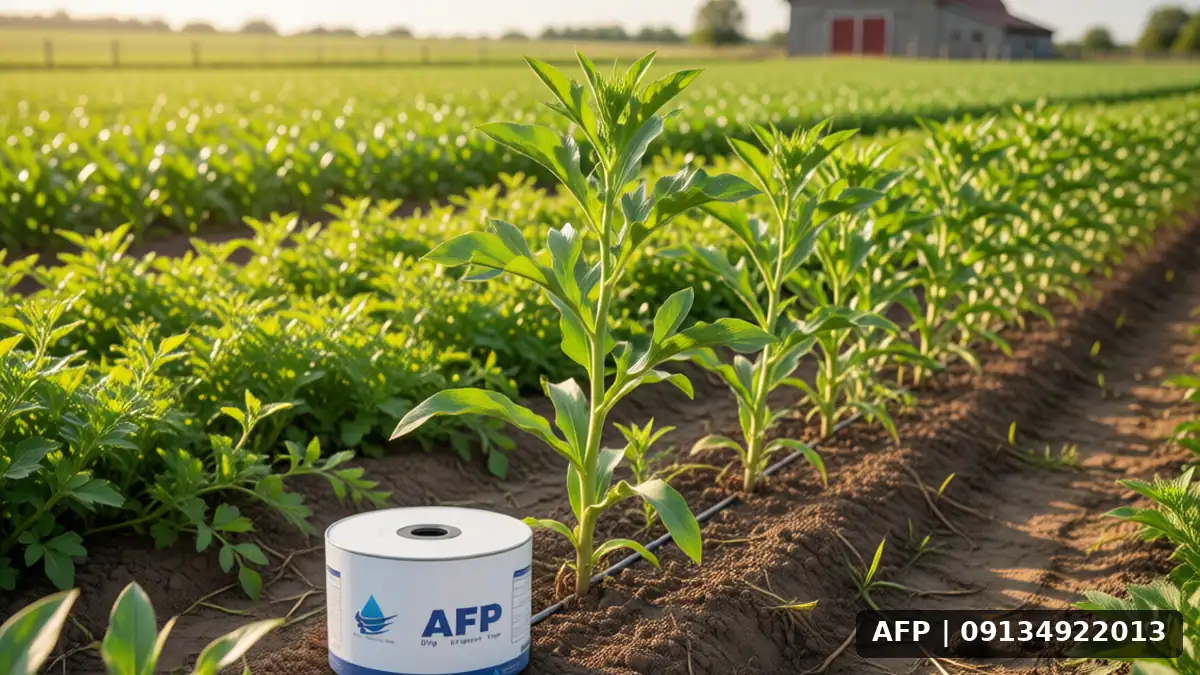
Furthermore, land slope also affects the layout. On steep slopes, water flow in the drip tape accelerates, potentially causing more water to move toward the downhill end. In this case, fava bean drip tape spacing should be narrower at the top of the slope and adjustable at the bottom, or dynamic flow emitters should be used to ensure uniform distribution.
Practical tips for optimizing drip tape spacing in fava bean farms
Proper implementation of the drip tape system requires attention to operational details. The following tips can help farmers optimize fava bean drip tape spacing:
- Accurate measurement of the planting furrow: Drip tape spacing should always be measured from the center of the planting furrow (not from the edge of the seed). Generally, a distance of 20 to 30 centimeters from the planting line is a good starting point for the drip tape.
- Consider the prevailing wind direction: If the prevailing wind comes from one direction, uniform pulse width spacing may cause one side of the plant to become drier. In such cases, a series layout can be used instead of an alternating layout.
- Interseeding and weeds: Wider pulse strip spacing results in increased weed growth between rows. To manage this issue without reducing the pulse strip spacing, multi-row planting can be used to minimize open space.
- Collaborate with experts: For more accurate determination of water requirements, refer to resources on water consumption in various crops and compare it with pulse needs. Greater precision in calculating ETc (evapotranspiration) leads to more accurate selection of pulse strip spacing.
- Soil moisture monitoring: Using soil moisture sensors at different distances from the pulse strip is the best way to understand the actual efficiency of the system. If the pulse strip spacing is too wide, moisture in the central area between rows may drop to zero.
Frequently Asked Questions (FAQ) about Drip Tape Spacing for Fava Beans
1. Can two drip tapes be used per row of fava beans?
Yes, using two symmetrical drip tapes in wide rows (over 70 cm) is recommended. This ensures the root zone is moistened uniformly. Each tape must be at least 15 to 20 cm from the central planting line. If using two tapes, the total emitter flow rate must be divided to prevent excessive moisture accumulation.
2. How can I determine if my fava bean drip tape spacing is appropriate?
The best method is deep digging (about 20 to 30 cm) at various points in the row, particularly between opposite tapes. If the soil is clean and dry, the drip tape spacing is too wide. If the soil is sticky and very wet, the spacing is too narrow. Uniform soil color indicates proper balance. You can also use specific drip tape system component details to troubleshoot flow issues.
3. Does fava bean drip tape spacing affect cultivation costs?
Yes, increasing drip tape spacing means lower total water consumption, but if the spacing is increased excessively, yield loss will be irreversible. Optimizing fava bean drip tape spacing is a balance between water cost and plant productivity. More precise calculations can be performed by referencing articles on estimated water usage and comparing them with economic returns.
Conclusion: Optimizing the legume drip tape spacing for the future
Determining the legume drip tape spacing is not an exact science but rather a combination of knowledge in soil science, hydraulics, and agronomy. The key to success is customizing each field based on soil type, drip emitter flow rates, and climatic conditions, rather than using a fixed number for all farms. Legume row layouts should be designed to ensure that the legume drip tape spacing guarantees complete root coverage.
Farmers are recommended to conduct a field trial with different spacings (e.g., 20, 30, and 40 centimeters) before installing the drip tape and monitor plant growth and soil moisture. This simple method reduces trial-and-error costs throughout the season. Ultimately, selecting the appropriate accuracy in water requirement calculations and combining it with the correct drip tape spacing leads to a significant increase in legume yield and a reduction in water consumption. By implementing these points properly, legume farms can achieve sustainable and economic production.
Related articles: miqdori tuxmi javori donador dar yak gektar, Related article Related article D8AFD8B1 Related article, Related article Related article Related article D988 Related article, drip tape melon irrigation guide tajikistan